Get Full Government Meeting Transcripts, Videos, & Alerts Forever!
Get email alerts on the Wetlands Bioenergetics topic
No spam. Unsubscribe anytime.
Utah State researcher outlines bioenergetics study of Great Salt Lake wetlands
Summary
Lauren Head, a Ph.D. student at Utah State University, presented a two-year observational bioenergetics study of six Great Salt Lake wetland areas, describing sampling design, early results on submerged aquatic vegetation and water-depth trends, and a plan to finish lab processing by spring 2025.
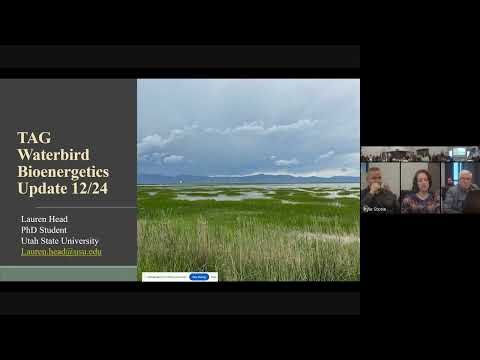
Lauren Head, a Ph.D. student at Utah State University, told the Great Salt Lake research working group that her team is building a bioenergetics model to estimate food availability for waterbirds in deep wetlands around the lake and to link that to population dynamics.
Head said the project deploys 240 sampling points across six wetland areas — four actively managed impoundments (public shooting grounds, Bear River, Carrington Bay and Farmington Bay) and two unmanaged units (Willard's Bay and the Spur) — and samples each site three times a year to collect water, core and half‑meter drag samples of submerged aquatic vegetation. “So essentially trying to quantify the caloric value of these wetlands for water birds, and then pair these with current population dynamics,” Head said.
The study is intended to support two model types: a standard carrying‑capacity model and an agent‑based movement/risk model. Head reported notable year‑to‑year variability in water depth and vegetation. At Bear River Migratory Bird Refuge the team recorded much lower depths in August 2024 than in August 2023, and in some managed hunting units managers were able to maintain water and vegetation levels for dabblers near the 50‑centimeter target. In unmanaged areas the team observed high spatial variability in submerged aquatic vegetation (SAV) from year to year.
Head described an early analysis comparing “hunt” versus “rest” units inside impounded areas. Using rate‑drag visual estimates of SAV proportion, she said the second sampling period of 2024 showed significantly lower SAV in rest areas than in hunted units, and a generalized linear model on period‑two data produced an effect size (log scale) that Head said corresponds to “approximately 45% lower SAB proportion in rest areas.” She emphasized the result is preliminary and that variability and sampling biases remain to be addressed in more detailed analyses.
Head told the group the team had processed roughly 284 water samples and 174 biomarker samples but that many more lab hours are needed: “we've probably got at least over 15,000 to go,” she said, and she plans to end field sampling after April 25 to complete two full years of seasonal data (April–August for two separate years) and prioritize lab processing.
Mike Conover, who identified himself as the project manager for the program, said the team will also expand to a second project developing a shorebird bioenergetics model and that a new shorebird researcher has accepted a start date in January 2025. Conover thanked Lauren and technicians for progress in the field.
The presenters and other meeting participants discussed likely drivers of SAV variability (timing and magnitude of spring runoff, water clarity/turbidity, and depth thresholds for growth) and how timing of inundation may influence SAV growth the following season. Head said future work will pair SAV metrics with bird density data to develop the agent‑based and carrying‑capacity models so management can test how water levels and parceling of rest vs. hunt units affect bird foraging access.
The team requested help hiring seasonal technicians and emphasized the need for more lab capacity to finish biomass and caloric analyses after the field season.
Why it matters: The project ties habitat management decisions — when to inundate impoundments and how to parcel hunting versus rest units — to food availability for waterbirds. Managers can use the bioenergetics outputs to inform timing and target water levels in impounded wetlands.
Sources and attributions: Quotes in this article come from Lauren Head (Ph.D. student, Utah State University) and Mike Conover (project lead). All direct quotations are taken from the meeting transcript provided to the working group.
Looking ahead: Head expects to finish field work by April 25 and concentrate on lab processing and model parameterization through the summer of 2025.