Get Full Government Meeting Transcripts, Videos, & Alerts Forever!
Get email alerts on the Land Use Moratorium topic
No spam. Unsubscribe anytime.
Bonner County commissioners defend emergency moratorium on minor land divisions; debate continues among commissioners and public
Summary
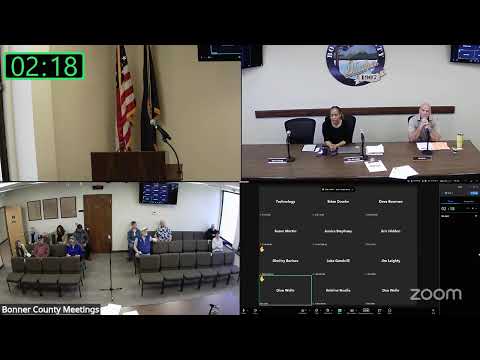
Commissioners and members of the public at Bonner County’s April 15 meeting debated a recent emergency moratorium on Minor Land Divisions (MLDs) and family exemptions and discussed related county priorities including ambulance-district finances and code updates.
Commissioners and members of the public at Bonner County’s April 15 meeting debated a recent emergency moratorium on Minor Land Divisions (MLDs) and family exemptions and discussed related county priorities including ambulance-district finances and code updates.
Commissioner Brian Domke (District 1) explained the board’s rationale: that the existing MLD and family-exemption processes allow higher residential density without verifying adequacy of water, sewage disposal and fire protection. "If you look at a 20-acre parcel that's zoned Rural-5 … that 20-acre parcel would be allowed to support up to a total of six dwellings," Domke said. "If that same 20-acre parcel were divided into four parcels of five acres each through a minor land division, that could result in a total of 16 allowable dwellings across that 20 acres. That's a residential density increase of 267% without accounting for important safety factors." He said the board enacted an emergency moratorium to prevent a near-term magnification of health-and-safety risks.
Domke urged public participation in forthcoming code updates and workshops to re-examine subdivision language and safeguard water, septic and fire protections. He said short plats and standard subdivision processes remain available for property owners; the moratorium targets the MLD and family-exemption pathway while the board works on code changes.
Commissioner Corn (District 3) signaled a differing view and said he supports property owners’ ability to divide land at lower cost. Corn said MLDs historically cost about $250 per applicant compared with short plats that can exceed $10,000, and expressed concern that the moratorium imposes a financial barrier on families splitting land.
Public comment reflected both support and opposition. Amy Lunsford, a local contractor, supported the board’s scrutiny of proposals and praised measures that require infrastructure to be built before lots are sold. "I really don't understand the huge heartburn on people just wanting things done right because then somebody does a subdivision… and it's just a huge pain," Lunsford said.
Other commenters urged transparency and fuller public explanation of commissioners’ positions. Dan Welly thanked Commissioner Domke for clarifying the emergency rationale and asked whether Domke has become a liaison for ambulance-district matters; Domke replied that the full board is acting as the ambulance district board and that members are sharing responsibilities in twice-monthly ambulance-district meetings.
Domke and other commissioners also discussed ambulance-district finances. Domke said the ambulance district had been "injected with a good amount of money" earlier in the fiscal year and has worked to reduce staffing costs; he said the district may use a tax-anticipation loan next year and that the board is reviewing levy rates and budget buckets to improve long-term financial stability. "We have to address if we want to continue with an ambulance district, it's the foundation of the existence, and then how we move forward," Domke said.
Several residents urged the board to make data on legal costs and taxpayer impacts public; Domke said the county has incurred legal and staff time addressing complaints and tort claims related to development patterns, though he said he did not have a ready dollar total for settlements or litigation.
Ending: Commissioners said they will continue code review and hold workshops; Domke invited residents to participate in public meetings and planning-department processes as the board considers updates to MLD, family-exemption and subdivision language. No new ordinance was adopted at the April 15 meeting; the discussion was part of ongoing review and outreach.