Get Full Government Meeting Transcripts, Videos, & Alerts Forever!
Get email alerts on the Ordinance Amendments Chapter 86 topic
No spam. Unsubscribe anytime.
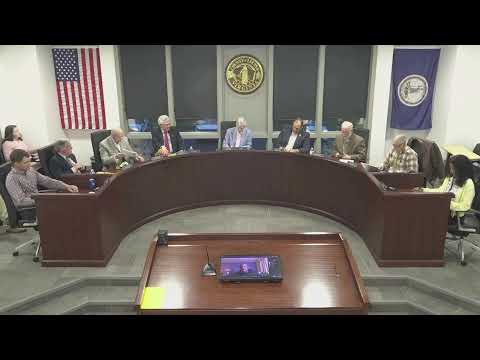
Commission moves most Chapter 86 amendments to public hearing, shelves emergency-shelter language for further review
Summary
The planning commission agreed to send a package of Chapter 86 ordinance amendments to public hearing in May — including telecommunications and electronic-sign provisions — but held the emergency-shelter/homeless-shelter and religious-assembly language for more research and a separate work session.
Louisa County planning staff briefed the Planning Commission on a broad package of proposed amendments to Chapter 86 (land development regulations) and the commission voted to move most of the package to a public hearing in May while postponing changes to emergency-shelter, homeless-shelter and religious-assembly language for additional staff research.
Staff said the package contains multiple changes: updated definitions (including off-grid construction and short-term rental effective-date corrections), adjustments to yard regulations in the A-2 zoning district, subdivision-plat and performance-agreement language (including a draft interim road-maintenance agreement), limits on the number of private lanes in subdivisions, and updates to security/bonding language that would require periodic reviews (staff proposed a 24-month review tied to published market indices such as Engineering News-Record for cost updates).
On telecommunications, the county’s new consultant recommended tighter application materials and follow-up documentation for tower collocations and modifications. Staff proposed ordinance language to allow the county or its consultant to request a recent (five-year) structural-analysis report for an existing tower and, if equipment is added, a like-for-like structural assessment at the mount or radome level. Staff also proposed (and the consultant recommended) requiring an as-built, engineer-signed report after modifications are installed to confirm the work matches the consultant’s approved review; staff noted the county building official typically lacks authority under the state building code to perform certain post-installation telecom inspections, and an engineer’s certification would close that gap.
Regarding generators at wireless sites, staff proposed that on-site generators be operable only during power outages or testing; the draft language removes broader allowances for continuous operation.
The commission also reviewed proposed changes to sign regulations—specifically electronic message signs and nighttime brightness. After reviewing multiple options and outside jurisdiction practices, staff recommended an alternative labeled “Option 2” as the clearest and most enforceable path forward; that alternative narrows how brightness and change intervals are regulated and avoids conflating flashing signs and electronic-message signs, which the staff said are distinct categories.
The most contested portion of the package concerned the definition now labeled in staff materials as “emergency shelter” and a separate discussion about homeless shelters and religious assemblies. Public commenters asked the commission to allow religious organizations to operate hypothermia or cold-weather shelters from November through March without the full conditional-use-permit process. Dwayne Surgeon of the Louisa Homeless Coalition told the commission he would “like to encourage the committee to adopt ordinance that allows for...hypothermia shelters during the winter months from November to March, in religious organizations, churches, etcetera.” Pastor David McWilliams of Zion United Methodist urged an amendment to permit religious assemblies to provide “hypothermia shelter from November through March, without the requirement of a conditional use permit.”
Commissioner John Goodwin and staff emphasized a need to separate Code of Virginia–defined emergency shelters (activated by a governor or local emergency declaration and included in the locality’s emergency-management plan) from locally regulated homeless-shelter uses. Goodwin recommended using the state Code definition for “emergency shelter” and moving any separate homeless-shelter definition into a distinct local code section if the county wants to regulate that use differently. Staff agreed to research the Code of Virginia definition and return with a clearer draft.
On a motion that excluded the emergency-shelter / homeless-shelter / religious-assembly sections, the commission voted to send the remainder of the Chapter 86 package — including the telecommunications and electronic-sign provisions with staff’s preferred sign Option 2 — to a public hearing in May. Commissioners also asked staff to produce sample VDOT/TJPDC plan excerpts and the draft performance and interim road-maintenance agreements for the public packet.
The commission directed staff to come back to a future work session with clarified emergency-shelter and homeless-shelter language that aligns with state code and explains how religious assemblies could participate (for example, being included in the locality’s emergency-management plan if they intend to operate a state- or locally activated emergency shelter). No final code change on that topic was adopted at this meeting.