Get Full Government Meeting Transcripts, Videos, & Alerts Forever!
Get email alerts on the Utility Rates topic
No spam. Unsubscribe anytime.
Fall River council holds rates steady after votes to shift $1.36 million from enterprise indirects
Summary
After hours of public comment and debate, the Fall River City Council voted to lower the water and sewer budgets by $527,000 and $832,000 respectively, keeping proposed water and sewer rates at FY2025 levels while directing the reductions be taken from enterprise transfers and indirect costs.
Fall River City Council voted on March 1 to reduce planned transfers and indirect costs in the city’s water and sewer enterprise budgets, a move councilors said would hold water and sewer rates at current levels for the coming year.
The council approved an amendment that reduces the water appropriation by $527,000 and the sewer appropriation by $832,000. The amended totals adopted during the meeting were $16,044,442 for water and $31,953,387 for sewer. Councilors cast roll-call votes on each amended appropriation and adopted both budgets as amended.
Why it matters: the council debated whether to raise rates to cover rising costs or to absorb some enterprise overhead in the general fund for one year. Advocates for keeping rates level said relieving ratepayers this year would give the council time to craft a longer-term policy on indirect-cost chargebacks; opponents warned the move would push the burden into the general fund and could require larger increases later.
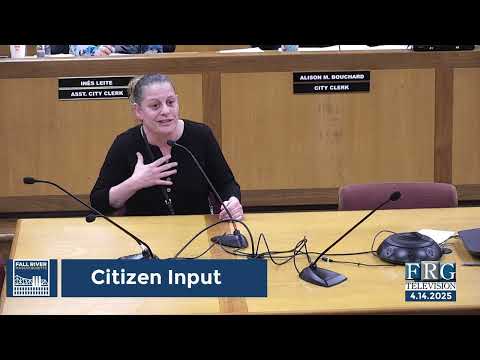
The meeting opened with public comments focused on the proposal. Kelly Buchanan told the council, “I’m gonna ask you all to vote no against raising the taxes again. People are struggling.” Sarah Cavallo made a similar plea: “Please don’t vote yes on this. We need a break here. Have some compassion.” Both comments were part of a larger public push against proposed rate increases.
Council discussion focused on the structure and calculation of indirect costs that enterprise funds pay back to the general fund. Mr. Furlan, the water and sewer director, gave line-item figures during a presentation: “So indirect, total, 1,680,000.00 on sewer,” and later he said water indirects total about $3,025,000 in the proposed budget. Emily, the city’s chief financial officer, described constraints on using one-time reserves: “The stabilization fund is designed specifically to be an emergent savings. It’s not supposed to be here to just balance budgets and to just smooth things out and just to make things easier.”
Councilor Pahn led the proposal to reduce enterprise transfers and indirects, initially proposing larger cuts and then revising the motion to the amounts that were ultimately adopted: a $527,000 reduction to the water transfers and indirects line and an $832,000 reduction to the sewer transfers and indirects line. Those reductions were described on the record as intended to hold rates at FY2025 levels while the council and staff pursue longer-term policy and revenue options.
Councilors and staff discussed alternatives to offsetting the reductions, including further department cuts, use of stabilization or free-cash reserves for one-year relief, pursuing additional intermunicipal service agreements (notably Westport and Dartmouth), and identifying capital items that could be funded with one-time sources (for example, ARPA commitments and other capital turnbacks). Emily said she and staff had worked department-by-department and had identified roughly $3 million in reductions through 0-based budgeting exercises but warned that fixed costs (health insurance, pension, debt service) are rising and will constrain options going forward.
Formal votes: after reconsideration and multiple procedural steps the council approved the amended water appropriation (reduction of $527,000 from the water transfers and indirects line) and the amended sewer appropriation (reduction of $832,000 from the sewer transfers and indirects line). The council then adopted both FY2026 enterprise budgets as amended. Councilors cast roll-call votes recorded in the minutes; the adopted, amended totals shown above were read into the public record at the end of the proceeding.
The meeting closed with staff and council members noting this is a near-term solution: if the council continues to hold rates down, staff warned, larger increases could be needed in the future to cover structural cost growth. Councilors called for follow-up work on a written indirect-cost policy and for further review of revenue and one-time-capital options before the next budget cycle.
Votes at a glance: the council approved amendments reducing enterprise indirect/transfers by $527,000 (water) and $832,000 (sewer) and then adopted the FY2026 water and sewer appropriations as amended. (Vote tallies are recorded in the meeting roll call; see actions[] for the structured vote records.)