Get Full Government Meeting Transcripts, Videos, & Alerts Forever!
Get email alerts on the Community Development topic
No spam. Unsubscribe anytime.
Council approves 2025–2029 consolidated plan, 2025 CDBG annual action plan after public hearing
Summary
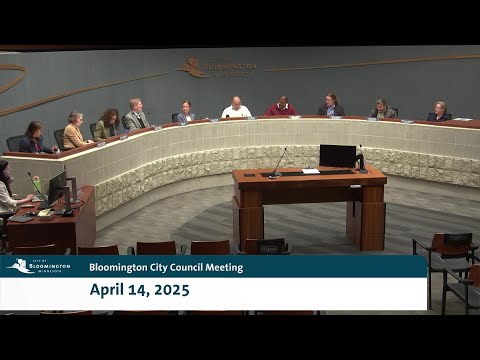
After a public hearing with no members of the public speaking, the Bloomington City Council approved the city’s 2025–2029 consolidated plan and the 2025 Community Development Block Grant annual action plan, and authorized submission of related documents for program administration by a 7–0 vote.
Bloomington City Council approved the city’s 2025–2029 consolidated plan and the 2025 annual action plan for Community Development Block Grant (CDBG) funds following a staff presentation and a public hearing that drew no speakers.
The plans, required by the U.S. Department of Housing and Urban Development, lay out a five‑year needs assessment and priorities and the one‑year program of activities the city proposes to fund with its annual CDBG allocation. Mike Polarmo, city staff lead on the presentation, said the consolidated plan frames broad priorities — preserving and creating affordable multifamily rental and single‑family homeownership opportunities, addressing homelessness, supporting neighborhood revitalization and fair housing — while the annual action plan translates those priorities into specific programs for the coming program year.
The annual action plan the council approved includes continuing the city’s long‑standing homeowner rehabilitation loan program, funding public service activities through a forthcoming RFP, targeted fair‑housing work through the regional fair‑housing partner, and use of carryover COVID CDBG funds to address deferred maintenance on city‑owned rental properties. Staff said the budget figures in the action plan are estimates because the city has not yet received a final HUD allocation; last year’s award was about $456,000, and staff said they expect a similar award for 2025 but will adjust once HUD issues the allocation.
Polarmo described how the consolidated plan and annual action plan must meet CDBG national objectives — primarily benefits to low‑ and moderate‑income residents — and walked through the plan’s structure: citizen participation provisions, a needs assessment (housing and nonhousing), high‑level strategic priorities and the specific activities proposed for the coming program year. He said the federal form used to assemble the consolidated plan is dense and prescriptive but required by HUD.
On programming specifics, staff told the council they anticipate using some existing program income (revolving‑loan payoffs) and carryover COVID funds for homeowner and rental rehabilitation, estimated the typical rehab loan in 2024 averaged about $35,000, and noted that nonprofit senior services programs served roughly 77 households last year. Polarmo said the annual action plan proposal includes an estimated public‑service allocation (capped at 20% of the award) that will be refined after the forthcoming RFP.
Councilors asked how and when HUD determines allocations and whether CDBG is at risk of federal cuts; Polarmo said allocations are formula driven, reflecting population and need, and that Congress had allocated funding for the program for the current year but that longer‑term funding remains subject to federal appropriations. Council members also discussed program‑income variability and the city’s options if HUD’s allocation is lower than estimated, including adjusting the mix of activities or supplementing with HRA levy dollars or other grants.
Council member Lohmann moved approval; council member D’Alessandro seconded. The council voted 7–0 to approve the consolidated plan, the 2025 annual action plan and the accompanying 2025 CDBG budget for submission to the Minneapolis–Hennepin consortium and HUD.
The approved documents will be submitted once the city receives HUD’s allocation; staff said the previously planned May 23 submission date may shift because HUD told consortium members not to submit before receiving the allocation.