Get Full Government Meeting Transcripts, Videos, & Alerts Forever!
Get email alerts on the Special Education Charter Concerns topic
No spam. Unsubscribe anytime.
Parents, union and advocates urge board to investigate Springs Charter special-education problems and paraeducator pay
Summary
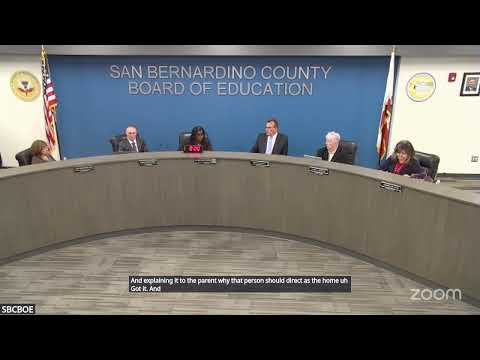
Members of the public and union representatives used the San Bernardino County Board of Education meeting to press the board to investigate complaints about Springs Charter Schools and to press for better pay and benefits for paraeducators.
Members of the public and union representatives used the San Bernardino County Board of Education meeting to press the board to investigate complaints about Springs Charter Schools and to press for better pay and benefits for paraeducators.
At the meeting, several parents described repeated special-education failures they said they experienced at Springs Charter’s Rancho Cucamonga campus, including frequent, inconsistent Individualized Education Program (IEP) documents, missing credentialed staff, and no on-site nurse. Anna Salvatierra, who said her son has a neurologic condition, told the board, “There is no credential nurse on-site since December…this is a safety concern.” She asked the board to “place Springs Charter on the agenda and take steps to resolve these ongoing systemic issues.”
The public comments followed remarks from Springs Charter staff who thanked the county office for a site visit. “We believe in the power of partnership and transparency,” Courtney Cook, senior director of special education for Springs Charter Schools in San Bernardino County, told the board, and said Springs will present more about its programs at an upcoming May presentation.
Union representatives and classified employees linked the complaints about services to broader labor issues. “Most of our paraeducators make less than $30,000 a year,” Cameron Kretz, a labor relations representative for the California School Employees Association (CSEA), told the board. He said many paraeducators are being asked to pay higher health premiums than higher-paid county employees and called for the board and negotiators to address those disparities.
Paraeducators who spoke described years of service and specialized roles. Amber Covarrubias, who identified herself as a braille specialist, said she and colleagues were told by county negotiators that paraeducator jobs should be viewed as “a stepping stone” rather than as careers. “It is insulting to be told that being a teacher should be my career,” Covarrubias said, adding that many paraeducators do not want to or are not qualified to be classroom teachers and take pride in specialist roles such as braille transcription.
Several parents said they had filed or plan to reopen complaints to the California Department of Education. Rika Baum said she has had multiple, inconsistent IEPs for her son this school year and said she will reopen a CDE complaint after “many failed attempts” to resolve issues at the local level.
Board members did not debate or take action on these specific complaints during the meeting. At the close of public comment President Dowdy Rogers reminded speakers that the board may not engage in a substantive discussion of non-agendized items during the meeting. Several speakers urged the board to place Springs Charter on a future agenda for formal review and to require a staff report.
The board did not announce any immediate investigatory steps during the meeting. Several commenters said they would follow up with the county office and with state agencies.
Ending: The comments added to the board’s public record and members acknowledged receipt; several callers requested formal follow-up and an agenda item for a future meeting so the concerns can be discussed with staff and legal counsel.