Get Full Government Meeting Transcripts, Videos, & Alerts Forever!
Get email alerts on the School Budget topic
No spam. Unsubscribe anytime.
Bibb County projects $24.5 million shortfall in preliminary FY26 budget
Summary
Bibb County School District staff presented a preliminary FY26 budget showing a projected $24.5 million deficit driven by a declining equalization grant, rising health-insurance and retirement costs, and ongoing inflation; staff outlined revenue and expense scenarios and a timeline for board review and tentative adoption.
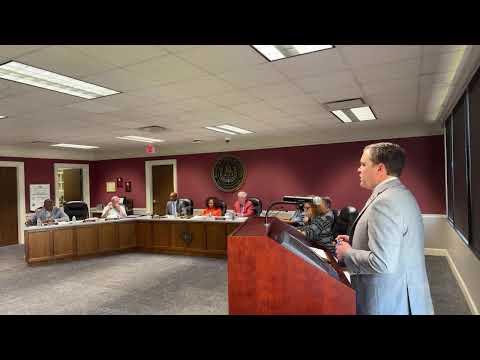
Eric Bush, chief financial officer for Bibb County School District, presented the district’s preliminary financial outlook for fiscal year 2026 at a budget work session, saying the district faces a projected $24.5 million net deficit under current assumptions.
The deficit follows an assumed beginning fund balance of $67,000,007.91 and projected revenues of $265,100,000, leaving a preliminary fund-balance-to-expenditures ratio of about 14.9%, inside the district’s stated tolerance and near the state’s stated minimum (8%) and maximum (15%).
Why it matters: the projected shortfall would affect staffing, program support and the district’s ability to maintain small neighborhood schools unless the district increases revenue or reduces expenditures. Staff warned that common remedies — salary increases or tax-increase measures — have substantial budget impacts and long-term trade-offs.
Bush said multiple state-level changes and inflationary pressures are driving the outlook. Among the largest impacts, he cited an expected $9.12 million decrease in the state equalization grant and sharp increases in local costs for employee health insurance and pension contributions. “The certified state health insurance ... raises the cost for them $1,500 per person,” Bush said, and classified staff health insurance rose by about $5,970 per employee.
Staff also called out a Teacher Retirement System (TRS) employer-contribution increase from 20.78% to 21.91% (a roughly 5.4% relative increase in the rate, per the presentation), and noted technology replacement needs tied to the district’s 1:1 device program — about $3 million per year for four years to refresh student devices implemented in 2020.
Enrollment and staffing: the district projects enrollment holding near 21,500 students, an increase of 81 students compared with 2025, and estimates a need for about 12.75 additional teachers to cover enrollment and program changes. Staff described how enrollment feeds staffing-allocation formulas and how those allocations translate into line-item school budgets and per-student cost calculations (about $10,864 per elementary student and roughly $9,400 per middle/high student in the materials).
Revenue assumptions and scenarios: Bush said staff budgeted no tax-digest increase for the preliminary scenario but modeled a 2–3% tax-digest assumption in alternatives and noted one mill of tax levy is worth about $5.9 million. The presentation showed a range of salary-increase options (2%, 3%, 4%) and multi-year projections that illustrate how even modest pay raises or persistent inflation could drive the fund-balance ratio below the state minimum in later years.
Unfunded mandates and grants: staff reported that unfunded state-mandated health-insurance costs rose from about $10.6 million in 2022 to $21.2 million in the latest projection (a change presented as a 99.47% increase since 2022). The district also expects some additional federal and competitive grants (Title I, after-school programs, an EPA award for electric buses, and smaller school-based health and mental-health grants) to add indirect revenue, though Bush said those grants represent a limited portion of overall revenue and are not a substitute for recurring local funds.
Board questions: board members asked about the state’s school-choice initiative and the potential local revenue effect. Bush said the district has not yet received detailed student-acceptance or allocation data from the state and therefore had not modeled precise fiscal impacts from school choice. Board members also asked whether potential federal funding changes could force a midyear supplemental budget; staff said that if federally funded positions or contracts lost funding midyear, the district could need a general-fund amendment or supplemental appropriation.
Program and operational choices: in the presentation staff identified recurring choices the district will study further: whether to consolidate schools or reduce programs or positions to keep per-school costs manageable and maintain competitive salaries for certified and classified staff. Staff estimated it would cost roughly $5 million to make classified salaries competitive with similarly sized districts and noted prior actions to raise certified salaries in 2025 had not fully closed competitiveness gaps.
Next steps and timeline: staff asked the board for questions and feedback ahead of additional work sessions. The presentation listed further budget work sessions on May 5 and May 14, tentative adoption in June and final adoption after public hearings once tax-digest information is finalized.
For context, the district’s presentation included comparison slides showing changes in the equalization grant over recent years (from about $4.4 million in 2023 to roughly $23 million in 2025, and an estimated $14 million in the current projection) and multiple scenarios projecting five years of revenues and expenditures under different salary and tax assumptions.