Get Full Government Meeting Transcripts, Videos, & Alerts Forever!
Get email alerts on the Sanitation Waste Management topic
No spam. Unsubscribe anytime.
Sanitation director flags vehicle maintenance, CPF questions and recycling limits
Summary
Service Director Nino Piccoli reported on curbside service, vehicle maintenance needs, Compost Processing Facility (CPF) fees and uncertain county-level flow-control discussions; recycling markets remain a barrier to expanding local recycling pickup.
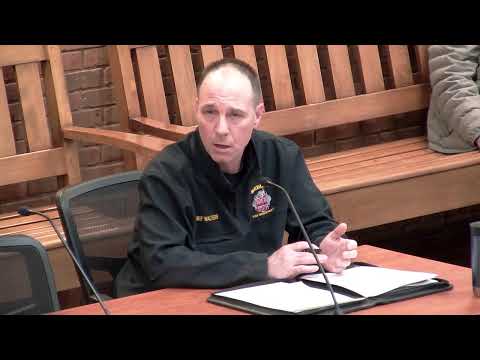
Nino Piccoli, service director for the City of Medina, updated the council on sanitation operations for 2025 and flagged several equipment and policy uncertainties that could affect future costs and service.
Piccoli said the city had about 7,570 residential curbside customers in 2024 and reported a total of 25,067 tons of municipal solid waste collected in 2024, split roughly evenly between residential and commercial sources. He said yard-waste pickup runs from mid-April to mid-November and that 2024 yard-waste totals were nearly unchanged from 2023 (about 315 tons in 2023 and 318 tons in 2024).
Piccoli reported the city's current CPF (compost processing facility) fee is $55 per ton and that the fee had not risen; it had been slated to go to $58 and be capped by 2028. He said county technical advisory discussions are considering whether to keep or remove flow control (designation that organics must go to the CPF) and that county officials had discussed selling roughly 52 acres including the CPF, a development Piccoli said could remove a fee ceiling if a private operator won a sale. "If it went to a private contractor, there would be no ceiling, with respect to the, CPF fees," Piccoli said.
Piccoli described progress on workforce shortages: the council-added positions and a city-run CDL program provide low-cost commercial-driver licensing; the city enrolls employees for about $400 rather than the roughly $5,000 private-class cost for a Class B license, he said.
Vehicle maintenance and aging hopper mechanisms remain Sanitation's biggest operational challenge, Piccoli said; the department will discuss vehicle-maintenance costs in the budget hearing later this week. He said staff are considering smaller single-axle trucks (20‑ or 13‑yarders) as replacement options.
On recycling, Piccoli said cardboard collection continues on a dedicated route (about 300 tons per year) because it is reliably clean, but that plastics and mixed-paper recycling remain unsettled because of market and contract reliability. He said a River Valley contract (vendor based in Summit County) suffered setbacks and the city is cautious about placing public containers at remote sites because contamination can taint loads.
Piccoli also said the county's anaerobic-digester program accepted roughly 989 tons of diverted industrial food waste but has had operational challenges; Sanitation identified alternate processing in Canton for some material.
Ending: Piccoli said the department will continue curbside yard-waste pickup as long as it is financially feasible and expected to discuss CPF and vehicle needs in upcoming budget deliberations.