Get Full Government Meeting Transcripts, Videos, & Alerts Forever!
Get email alerts on the Child Welfare topic
No spam. Unsubscribe anytime.
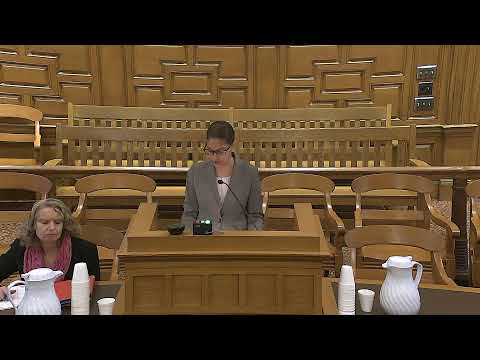
Appeals court hears challenge to DCF reunification efforts in parental-rights termination; matter under advisement
Summary
At a hybrid appeals-court oral argument in docket 24P1110, attorneys disputed whether the Department of Children and Families provided the hands-on, ADA‑accessible services a mother with cognitive impairments needed to reunify with her child. The panel took the case under advisement.
At a hybrid oral argument before an appeals-court panel, attorneys for a mother and the Department of Children and Families disputed whether the agency provided legally required reasonable efforts tailored to a parent with cognitive impairments in a termination-of-parental-rights case, docket number 24P1110.
The mother’s attorney, Kyla Clay, argued that DCF repeatedly failed to provide the hands-on supports the mother needed — particularly enrollment in Department of Developmental Services (DDS) — and that the juvenile court’s decision should be vacated and the case remanded for a new trial after appropriate reunification services are provided. DCF counsel Carol Fizzoli countered that the department provided multiple stabilization and referral services and that the mother repeatedly declined or failed to follow through. Child’s counsel Anna Maria Joy urged the panel to affirm the lower court’s findings and the termination.
The issue matters because the appeals court’s ruling could clarify how and when an agency’s duty to provide “reasonable efforts” must be tailored to a parent’s cognitive disabilities, including whether failing to secure hands-on assistance from DDS or to take specific steps to accommodate a parent under the ADA can require a new trial.
Kyla Clay, attorney for the mother, told the panel that from the case’s start DCF “knew [the] mother's cognitive impairments required additional services and support” and that the agency failed to ensure she received them. Clay said the mother repeatedly sought reenrollment in DDS and completed the application steps but was missing a signature that DCF personnel did not help obtain. Clay said DCF “told mom to go to the DDS office and figure it out on her own” despite knowing the mother needed direct assistance to enroll and sustain services.
Clay also said DCF did not provide effective domestic-violence or mental-health referrals and instead “flooded the parent with meaningless referrals,” which she argued is insufficient where a parent’s cognitive limitations prevent independent follow-through. Clay asked the court to vacate the juvenile court’s judgment and remand with instructions to provide “appropriate and accessible reunification services.”
Carol Fizzoli, counsel for the Department of Children and Families, said the department provided multiple services before and after removal, including two separate family-stabilization programs (the second described in the record as Youth Villages), repeated early-intervention referrals and weekly visits from a social worker. Fizzoli said some services were set up and the mother “no showed” or otherwise failed to participate; she added that workers even walked the mother to the Family Nurturing Center and attempted intake contacts with the prior DDS worker.
Fizzoli also argued the ADA/accommodation issue was waived at trial because it was not raised before the juvenile court, and that documentation attached to the parties’ briefs but not introduced at trial shows the department’s responses and offered accommodations. “Even if hypothetically this issue of reasonable efforts was not waived,” Fizzoli said, the department “went well overboard in providing services.” She emphasized evidence in the record that the mother repeatedly declined or did not complete offered services.
Child's counsel Anna Maria Joy said the trial court made “very specific” factual findings and that reversal was not warranted. Joy highlighted record examples where the mother showed initiative — for example, traveling in bad weather to attend a visit — but argued that the mother’s inconsistent engagement with services supported the trial court’s conclusions that she was unfit at trial and that her unfitness would likely continue.
Panel questions focused on whether the ADA/accommodation claim was waived and on the standard of review for the trial court’s factual findings vs. its legal conclusions under the cited statutory factor referenced in argument as “2 10 3 c.” One panel member noted familiarity with a cited case (adoption of Elena) and asked counsel to address more recent case law and waiver doctrines. The panel did not rule from the bench and took the matter under advisement.
The record excerpts produced at argument show several quantitative details the parties relied on: the child was not removed until about seven months after birth; the record references two separate family-stabilization programs, four early-intervention referrals, the mother completed 5 of 14 parenting-class sessions, and the social-worker testimony reported that roughly 50% of scheduled visits were missed. Counsel also referenced a letter to the department about ADA accommodations that was attached to briefing but not offered at trial.
The panel thanked counsel and court staff and recessed. The appeals court will issue a written decision at a later date.