Get Full Government Meeting Transcripts, Videos, & Alerts Forever!
Get email alerts on the Claims Behavioral Health topic
No spam. Unsubscribe anytime.
OCA details claims‑code set for behavioral‑health spending measurement, including screening and pharmacy rules
Summary
OCA proposed a claims‑based definition that would include claims with a primary behavioral‑health diagnosis, screening/assessment service codes regardless of diagnosis, place‑of‑service categorization and an NDC list to flag behavioral‑health drugs. Staff shared the draft code counts and sought input on how to capture screenings across settings.
The Office of Health Care Affordability on Oct. 9 presented a draft claims‑based methodology for identifying behavioral‑health spending in payer data, proposing a multi‑step process that uses diagnosis, service, place‑of‑service/revenue and national drug codes.
The proposal: include primary‑diagnosis behavioral‑health claims and screening/assessment service codes
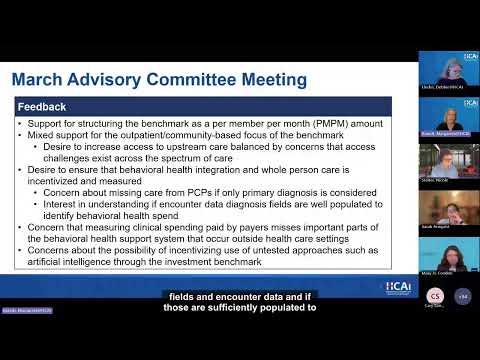
Mary Jo Condon, principal consultant with Friedman Healthcare, outlined OCA’s high‑level rule: if a claim lists a behavioral‑health diagnosis in the primary diagnosis field it will be included in behavioral‑health spending totals; separate service codes for mental‑health or substance‑use screening and assessment would also be counted even when the claim’s primary diagnosis is not behavioral health. "All claims with behavioral health diagnosis, a primary behavioral health diagnosis will be included in the measurement of behavioral health spend," Condon said.
OCA would then categorize included claims by place of service codes, revenue codes and service codes to support reporting and to identify the subset of spending eligible for a focused outpatient/community investment benchmark.
Code set and counts
- Diagnosis codes: OCA shared a draft set that contains about 2,950 ICD‑10 diagnosis codes for mental health and substance‑related conditions. - Service codes: the draft includes approximately 586 CPT/HCPCS service codes linked to behavioral‑health services. - Care‑setting codes: OCA listed about 238 place‑of‑service and revenue codes that it will use to assign claims to reporting categories (outpatient/community, emergency department, inpatient/long‑term/residential, pharmacy, etc.). - Drugs: OCA’s NDC list contains 164 drugs identified for mental‑health or substance‑use treatment; staff noted pharmacy claims often lack diagnosis fields and that using NDCs helps capture treatment spending that would otherwise be missed.
Screenings and submitter burden: two options
OCA presented two options for how data submitters should report screening/assessment spend:
- Option 1: submit screening and assessment as a separate subcategory regardless of setting. This exposes the volume of screening but increases the analytic burden on submitters who must isolate those service lines from multi‑line claims. - Option 2: fold screening and assessment into the setting‑specific subcategories (for example, outpatient screening would be counted within outpatient community‑based spending). This reduces submitter burden but makes it harder to report screening as a distinct volume.
Debbie Lindes, manager of OCA’s healthcare delivery system group, and Mary Jo asked for feedback on which approach would best balance visibility and reporting burden. A hospital representative asked whether intensive outpatient programs (IOP) and partial hospitalization would be counted in outpatient community‑based spending; Mary Jo affirmed those services would be included under the outpatient community category.
Data challenges and next steps
Work‑group members noted that screenings are inconsistently billed, particularly in capitated environments and in visits that include multiple services. OCA acknowledged the limitation and said it will ask payers for the cleanest, best evidence available while documenting the method’s imperfections.
OCA will circulate the full draft code set for public review and solicit specific recommendations for additional service, place or drug codes to add or exclude.