Get Full Government Meeting Transcripts, Videos, & Alerts Forever!
Get email alerts on the Nonclaims Behavioral Health topic
No spam. Unsubscribe anytime.
OCA proposes rules to count non‑claims behavioral‑health payments, recommends excluding plan‑level connector spend
Summary
The Office of Health Care Affordability on Oct. 9 outlined a methodology for counting non‑claims payments toward statewide behavioral‑health spending, saying payments must be made to behavioral‑health providers to be fully included and recommending limits on some categories of infrastructure and transformation payments.
The Office of Health Care Affordability on Oct. 9 outlined a methodology for counting non‑claims payments toward statewide behavioral‑health spending, saying payments must be made to behavioral‑health providers to be fully included and recommending limits on some categories of infrastructure and transformation payments.
OCA staff described the approach during the work group’s meeting and sought feedback from clinicians, consumer advocates and payer representatives. Margaret DeBrant, assistant deputy director for health system performance at the Office of Health Care Affordability, opened the meeting and framed the session as a continuation of the agency’s efforts to define behavioral‑health spending for measurement and benchmarking.
Why it matters: Non‑claims payments are widely used to fund care integration, workforce supports and practice transformation. How OCA counts those dollars will affect the state’s measurement of payer investment in outpatient and community behavioral‑health services and the baseline used to set any investment benchmark.
Key elements of OCA’s proposal
- Payments to behavioral‑health providers: OCA recommends including in behavioral‑health spending those non‑claims payments made directly to behavioral‑health providers for population‑health work, behavioral‑health integration and care management. Mary Jo Condon, principal consultant with Friedman Healthcare supporting OCA, summarized the approach and the agency’s intent to mirror allocation methods used previously for primary care.
- Social‑care integration: OCA would include payments when they are made to behavioral‑health practices for screening and referral related to health‑related social needs (for example, housing or food insecurity). Mary Jo Condon said: "we define social care integration as prospective non‑claims payments paid to health care providers or organizations to support screening for health related social needs, connections to social services, and other interventions to address patient social needs, such as housing or food insecurity, that are not typically reimbursed through claims." Nicole, a work‑group participant, asked bluntly: "Have we defined, what constitutes social care?" and staff pointed to the expanded framework definitions and offered to post links to the guidance.
- Excluding plan‑level connectors and third‑party vendor payments: OCA recommended not counting payments that a plan makes to its own staff to connect members to services or to vendors that act as referral/connector platforms. The office drew a line between funding that directly supports clinical teams (included) and funding for plan operations or vendor referral infrastructure (excluded).
- Limits on transformation and other categories: For practice transformation, IT infrastructure and certain other categories, OCA proposed applying a maximum allowable allocation to behavioral‑health spending similar to the 1% cap the agency uses for primary care allocations. OCA staff said they will return with a specific recommended percentage for these limits.
- Capitation apportionment: OCA proposed using a fee‑for‑service‑equivalence ratio to apportion portions of broader capitation payments to behavioral health, the same methodology developed with payers for primary care. Staff stressed that apportionment will be a best estimate derived from payer‑submitted data rather than provider accounting.
Points of contention and clarification requests
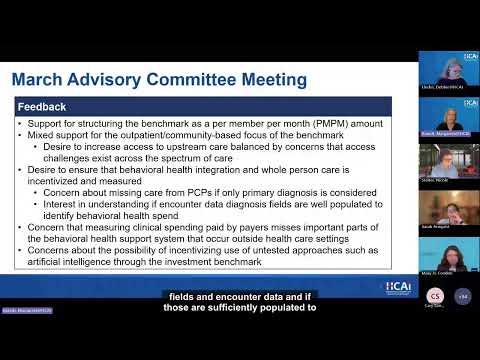
- Prevention and subclinical services: Several clinicians and advocates urged broader inclusion of preventive behavioral‑health activities and community‑based nonclinical supports. Monica Saxena, a geriatric psychiatrist representing the California State Association of Psychiatrists, said clinical prevention and nonpharmacologic treatments should be counted: "I feel like the things that are included in primary care ... we're not including preventative care for behavioral health issues." OCA staff responded that the agency’s immediate scope is payer‑reported clinical spending and that capturing the full spectrum of community and prevention spending may require supplemental data sources.
- Peer and subclinical services: Work‑group participants asked whether payments to peer support specialists and other non‑licensed staff employed by clinical practices would count. OCA’s recommendation was to include those services when they are provided by staff of a clinical practice and paid through a clinical payment to that practice.
- Data limitations and pilots: Multiple participants asked whether OCA could do smaller pilots or supplemental studies (for example, sampling federally qualified health centers) to surface spending not visible in large payer claims and capitation feeds. OCA said it will consider how to supplement payer data in reporting but reiterated that the present definition focuses on payer‑supplied claims and non‑claims data.
Next steps
OCA will bring a recommended maximum allowable percentage for practice infrastructure and transformation payments to a future meeting and continue refining the apportionment formula for capitation. Staff asked work‑group members and stakeholders to provide written feedback and signaled plans to revisit how prevention and subclinical supports might be represented in future reporting.