Get Full Government Meeting Transcripts, Videos, & Alerts Forever!
Get email alerts on the Finance New Markets Tax Credit topic
No spam. Unsubscribe anytime.
Ogden financing plan would bring about $2.1 million in net grant-equivalent funding for Marshall White Center
Summary
Cody Rogers, an attorney with Stinson working for the city, told a March 25 joint work session that a New Markets Tax Credit transaction has been structured to finance the rebuild of the Marshall White Community Center in Ogden.
Cody Rogers, an attorney with Stinson working for the city, told a March 25 joint work session that a New Markets Tax Credit (NMTC) transaction has been structured to finance the rebuild of the Marshall White Community Center in Ogden.
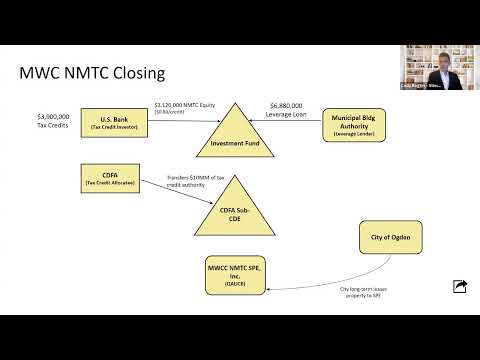
Rogers said the Community Development Finance Alliance (CDFA), a Utah-based community development entity (CDE) that recently received an allocation of NMTC authority, has allocated $10,000,000 of its authority to the Marshall White project. That allocation yields $3,900,000 in tax credits (39 percent of the qualified equity investment), and US Bank — the investor in the deal — agreed to pay about $0.80 for each dollar of credit, yielding roughly $3,120,000 in equity to be invested in the project.
Why it matters: the structure is designed to move private equity into a low-income community project while keeping the city’s operations unchanged. Rogers described the $3.12 million from the investor, minus placement, audit and closing reserves, and fees, as resulting in “a little over $2,000,000 … essentially given to the project for free.” That sum, Rogers said, would be advanced on the day of the NMTC closing and held in an account the city can draw against for eligible project costs.
Rogers outlined the mechanics: because municipalities cannot be direct recipients of NMTC financing, the city will long-term lease the property to a specially formed nonprofit special-purpose entity (SPE). The SPE will receive the NMTC financing; the Municipal Building Authority (MBA) is expected to make a leverage loan that, together with investor equity and reserved fees, funds the SPE. The SPE will then sublease the property back to the city so the city continues to operate the center.
Rogers said the investor — US Bank — is not seeking distributions from the project cash flows and instead realizes its return through the tax credits over the seven-year NMTC compliance period. The city will make lease payments to the SPE set to cover debt-service cash flow the SPE owes to the investment fund during that compliance period. Rogers described administrative costs for the compliance period as modest: “less than $3,000 annually” in his presentation, and later estimated about $2,500 per year for the city’s operating costs tied to the structure.
City staff described the planned governance and reporting. The SPE’s governing board is expected to be five members, with a city-appointed majority (the mayor, council chair and a third city appointee) and two “independent” members who cannot be city employees. Staff said the SPE will file the IRS exemption application (Form 1023) and annual Form 990 returns and that management services will handle ongoing reporting and provide annual reports to council. CDFA and the investor will also expect regular compliance reporting to meet NMTC requirements.
Risk and indemnity: council members asked about recapture risk and “change-of-law” exposure. Rogers said indemnities requested by the investor would require the city to make the investor whole only if the city or the SPE caused a qualifying recapture event, but he emphasized that in 25 years of NMTC practice there has been no recapture event and that the documents are typically structured conservatively to avoid such outcomes. He said the city will seek contractual carve-outs for change-of-law events so the city is not liable if Congress or Treasury alters the program.
Planned next steps: staff told the joint session that several approvals are required as soon as the following week (documents and resolutions currently scheduled for April 1): the council would authorize a no-cost long-term lease to the SPE, and the MBA would approve a budget amendment recognizing approximately $6,800,000 (the transcript identifies this figure as the leverage/credit recognition) and would approve the leverage loan, the lease-back, and related closing documents. Staff said the mayor will likely be authorized to sign the closing documents if final changes are needed before CDFA’s required closing date.
What the money will pay for: Parks staff said the funds would be used for Marshall White Center site and facility improvements, including landscaping, new lights for the pickleball courts and field area, concrete replacement, and interior equipment.
What remains unresolved: draft legal documents remain under review; staff and counsel said they will continue to coordinate final indemnity language, the SPE bylaws, and audit/reserve funding for compliance costs. Documents identified in the presentation include a placement fee (estimated $250,000), audit/tax reserves ($59,500), estimated closing costs (about $300,000), and miscellaneous expenses (roughly $7,000). Rogers described those items as being paid from the investor’s equity before the city receives net proceeds.
Credits and duration: Rogers described the seven‑year NMTC compliance period during which the flow of funds and ownership structure remain in place; after the compliance period the parties can “unwind” the structure via a put/call and restore the prior ownership arrangement, which Rogers said is how the leverage loan effectively becomes forgiven in practice.
The joint session did not take the approvals; staff said formal council and MBA votes are scheduled for early April.