Get Full Government Meeting Transcripts, Videos, & Alerts Forever!
Get email alerts on the Residential Landlord Tenant Ordinance topic
No spam. Unsubscribe anytime.
Evanston amends landlord-tenant rules: AC and internet now essential services; new fee and notice limits take effect Jan. 1, 2025
Summary
City staff and a tenants’ attorney reviewed changes to Evanston’s Residential Landlord Tenant Ordinance that take effect Jan. 1, 2025, including caps on late fees, new disclosure and deposit rules, expanded essential services to include air conditioning and internet, limits on landlord entry and new anti‑retaliation protections.
Evanston’s amended Residential Landlord Tenant Ordinance (RLTO), effective Jan. 1, 2025, introduces new tenant protections and disclosure requirements that apply to most rental units in the city, a City of Evanston housing official and a tenants’ advocate said during a city webinar.
Anna Elisaraga, housing and economic development staff for the City of Evanston, and Philip Devon, staff attorney for the Metropolitan Tenants Organization, walked webinar attendees through the ordinance changes and how they affect leases, deposits, fees, repairs, landlord entry and eviction notices.
The changes matter because the ordinance covers “almost every unit in the city,” Devon said, and because several common landlord practices are now restricted or must be disclosed to prospective tenants. "It's really important that renters know their rights and the rules and obligations that come along with leasing an apartment," Devon said.
Most rentals remain covered; a limited list of exclusions includes educational residences (for example, sororities, fraternities and dormitories), religious institutions, medical facilities and licensed transitional facilities, shelters and rooming houses. When a unit is excluded, the landlord must disclose that exclusion in marketing materials and during the application process.
Leases and disclosures
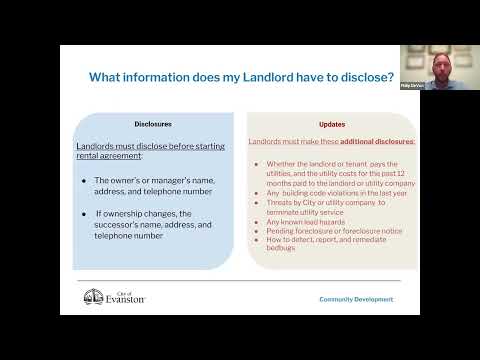
Under the amended ordinance, leases must be in writing and include the full names and birth dates of all occupants. Landlords must disclose whether the landlord or tenant pays utilities and must provide utility costs for the prior 12 months or a best estimate. Leases may not require tenants to waive statutory notices or emergency access to law enforcement, and they may not bar truthful negative reviews after tenancy ends. The ordinance also bars breed-specific bans if a lease otherwise permits pets.
Fees and deposits
The RLTO now caps routine late fees: landlords may charge up to $25 when monthly rent is $1,600 or less; for rents above $1,600 the maximum is $25 plus 5% of the amount over $1,600. Move-in and application fees must be tied to reasonable, itemized costs; landlords must supply an itemized list supporting nonrefundable move-in fees. Landlords may not label a security deposit as a nonrefundable fee to evade the deposit rules.
Security deposits are limited to 1.5 times monthly rent; funds must be held in a federally insured bank located in Illinois and kept separate from the landlord’s assets. Landlords have 21 days after move-out to return deposits or provide a detailed written accounting of any deductions. Devon noted landlords are no longer required to pay interest on deposits.
Repairs, essential services and tenant remedies
Landlords must maintain premises in compliance with building codes and applicable law and bear the cost of repairs for provided fixtures and appliances. Tenants must provide written notice of defects. The ordinance expands “essential services” to include air conditioning and internet when the lease requires them; essential-service problems are subject to faster repair timeframes.
Tenants may use a repair-and-deduct remedy after providing written notice and giving the landlord 10 days to act. The new cap for repair-and-deduct is $500 or one-half month’s rent, whichever is greater. Tenants also may seek a rent reduction when a condition cited as a city code violation meaningfully reduces the unit’s value; the ordinance does not prescribe a fixed withholding percentage and advises modest, well-documented reductions.
Landlord entry and showings
Landlords must give 48 hours’ notice before entering a unit, using mail, telephone, writing or another good‑faith method designed to provide notice; reasonable entry hours are presumed to be 8 a.m. to 8 p.m. Showing a unit to prospective renters or buyers is a permitted purpose only within 90 days before the lease ends.
Eviction notices, reinstatement and retaliation
For unpaid rent, Evanston landlords may issue a 10‑day notice to pay or quit; the notice must comply with the Illinois Eviction Act’s delivery methods (for example, personal delivery to a household member aged 13 or older, certified mail with proof, or other method consistent with the statute). If a landlord accepts the full rent due after expiration of a timely 10‑day notice, the notice is waived and the tenancy is reinstated. Tenants are allowed a one‑time reinstatement per tenancy by paying rent plus legal costs after a 10‑day notice expires.
Other lease violations require a 30‑day written notice with an opportunity to cure; a repeat violation during the same lease term can allow the landlord to terminate with 30 days’ notice and without a second cure period. When a landlord accepts rent after issuing a 30‑day notice, the landlord generally may not pursue eviction on that basis.
The ordinance strengthens anti‑retaliation protections. Landlords may not increase rent, cut off services, refuse renewal, file eviction in response to tenants filing code complaints, testifying in proceedings, organizing tenants, contacting tenant‑advocacy groups such as the Metropolitan Tenants Organization, or exercising other rights identified by the ordinance.
Lockouts and prohibited conduct
The RLTO prohibits lockouts — including changing locks, blocking access, or removing doors — and now explicitly covers cutting off internet service and removing appliances or fixtures provided by the lease as prohibited lockout methods. Tenants who experience a lockout were advised to contact police and tenant‑advocacy groups and to document the incident.
Resources
Devon and Elisaraga directed tenants with questions to the city’s landlord and tenant resources page and to local tenant advocates. The webinar replay and a model lease will be posted on the City of Evanston website; the city’s text helpline number shown in the webinar is (205) 736-0293. Devon also urged tenants to contact the Metropolitan Tenants Organization for individualized help and sample legal letters to preserve rights and evidence.