Get email alerts on the Kit Homes topic
No spam. Unsubscribe anytime.
SB 5552 prompts SBCC to request more time, scoping support for 'kit homes' rulemaking
Summary
Members of the State Building Code Council's legislative committee discussed Senate Bill 5552, which would direct rulemaking on prefabricated "kit homes," and agreed to urge sponsors to move the adoption timeline into the 2024/2027 code cycle and to clarify scope and single‑story limits before the bill's hearing.
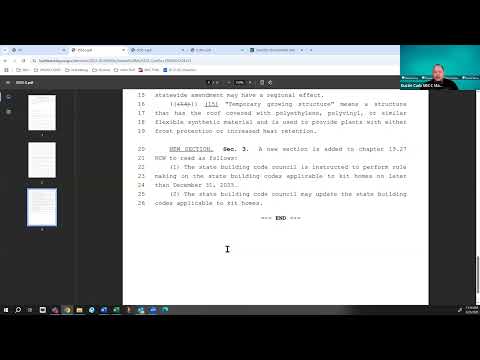
The State Building Code Council (SBCC) legislative committee discussed Senate Bill 5552 on March 25, 2025, and agreed to ask the bill sponsors to change the bill's December 31, 2025, rulemaking deadline and to clarify scope before the bill's hearing scheduled for March 26, 2025.
Committee members said the bill as filed would require the SBCC to complete rulemaking on structures described as prefabricated “kit homes” (assembled on site, 800 square feet or smaller) by Dec. 31, 2025 — a schedule members described as compressed given the work and the absence of an existing, directly applicable model code.
Members recommended three points for testimony: (1) that the proposed work represents off‑cycle rulemaking and would be burdensome under the Dec. 31 deadline; (2) that no single, ready‑to‑adopt model code currently exists for the full scope described in the bill; and (3) that the committee recommends changing the section 3 deadline to instead include the kit‑home provisions in the 2024 code adoption process (for implementation around Nov. 1, 2026) or otherwise align with the SBCC's 2027 adoption cycle to allow proper scoping and coordination.
Discussion and context
Committee members noted the draft bill’s 800‑square‑foot threshold and said parties had informally assumed the structures would be single‑story, but that the bill text did not explicitly limit buildings to single‑story. Members suggested either adding a single‑story limit to the statutory definition or leaving that detail to SBCC rulemaking. Members also discussed whether the work belongs in the code body or as an appendix, with several preferring an appendix chapter in the International Residential Code (IRC) as a practical landing place in the near term.
Speakers emphasized that the work could range from adopting a model standard (if one existed) to creating new code text and referenced ongoing ANSI work on tiny‑home standards and experience in other states (including Colorado) as potential models or sources of external support. Committee staff said that a standards‑based pathway that allows third‑party certification by recognized bodies (similar to some modular or manufactured housing certification processes) may be a practical approach.
Next steps
Members agreed to prepare testimony for the bill’s hearing and to offer specific alternate language to the sponsors that would shift the deadline into the SBCC's code cycle and clarify scope. A committee member volunteered to deliver oral testimony and to circulate a draft script to the committee for review before the hearing.
Ending
The committee did not take formal rulemaking action at the meeting; members instructed staff to draft a short testimony and suggested the council seek close coordination with industry groups and other agencies if the legislation moves forward.
AI generated
The text on this page is AI generated. Summaries, highlights, analysis, and video transcripts are all produced from the original source material.
AI can make mistakes, so if you spot one, and we will fix it for everyone.
Note: the source content is unaltered by us. Any content source we link to, be it a video, an audio recording, or a document, is presented exactly as its publisher released it. That publisher is usually a government body, sometimes an individual official or another organisation.