Get Full Government Meeting Transcripts, Videos, & Alerts Forever!
Get email alerts on the Assessment Diagnostics topic
No spam. Unsubscribe anytime.
Milton Public Schools presents winter diagnostic results; I Ready and DIBELS show consistent midyear patterns
Summary
Milton Public Schools curriculum leaders briefed the school committee on winter diagnostic results for I Ready (math) and DIBELS (literacy), reporting consistent midyear patterns with prior years and highlighting persistent subgroup gaps.
District curriculum leaders presented winter diagnostic results and described how teachers and intervention teams are using I Ready (math) and DIBELS (literacy) to guide instruction across Milton Public Schools.
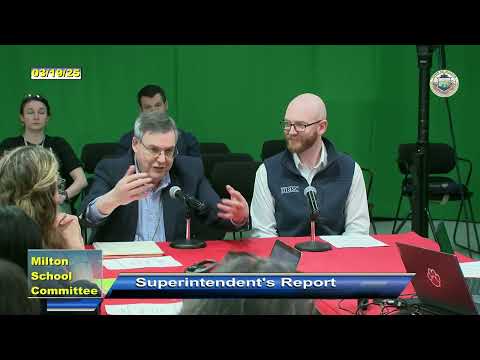
Kat Durosh, literacy director for kindergarten through eighth grade, and Brian Seelig, district math director, walked the committee through assessment types, how the district administers each diagnostic, limitations of the measures and how results are used to form instructional groupings and interventions. "Formative assessments are assessment for learning," Durosh said. "Teachers use formative assessments to see what they need to teach next."
Seelig described I Ready administration: elementary students take the diagnostic three times a year; middle school students are assessed in fall and spring and only specific groups in the winter. He noted completion time ranges from about 30 minutes for early grades to more than an hour for some middle-school students and said student buy-in can affect data validity at the secondary level. "One of the biggest challenges we've run into with I Ready at the middle school ... is the amount of time it takes for students to complete the diagnostic and how that infringes on instructional time," Seelig said.
The presenters summarized winter findings: districtwide K–5 performance and growth metrics were largely consistent with the prior two years; many students who were placed below grade level in the fall showed growth by winter, and a subset of students multiple grade levels below made notable midyear progress. At the same time, subgroup analysis showed consistent underperformance by students with disabilities, English learners and, especially, Black/African American students; presenters called the latter pattern "deeply troubling and concerning." Durosh said the district is using DIBELS and subgroup growth reports to create targeted intervention groups and to guide Multi-Tiered System of Supports (MTSS) work.
Both presenters emphasized the measures are one part of a broader assessment picture. Seelig noted I Ready produces a scaled score and domain placements (number and operations, algebraic thinking, measurement and geometry) and growth measures such as typical growth and stretch-growth targets. He said reaching 50% of typical growth by midyear is an indicator of being on pace to make expected yearlong progress. Durosh stressed DIBELS is a short, skill-based screener used K–5 to identify students for progress monitoring and intervention. "This is just one part of their learner profile," she said. "We do follow-up with other assessments to ensure that that was a true reflection of a student's abilities."
Committee members asked about middle- and high-school coverage, curriculum alignment and the district’s plans to address persistent subgroup gaps. Presenters described ongoing MTSS development, targeted interventionists who work with teachers, and curriculum implementation steps for next year. The committee discussed setting clear, districtwide key performance indicators to measure progress over multiple years.
There were no formal votes tied to this presentation. The committee asked that future quarterly diagnostic reports continue and include planned key performance indicators tied to curriculum and intervention work.