Get Full Government Meeting Transcripts, Videos, & Alerts Forever!
Get email alerts on the Alternative Compliance topic
No spam. Unsubscribe anytime.
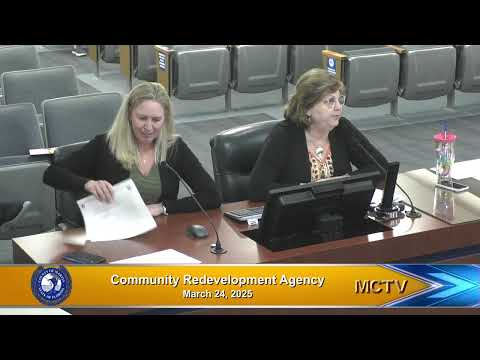
Martin County CRA board adopts new public process for alternative compliance requests
Summary
The CRA board approved a change to the CRA alternative compliance process to move many decisions from an administrative approval to a public hearing before the CRA board, aligning the procedure with variance practice outside CRAs and adding public notice and quasi-judicial hearing elements for dimensional and architectural requests.
The Martin County Community Redevelopment Agency voted to recommend a change to the CRA alternative compliance procedure that will bring most requests requiring deviations from the code to a publicly noticed CRA board hearing rather than leaving them to administrative decision by the growth management director.
Deputy County Attorney Elise Elder and Office of Community Development staff explained that the proposed ordinance aligns alternative compliance—used inside CRAs as a substitute for variances—with Florida statutory standards for variances and with how such deviations are handled outside CRA boundaries. Under the new process, most minor alternative compliance requests would be heard by the CRA board; major requests would go to the Board of County Commissioners. Growth management staff would still prepare assessments and staff reports for hearings.
Under the proposed ordinance, the CRA board would apply a set of criteria drawn from Florida law for variance-like relief, including whether a special condition exists on the parcel that was not caused by the applicant, whether denial would deprive the property of reasonable use, and whether granting alternative compliance would compromise public health, safety or the comprehensive plan. The ordinance explicitly disallows alternative compliance for changes in height or increased density.
Gary Earl of Port Salerno told the board he opposed removing the option for the growth management director to request input from the Neighborhood Advisory Committee (NAC), saying many local residents cannot attend CRA board meetings because of the 3 p.m. meeting time. Gary asked that alternative compliance continue to go before NACs in addition to any CRA board hearing to preserve public access.
Staff and board members responded that the change will bring more requests before the CRA board (instead of being decided administratively) and that the CRA board may, through its decision or motion, refer individual applications to NACs for further neighborhood review. Staff also noted the CRA agenda will provide public notice in advance, and that written public comments submitted prior to hearings may be attached to the agenda and read into the record.
After discussion, a member moved that the agency recommend approval of the proposed alternative compliance procedure and ordinance; another member seconded. The board recorded a voice vote in favor and the chair declared the motion carried.
What changed: The ordinance removes administrative-only approval for most alternative compliance requests within CRAs and creates a public hearing process with staff reports, sworn testimony as appropriate, and CRA board decision-making authority for minor requests and BOCC review for major developments.
Next steps: The CRA will forward the ordinance to the Local Planning Agency (LPA) and then to the Board of County Commissioners for final consideration; staff indicated training for CRA board members to conduct quasi-judicial hearings will be provided if the BOCC approves the ordinance.