Get Full Government Meeting Transcripts, Videos, & Alerts Forever!
Get email alerts on the Wastewater Treatment topic
No spam. Unsubscribe anytime.
Portage City hears final-design update on wastewater plant; estimated cost about $55 million
Summary
Portage City Council on Tuesday received Strand Associates’ final-design and cost update for the city’s wastewater treatment plant, which recommends replacing aging rotating biological contactors with oxidation ditches, adding class A dried biosolids processing and other upgrades to meet forthcoming DNR phosphorus limits; Strand estimated the total project at about $55 million and outlined a construction schedule that would complete work in mid-to-late 2028.
PORTAGE CITY — The Portage City Council received a final-design and cost update on its wastewater treatment plant overhaul on Tuesday night from Strand Associates, which recommended replacing the plant’s rotating biological contactors with oxidation ditches, adding class A dried biosolids processing and other mechanical and electrical upgrades to meet new discharge limits and to address aging infrastructure.
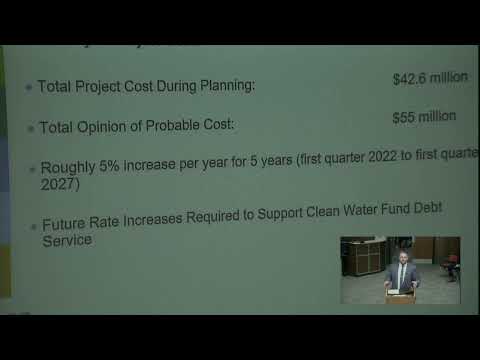
Strand Associates engineer Randy Lehner said the firm’s current planning estimate places the total project cost “in that $55,000,000 range,” and outlined a multi-year schedule that would submit design documents to the Wisconsin Department of Natural Resources (DNR) in April, advertise for bids in July, open bids in August and aim for construction completion in mid-to-late 2028.
The project responds to coming WPDES permit phosphorus limits from the Wisconsin DNR and to equipment that dates from the plant’s original 1980 construction. Phil Livingston, a city staff member who opened the presentation, told the council that the city contracted Strand in 2021 and that “Strand has been a great asset to our utility department.”
Why it matters: Council members and staff said the plan will affect long-term compliance obligations and the utility’s finances. City staff engaged financial adviser Ehlers and signaled that future rate increases and debt structure will be discussed separately; Strand and staff said the city may be eligible for up to $3,000,000 in principal forgiveness from state funding programs.
Key design elements and operational implications
- Process changes: The design replaces the existing rotating biological contactors (RBCs) with oxidation ditches intended to provide biological phosphorus and nitrogen removal and to handle higher flows and slug loads from industrial users. Strand said oxidation ditches require fewer pieces of equipment than RBC trains and provide greater volume buffering and operational reliability.
- Biosolids: The plan shifts from current cake sludge handling to a dryer-based system producing class A dried biosolids and includes a new biosolids silo for storage or off-site shipment. Strand said the dryer will raise solids content from about 17% (current belt filter press cake) to roughly 90% solids, reducing moisture by about 70 percentage points.
- Site and buildings: Other components include new influent screw pumps, a small electrical-room addition to meet code, fermentation reactors converted from primary clarifiers, new final clarifiers larger and deeper than existing tanks, a return-activated-sludge (RAS) pumping building and reuse/modification of some existing anaerobic digester tanks for waste-activated sludge processes.
- Operations and odor control: Strand said converting digesters from anaerobic to aerobic operation generally reduces odor, but noted that the dryer emits water vapor and off-gassing. The design reserves space in the biosolids building to add odor-control equipment such as granular activated carbon if monitoring and complaints show it’s needed.
Construction sequencing and continuity of service
Strand emphasized that the existing plant must meet its permit limits throughout construction. The firm said major new components (oxidation ditches, clarifiers and the RAS building) are located outside the existing plant footprint, allowing them to be built and started up while the old plant remains in service. To commission the new biological process the design calls for “seeding” the oxidation ditches with mixed liquor transported from another operating plant that has biological phosphorus removal.
Cost drivers and risks
Strand identified four principal cost drivers: (1) inflation and construction-cost escalation since the facilities plan was prepared in early 2022 (Strand used the Engineering News-Record construction-cost index and projected costs to mid-2027), (2) scope changes identified during detailed design—most notably a decision to build a new RAS pumping building and two new final clarifiers rather than retrofitting existing tanks—(3) a major, unforeseen geotechnical condition requiring ground improvements because near-surface soils at the site are poor, and (4) higher-than-expected bid prices in some trades (notably concrete and reinforcing steel, electrical and piping) and the potential impact of tariffs on control-system components.
On tariffs and domestic sourcing, Strand told the council that Clean Water Fund funding requires the use of American iron and steel for items such as reinforcing and ductile-iron piping. The city does not have to meet the broader Build America, Buy America (BABA) requirements tied to larger-population thresholds, but Strand said industry pressure and tariff developments could still raise prices on equipment and control components; the firm reported contractors estimating a possible 5%–10% materials increase tied to tariffs for electrical and controls.
Schedule, finance and next steps
Strand said it will submit the final design to DNR in April, advertise the project in July and open bids in August, with ground improvements likely to begin in late 2025 after contract award. Final completion was projected for mid-to-late 2028, which Strand said aligns with the phosphorus compliance date. Strand and city staff said the city has engaged Ehlers for financing analysis and will present proposals for rate increases and debt structure in coming months to support Clean Water Fund borrowing and debt service.
Discussion points from council and staff
Council members asked about operator workload and reliability; Strand said oxidation ditches are generally easier to operate than aging RBCs and that redundancy and spare equipment are built into the design (for example, multiple RAS pumps). Staff and Strand discussed odor control, potential temporary use of existing processes if the dryer is out of service, and options to store cake sludge during dryer outages. Strand said reusing some existing tanks and piping will reduce cost where feasible but that purchasing new blowers and replacing failing components proved necessary in detailed design.
No formal vote
The presentation was an update and no formal motion or vote on project authorization occurred during the meeting. Council members and staff flagged that future agenda items will cover project financing, bond/loan structure and any required rate changes.
Ending note
City staff and Strand said they will return with financing recommendations and will present the design for any required approvals before advertisement. Strand requested that the council note the uncertainty inherent to multi-year construction estimates and that final contract prices will be set by bids when the project goes to market.