Get Full Government Meeting Transcripts, Videos, & Alerts Forever!
Get email alerts on the Land Use Subdivision topic
No spam. Unsubscribe anytime.
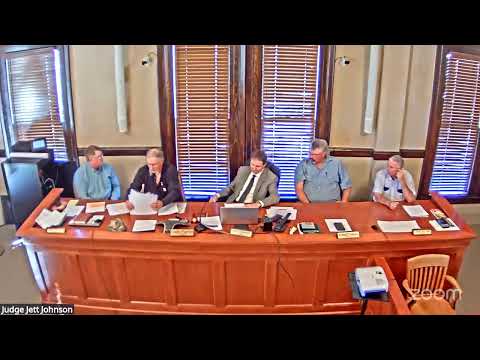
Mills County approves preliminary plat for Hoop and Horns subdivision amid groundwater and boundary concerns
Summary
The Mills County Commissioners Court voted 4-1 to approve the preliminary plat for the 1,600-acre Hoop and Horns subdivision, allowing survey staking to proceed while leaving multiple water, boundary and TxDOT access questions to be resolved before final platting.
Mills County Commissioners Court approved the preliminary plat for the Hoop and Horns subdivision by a 4-1 vote on March 24, 2025, allowing surveyors to begin staking and on-the-ground boundary work while leaving remaining technical and regulatory issues to be addressed before a final plat is filed.
The court’s action grants preliminary approval for a project described in the meeting as about 1,600 acres subdivided into 213 lots. County surveyor Don King and consultants for the developer described the vote as the next step that permits field surveys and stakeout so the surveyor can verify boundaries and adjust lot layouts where necessary.
Supporters said the preliminary plat is needed so surveyors can “go on the ground” to set corners and resolve title and boundary issues that still exist in the documents. The court and consultant teams stressed the preliminary plat is not final approval; multiple revisions and additional studies were described as likely before a final plat is filed.
Opponents and several commissioners pressed technical concerns during more than two hours of discussion. The principal concerns recorded in the meeting were groundwater availability for individual wells, the assumptions used in the original water-demand calculations, potential requirements for federal review, road access approval from the Texas Department of Transportation (TxDOT), and boundary/fence-line discrepancies that may affect lot lines.
Consultant and hydrogeology testimony: The developer’s hydrogeologist (identified in the transcript as Dr. Allison McDonald) told the court he had recalculated demand using a groundwater availability certification methodology and increased the demand assumption to 350 gallons per day per lot. He reported model runs projecting small declines in pump-water levels (about 0.518 feet at 10 years and about 2.5 feet at 30 years under the applied assumptions) and concluded the modeled supply would be sustainable for 30 years under the 350 gpd assumption. Commissioners asked for the updated report be provided to the court.
County surveyor Don King and others described multiple rounds of revisions to the preliminary plan; King said some earlier requested corrections had been addressed and others remained. County staff and developers said final platting will require additional on-the-ground staking, resolution of title and boundary issues, and possible adjustments to lot lines based on field conditions.
Legal and regulatory flags: Speakers noted that subdivisions above certain size thresholds have additional review requirements; the transcript references HUD involvement for subdivisions above a threshold (discussed in the meeting as a potential federal review step). Commissioner and staff questions also focused on whether lots would rely on individual wells and septic systems and who would be liable if individual wells failed to produce water after a sale.
TxDOT and access: Attendees said TxDOT standard spacing and entrance requirements would need to be satisfied for main highway access points; staff reported ongoing coordination but no final TxDOT approvals were in hand.
Court direction and vote: Commissioner Williams moved to approve the preliminary plat; the court’s record shows a second and, following discussion, a roll-call-style affirmation that resulted in four votes in favor and one opposed. The court approved the preliminary plat with the understanding that numerous technical issues — groundwater documentation, boundary stakes, TxDOT access, and HOA/parcel restrictions — remain to be resolved before a final plat.
The court and consultants agreed to exchange the updated hydrogeology report and continue work on the outstanding items before the developer returns with a final plat.
Ending: The court’s approval moves the project into the next phase (field staking and further technical review) but does not authorize final lot sales or construction; the transcript records multiple commissioners emphasizing the need for more documentation and corrected drawings before final approval will be considered.