Get Full Government Meeting Transcripts, Videos, & Alerts Forever!
Get email alerts on the Front Yard Definition Fence topic
No spam. Unsubscribe anytime.
Zoning board upholds city front‑yard finding and denies 6‑foot fence at 3320 W. Lyndale
Summary
The board found the city correctly identified the front yard at 3320 West Lyndale and denied a request to keep a 6‑foot solid front‑yard fence, citing ordinance standards and concerns about setting precedent; the owner may reapply with structural evidence or a revised design.
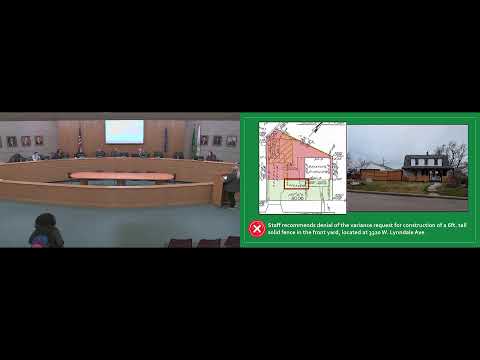
The Zoning Board of Appeals on Jan. 23 determined the city did not err in identifying the front yard at 3320 West Lyndale and then denied a request to allow a 6‑foot solid fence in that front yard.
Gina, city planner and zoning administrator, explained the legal test: when the front yard is not "obviously evident," the zoning administrator must determine its location. Staff reviewed the property survey, the porch configuration and code definitions, and concluded the front yard begins at the primary dwelling, not at the porch.
Marcia Hernandez, the property owner, told the board the porch was built with the house in the 1930s and that she believes it is structural and should be treated as part of the dwelling, allowing the fence to remain in what she considers her side yard. "I have always considered [the porch] a part of the home," Hernandez told the board.
Staff disagreed: building‑inspection staff did not find evidence in city records that the porch is load bearing, and the zoning administrator said the applicant bore the burden to provide proof. The board first voted 4–0 to affirm the city's front‑yard determination. After further discussion about lot irregularities, a new garage added in 2023 and precedence in other cases, the board voted to deny the requested 6‑foot solid fence; the final vote to deny the variance was recorded with three members voting yes and one no.
Board members and neighbors discussed options the owner could pursue if she wants to keep some form of frontage screening: provide engineering or historic documentation that the porch is load bearing (which could change the classification), submit a redesigned fence with greater openness and lower height in the front yard, or move the fence line further back from the curb. Staff noted that decorative fences in front yards are limited by code to a maximum height of 3 feet and must be at least 75% open.
The board directed staff to enforce the denial if the property owner does not take corrective action within an enforcement timeline; staff suggested a multi‑month period given winter weather and construction realities. The owner said she would work with staff and, if necessary, pay reapplication fees to bring revised plans or engineering evidence to the board.