Get Full Government Meeting Transcripts, Videos, & Alerts Forever!
Get email alerts on the Accessibility Fence Accommodation topic
No spam. Unsubscribe anytime.
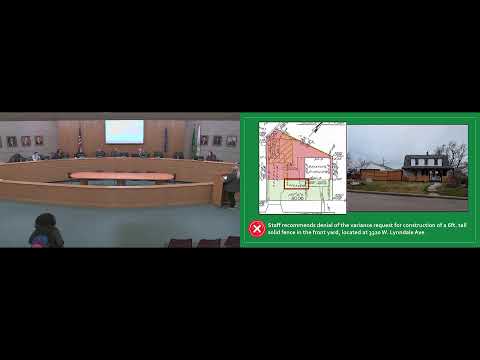
Zoning board denies variance for 4‑foot solid fence at 6800 W. Edgerton; ADA accommodation discussion moved to next month
Summary
The Zoning Board of Appeals denied a requested variance to allow a 4‑foot solid fence in the front yard at 6800 West Edgerton but agreed to consider a reasonable‑accommodation request under the Americans with Disabilities Act at the board's next meeting after the applicant supplies additional materials.
The Zoning Board of Appeals on Jan. 23 denied a variance request to allow a 4‑foot solid fence in the front yard at 6800 West Edgerton but agreed to take up a separate ADA reasonable‑accommodation request next month if the homeowner supplies a clearer site plan and documentation.
Gina, city planner and zoning administrator, told the board staff recommended denial of the variance because the property lacks “exceptional, unusual or extraordinary” circumstances that would justify changing the code for a single lot. "Because there is not a unique feature to this lot, staff recommends denial," she said.
The homeowner and family pressed for the fence as a safety measure for their six‑year‑old son, who the family says has severe elopement behavior related to autism. The unnamed homeowner told the board the child had escaped 12 times over a four‑day period and that the family has tried other measures including ABA therapy and alarmed doors. A neighbor testified that they have witnessed the child elope and supported the request.
Board members discussed two separate decision paths: whether to grant a property variance (which would run with the land) or to grant a reasonable accommodation under ADA tied to the individual living in the house. Amanda Henderson (first alternate) and other members emphasized seeking middle‑ground options such as moving a fence back from the lot line, using a more open (picket) style rather than a solid panel, or allowing staff to approve aesthetics if the board sets an openness requirement.
After discussion the board voted 4–0 to deny the variance. The board then moved and voted 4–0 to table the reasonable‑accommodation item to the next monthly meeting and asked the homeowner to work with staff on a clearer site plan, documentation of the proposed fence and any state program paperwork that would cover costs. Gina reminded the board that a reasonable accommodation would be tied to the individual and would not "run with the property" after the person no longer lives there.
The board and staff suggested interim safety steps the family could pursue while the accommodation is pending, including door‑hardware options and local programs the homeowner said she had previously tried. Board members encouraged the applicant to provide medical or therapy documentation, a site survey showing proposed setback, and any program approvals that would fund the work.
Next steps: the reasonable‑accommodation request will return to the board at the next monthly meeting; staff offered to work with the applicant in the meantime to refine plans and documentation.