Get Full Government Meeting Transcripts, Videos, & Alerts Forever!
Get email alerts on the Municipal Budget topic
No spam. Unsubscribe anytime.
Shelton finance director warns of multi‑year shortfall, urges council to set service‑level priorities
Summary
Finance Director Mike Giddens told the March 25 study session that Shelton used ending fund balance to balance the 2025 budget and that continuing that practice is unsustainable; he urged council priority‑setting ahead of the May retreat to shape the 2026–27 budgets.
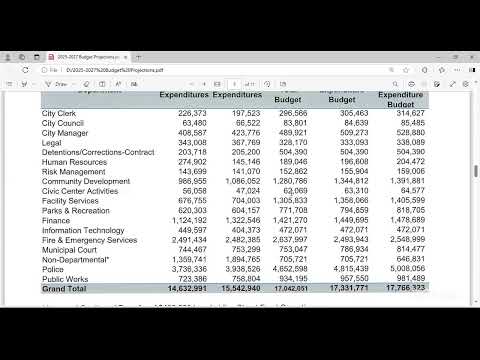
Finance Director Mike Giddens presented a multi‑year budget forecast to the Shelton City Council study session on March 25, outlining how the city used ending fund balance in 2025 and why staff recommend early policy decisions to avoid deeper cuts in 2026 and 2027.
The forecast matters because it frames likely decisions on service levels, staffing and one‑time capital projects: using unreserved fund balance to cover ongoing operations is not sustainable, Giddens said, and the council will need to decide which services to keep, cut or fund with one‑time resources.
Giddens said the 2025 adopted budget relied on some ending fund balance and that staff want to address the issue earlier in the process for the 2026 budget cycle so the council can set priorities before staff prepare detailed budget proposals. He told the council the city had a reserve policy expressed in the presentation as a percentage of prior‑year expenditures (the slides referenced both 16% and 20% in discussion), with the amount above the reserve treated as unreserved fund balance used to balance the 2025 budget.
“Leading into our 2026 budget formulation, we want certain by council's much information as we did,” Giddens said in the presentation, urging that the council use the upcoming May 5 retreat to discuss service levels and priorities that will inform staff budget work. He described the staff approach as conservative on revenue estimates and said some 2024 revenue was one‑time in nature (permits, grants and other receipts) that masked structural pressure on ongoing operations.
Giddens walked through the city’s revenue mix: property taxes are predictable and were held mostly flat in the forecast; sales tax was strong in 2024 but early 2025 months were weaker, so staff kept sales‑tax projections conservative; utility taxes are tied to rate levels; and other categories were stable. He described a local tax increase (referred to in presentation as a D&O or DNO tax change) that took effect for 2024 and lifted that revenue line for 2025.
The forecast shows revenue roughly stable but declining after one‑time transfers and receipts are removed; Giddens said staff reduced assumed transfers‑in used for balancing in the projection. He acknowledged existing capital commitments and maintenance work funded from capital funds in 2025 (HVAC replacement and facility maintenance, and a museum/library deck project coordinated with the library district), and noted that some one‑time capital resources remain but are limited.
Giddens emphasized transparency and staff willingness to provide detailed data to the council and public. He explained the purpose of the council retreat and staff outreach to refine service‑level choices: the retreat would allow council members to indicate priorities that staff can convert into a balanced budget proposal for 2026.
No formal votes or budget actions were taken during the study session; the presentation was informational and intended to inform the retreat schedule and subsequent budget work.
Council members and the mayor acknowledged receipt of the forecast and thanked staff for the presentation. The finance office will return with refined proposals once the council indicates its service‑level priorities at the retreat and through further direction to staff.