Get Full Government Meeting Transcripts, Videos, & Alerts Forever!
Get email alerts on the Homelessness Services topic
No spam. Unsubscribe anytime.
Dream Tree’s NEST shelter reports steady use, seeks funding after AmeriCorps cuts
Summary
Dream Tree Project told the Taos Town Council on May 13 that NEST, the low‑barrier shelter opened in November 2023, remains in nightly operation and runs at high winter occupancy; the program’s annual operating cost is roughly $500,000 and staff sought short‑term relief after an AmeriCorps funding cut.
Dream Tree Project and its partners updated the Town Council on May 13 about operations at NEST, the region’s low‑barrier overnight shelter and developing daytime resource center located in the former Phil Lovato Senior Center.
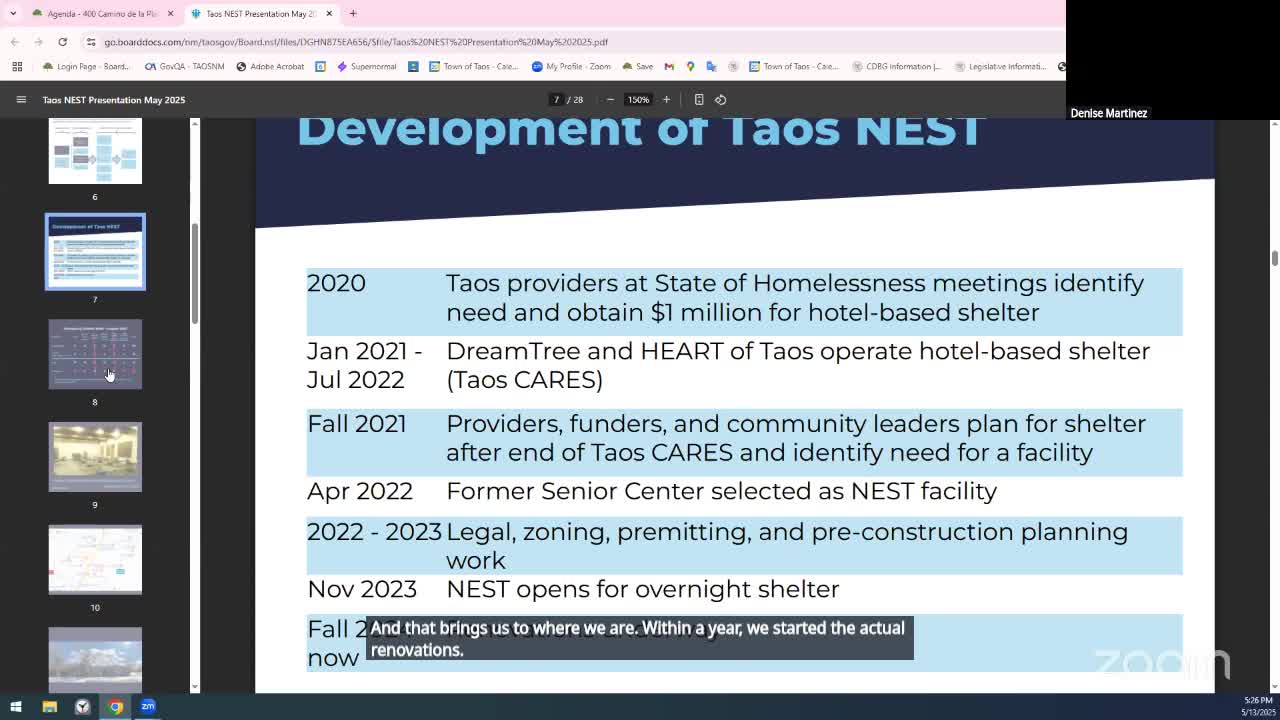
Catherine Hummel, Dream Tree Project executive director, said NEST opened for overnight shelter on Nov. 30, 2023, and has operated nightly since then. She said the facility provides crisis‑response services — overnight beds, case management and street outreach — and that construction is underway to finish interior renovations and build a daytime resource center with showers, laundry and co‑located provider offices.
Hummel told council that the shelter network in the county averages 59 beds available after recent changes and that on many nights NEST is full; at the time of presentation staff reported about 19 beds typically open on an average night, and substantially higher occupancy in winter months. She said NEST’s operating budget is roughly $500,000 per year, driven largely by staffing costs: the program runs two staff for 16 hours per night and provides other services including housing navigation, a mailing address, hygiene supplies and diversion services with law enforcement.
Steven Serrano, Dream Tree’s director of adult services, described intake and service patterns: most guests are adults, more than 65% have been in the Taos community for more than one year and roughly 40% have lived in the area longer than a decade. Serrano said Dream Tree’s intake data show a disproportionately high share of Native American and Black guests relative to county demographics, and that about 12% of guests are veterans. He also said about 20% of guests self‑report a disabling condition (physical, mental health or substance‑use disorder), consistent with national patterns for sheltered populations.
Hummel told council that NEST costs about $55 per bed‑night under current occupancy and service levels — a substantially lower figure than hotel vouchers — and that most operating funds come from private fundraising and a mix of state and federal grants. She said Dream Tree secured a 25‑year lease for the facility from Taos County and that construction and service funding have come from federal COVID response money, other grants and private fundraising.
A central topic at the meeting was an unexpected federal AmeriCorps contract termination that reduced Dream Tree’s funding for the Enchanted Circle Corps program. Hummel said the cut initially created a funding gap of about $67,000; state and local short‑term measures have reduced the immediate gap to an estimated $35,000 to cover staffing through the summer while Dream Tree seeks longer‑term solutions. Council members and staff discussed possible town/county contributions and a forthcoming town cannabis‑tax RFP (the manager’s office described approximately $260,000 available across allocations) to help sustain community social‑service contracts.
Hummel and Serrano asked council to support continued collaboration on co‑located daytime services and on funding strategies that allow NEST to operate year‑round. Council members thanked staff and community providers for the shelter’s operation and stressed the need for broader affordable‑housing and prevention strategies to reduce long‑term homelessness.
No formal council action was taken on a funding commitment at the May 13 meeting; council and staff discussed next steps for grant applications and a town RFP process for social‑service contracts.