Get Full Government Meeting Transcripts, Videos, & Alerts Forever!
Get email alerts on the Land Development topic
No spam. Unsubscribe anytime.
Hart County commissioners approve second reading of revised Land Development ordinance after hours of debate
Summary
The Hart County Board of Commissioners advanced a rewritten Chapter 46 (Land Development) to a second reading after lengthy discussion about minimum lot sizes, pre‑application review, infrastructure completion and protections for farmland. The measure passed 4‑1; Commissioner Bennett opposed.
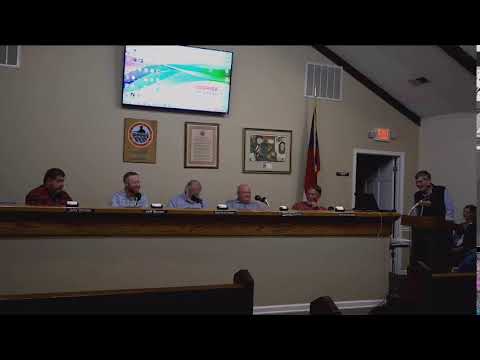
Commissioner Dorsey presented revisions to Chapter 46, the county’s Land Development ordinance, during the March 20 meeting of the Hart County Board of Commissioners, and the board voted to take the draft as a second reading after extensive discussion of lot sizes, road standards and protections for farmland.
The board approved taking the revised ordinance as the second reading by a 4‑1 vote, with Commissioner Bennett recorded in opposition. Commissioner Dorsey made the motion and Commissioner Teasley seconded it.
The draft contains several substantive changes discussed at length at the meeting. Among the principal edits: defining a county road or street to require a minimum 60‑foot right of way with 20 feet of paved width; raising the lot size threshold for Level 2 subdivisions; tightening ownership and transfer rules so approvals stay with the named owner during infrastructure construction; and making the pre‑application review by the county administrator mandatory (changed from “urged” to “shall”).
Commissioner Dorsey said the ordinance now requires that “prior to a change in ownership, all of the required infrastructure must be completed by the property owner,” language intended to prevent partially finished subdivisions from being transferred before roads and utilities are finished. The draft exempts transfers to immediate family and transfers to entities whose ownership remains the same as the applicant; in those cases the applicant must provide proof that the ownership did not change during infrastructure installation.
The board also debated minimum lot sizes and septic/water rules. The draft retains reliance on health‑department standards for septic and allows a municipal or county water connection where available; it replaces an absolute “shall connect” requirement with language that developers must obtain a “letter of concurrence” from the municipal water authority. Commissioner Brown and others stressed that minimum lots should generally be one acre when wells are required but acknowledged state health rules can allow smaller lots where public water is available.
Commissioner Teasley and several others urged adding a requirement that subdivision applicants hold a mandatory pre‑application meeting with the county administrator and the property owner (not only an agent) before submitting a plat for approval. “The owner has to be a part of this,” he said, arguing that ownership clarity prevents later disputes when infrastructure is incomplete.
The board also discussed performance bonds and completion windows for infrastructure. Commissioners referenced a 24‑month completion period for infrastructure in prior practice; Dorsey said the draft contemplates that approvals should lapse if infrastructure is not completed within the specified time and that bonds or similar financial assurances may be needed to guarantee build‑out.
Separately, staff reported on a county soil‑productivity review conducted by Mr. Hicks. The spreadsheet reviewed at the meeting showed that, for parcels 25 acres and larger, a substantial share (about two‑thirds by the presenter’s count) scored in higher productivity classes on USDA/NRCS soil maps. Commissioners discussed using soil productivity mapping to help target farmland protection, and asked staff to prepare additional breakdowns by different minimum acreages (30, 50 acres) to see how different thresholds would change the amount of land affected.
No changes relating to the county’s interim solar moratorium were made at this session; several commissioners said solar issues will be addressed later and that the current focus was on clarifying subdivision review and completion requirements.
Next steps: the board took the draft as a second reading with the changes reviewed at the meeting and directed continued work on bonding language, completion timelines and the farmland/soil productivity analysis before final (third) reading.