Get Full Government Meeting Transcripts, Videos, & Alerts Forever!
Get email alerts on the Appointments Committees topic
No spam. Unsubscribe anytime.
Governance committee debates routing of volunteer appointments and committee workflow; city attorney clarifies ordinance reading rules
Summary
The Governance Committee spent its Feb. 24 meeting discussing where mayoral and council appointments should be vetted, how to reduce volunteer and staff burden, and how committee hearings count toward ordinance readings under the city charter.
The Governance Committee spent much of its Feb. 24 meeting debating how volunteer board and commission appointments and ordinances should move through Portland’s new committee structure, and how committees should balance thorough vetting against volunteer and staff time. The committee did not take a formal vote on policy; members asked staff to draft options for future consideration.
Councilors discussed three main routing models for appointments: (1) default to a subject‑matter policy committee (for example, transportation appointments to a transportation committee), with governance serving as a backstop if a policy chair requests referral; (2) default to governance committee for appointment vetting, with policy chairs able to pull items into their committees; or (3) a hybrid “release valve” model in which appointments go to a policy committee unless its co‑chairs send it to governance. Councilor Pertelgini emphasized the difference between mayoral confirmations and council‑generated appointments and suggested governance act as a vetting forum for mayoral recommendations. Councilor Dunphy and others said they favor referring most appointments to policy committees, with governance as an overflow for items that do not fit neatly in a subject committee.
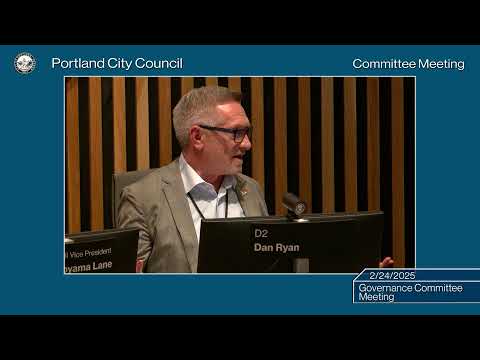
Councilors also raised concerns about the volume of advisory bodies and the burden on staff and volunteers. Vice Chair Ryan and several members urged a near‑term inventory and ‘‘reset’’ of boards and commissions to eliminate duplicative or inactive bodies and reduce staffing pressure. Ryan suggested a task force and coordination with the Office of Community and Civic Life to standardize and streamline appointments and support for volunteers.
On ordinance workflow, City Attorney Robert Taylor clarified how readings and emergency clauses operate under the charter. Taylor told the committee that the charter requires first and second readings to occur at the full council for non‑emergency ordinances; committee hearings are advisory. He explained that a committee can vote by majority to report an ordinance to full council when it is ready. Taylor also outlined emergency clause rules: "That amendment to add the emergency clause passes on a majority vote, 7 votes, but then to pass it from the full council that same day, you need 9 votes to do that." Committees are not required to perform two formal readings of an ordinance; the two‑reading requirement applies to full council.
Committee members discussed public testimony logistics and protections for volunteers. Several councilors said volunteers should not be expected to appear multiple times; committee hearings should suffice for vetting where appropriate. Members also discussed putting appointments on the consent agenda after committee consideration to avoid redundant hearings and protect volunteers’ time.
Why it matters: routing of appointments and clarification of committee rules will affect how quickly boards are staffed, how much time volunteers must spend in public hearings, and staff workload for preparing multiple hearings. Councilors signaled support for faster, clearer procedures but also for careful housekeeping to ensure volunteers’ work is respected and substantive policy appointments get appropriate subject‑matter review.
Next steps: staff said they will work with Civic Life and other offices to produce an inventory and propose phased changes; the committee scheduled deeper budget and process discussions for upcoming meetings (GTAC members to appear March 10). No formal policy vote was taken Feb. 24; committee members asked staff to draft clearer guidance and a rulebook section for committee chairs to ensure consistent expectations.