Get Full Government Meeting Transcripts, Videos, & Alerts Forever!
Get email alerts on the Homelessness topic
No spam. Unsubscribe anytime.
Councilor reports county backing off shelter beds and low shelter-to-housing transitions; committee seeks more data
Summary
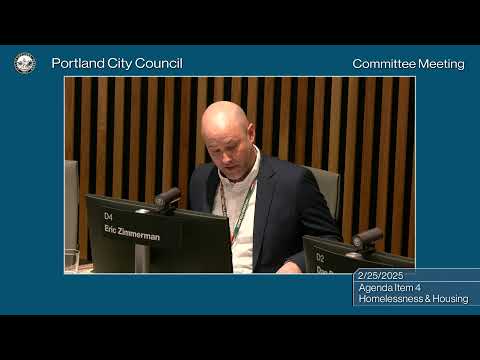
Councilor Zimmerman, Portland’s liaison to the Homelessness Response System’s Steering and Oversight Committee, told the Homelessness and Housing Committee that the county has trimmed about 100 committed shelter beds from its plan and that transitions from shelter to housing were at roughly 20%, far below the HRAP target of 41% by 2025.
Councilor Zimmerman, Portland’s representative to the Homelessness Response System (HRS) Steering and Oversight Committee, updated the Homelessness and Housing Committee on the SOC’s first meeting and upcoming March 11 convening. He said the county has “backed off on some of its about a hundred of its committed shelter beds that were originally in its sheltering plan.”
Zimmerman also read data from the county’s quarterly Homeless Response Action Plan (HRAP) showing the program “goal of transitioning 41% of all exits from shelter into housing by the end of 2025” but that the county is “at about 20%,” a shortfall Zimmerman called “notable.” He asked that the committee monitor which shelter types and locations show stronger transitions so the city can learn what works.
The committee discussed budget and program concerns after the county’s recent public announcement seeking help to fill a roughly $100 million gap in homeless services funding. "I didn't hear it [the $100 million gap] at SOC; that was a bit of a news flash to me as well as it was the public," Zimmerman said, adding that he expects the March 11 SOC meeting to focus on funding priorities.
Committee members pressed for more detailed data. Councilor Rhine said field visits revealed differences across sites: at one shelter she described as “Angoma Village,” staff reported about 15% of residents were accessing behavioral health services while at “Peninsula Crossing” the breakdown was roughly 50/50. Rhine and others urged the county to disaggregate transition metrics by shelter model, location and provider to identify trends and inform contracting decisions.
Councilor Dunphy called Zimmerman’s report “deeply disturbing,” saying the lack of advance notice about the county’s funding gap raised questions about whether the mayor’s plan could allow the county to "take the foot off the gas." Zimmerman replied that he remains “outwardly supportive” of new shelter expansions but cautioned that oversight and regular updates are needed.
Committee members also discussed neighborhood impacts and provider performance. Zimmerman said one county-contracted site in Multnomah Village underperformed on engagement with services and neighborhood needs, prompting the city to step into liaison and cleanup roles at comparable city-run sites. Several members said the committee should be prepared to press the county on contract management and, if necessary, changes in providers.
The committee did not take formal action at the meeting. Members asked Zimmerman to return with more targeted questions for the SOC and to bring back specific data about which shelter types show the strongest transitions to housing, where capacity fell out of county plans, and how the county plans to close the funding gap.
What comes next: Zimmerman said he will report back after the March 11 SOC meeting and requested the committee identify priorities the council wants him to convey as its official position.