Get Full Government Meeting Transcripts, Videos, & Alerts Forever!
Get email alerts on the Sidewalks And Bike Networks topic
No spam. Unsubscribe anytime.
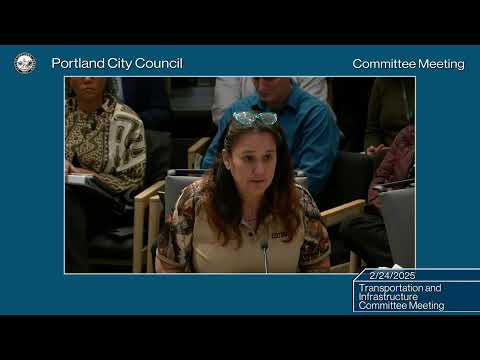
Southwest residents press committee on large sidewalk and bike network gaps
Summary
Community advocates from Southwest Portland told the Transportation & Infrastructure Committee that sidewalk coverage and bicycle network buildout lag the rest of the city, urged prioritized sidewalk infill and low-cost bike connections, and asked PBOT to take advantage of nearby projects to close gaps.
A coalition of Southwest Portland neighborhood advocates told the Transportation & Infrastructure Committee that sidewalk coverage and the bicycling network lag citywide standards and asked for accelerated, coordinated investments.
"If the city can pass off a white stripe as a sidewalk this close to a major employment center, then it can happen anywhere," Lisa Caballero of Southwest Transportation Advocates told the committee, describing piecemeal frontage improvements such as painted pedestrian stripes in place of continuous sidewalks.
Advocates emphasized three recurring problems: missing continuous sidewalks on major neighborhood streets, expensive stormwater constraints that raise costs for sidewalk construction in hilly Southwest neighborhoods, and gaps in the bicycle network that leave short but critical segments unprotected.
Why it matters: PBOT staff told the committee that the city inherited many gravel streets and sidewalk gaps when it annexed portions of Southwest over the decades; PBOT said the city now manages about 50 miles of gravel streets, roughly 20 miles of streets with no sidewalks on either side and about 52 miles with sidewalks on only one side. Don Bach, a retired civil engineer and founder of Southwest Trails, urged the city to finalize a feasible plan for the Bridal Electric Regional Bike Trail (a council-approved alignment) to be eligible for state and Metro funding.
Speakers urged the bureau to prioritize sidewalk filling on major corridors and to use opportunistic moments '1 for example, when a nearby capital project is under construction '1 to stripe and complete bicycle and pedestrian facilities. Testimony cited a Southwest bike-network completion figure of about 29 percent for a specific Southwest bicycle plan, and attendees said targeted, lower-cost interventions such as neighborhood bridal filters and striping could be implemented quickly.
A local example: Marita Inglesby, chair of the Hayhurst Neighborhood Association, described a 263-home development on former Alpine Rose Dairy property along Southwest Shattuck Road that will increase daily traffic and leave a half-mile gap to reach Beaverton-Hillsdale Highway, a corridor with frequent transit and retail access. She urged the city to require or fund an extension of safe walking and bicycling facilities to close that half-mile link.
What PBOT said: Director Millicent Williams and staff acknowledged the need and pointed to recently awarded Portland Clean Energy Fund money for nine sidewalk projects near schools (about $20.5 million), while reiterating limited flexible revenues for routine maintenance and infill. Advocates asked council to prioritize sidewalk infill and to look for low-cost ways to accelerate bike network completion.
Ending: The committee asked PBOT and staff to accept follow-up materials; advocates said they would submit maps and written testimony for committee review. No formal action was taken at the hearing.