Get Full Government Meeting Transcripts, Videos, & Alerts Forever!
Get email alerts on the Housing topic
No spam. Unsubscribe anytime.
Housing Authority of Travis County reports preservation and workforce-housing progress; tenant organizing concerns raised
Summary
Housing Authority CEO Patrick Howard updated the Commissioners Court on preservation projects, workforce-housing developments and resident services; a tenant-organizing complaint at one property prompted the authority to report an investigation and new resident engagement steps.
Patrick Howard, chief executive officer of the Housing Authority of Travis County, briefed the Travis County Commissioner's Court on Feb. 27 on the agency’s biennial update and 50th‑anniversary activities, outlining preservation work, recent and planned workforce‑housing projects, and resident‑experience initiatives.
Howard told the court the authority manages a mixed portfolio that includes 105 project‑based rental assistance units, two recently developed senior buildings in Manor (one 20‑unit development that just opened and an existing 33‑unit senior building), and 16 family units at Carson Creek Homes. The authority said it used roughly $1.8 million generated from multifamily development projects to underwrite a substantial rehabilitation of Carson Creek; the work is nearly complete but has been delayed by city permitting. Howard also highlighted the authority’s designation as a Moving to Work (MTW) agency — a federal designation that grants participating housing authorities certain regulatory flexibilities — noting the authority is one of about 100 MTW agencies nationwide and one of three in Texas.
Howard discussed the agency’s workforce‑housing efforts aimed at serving households at about 60% of area median income (AMI) and said the authority has used workforce projects to create deeper‑affordability units through gap financing. The presentation noted that, under 2024 figures cited in the briefing, 60% AMI for a single person was roughly $52,920; the authority also said 18 of 20 units at one recently completed senior site are set at 30% AMI.
Howard and staff acknowledged ongoing challenges recruiting landlords for the Housing Choice Voucher program, calling results “mixed” and pointing to a forthcoming HUD initiative that may raise screening requirements and affect landlord participation. The housing authority said it continues landlord outreach and offers incentives where feasible.
On resident services and transparency, Howard described partnerships with local groups — including Big Austin and the Capital Area Food Bank — to expand family‑self‑sufficiency programming, launch farmer’s markets at senior sites and host financial‑literacy and college‑prep events. Howard said the authority had won a HUD family self‑sufficiency coordinator grant and was increasing use of third‑party compliance reviews and technology to improve resident experience and regulatory readiness.
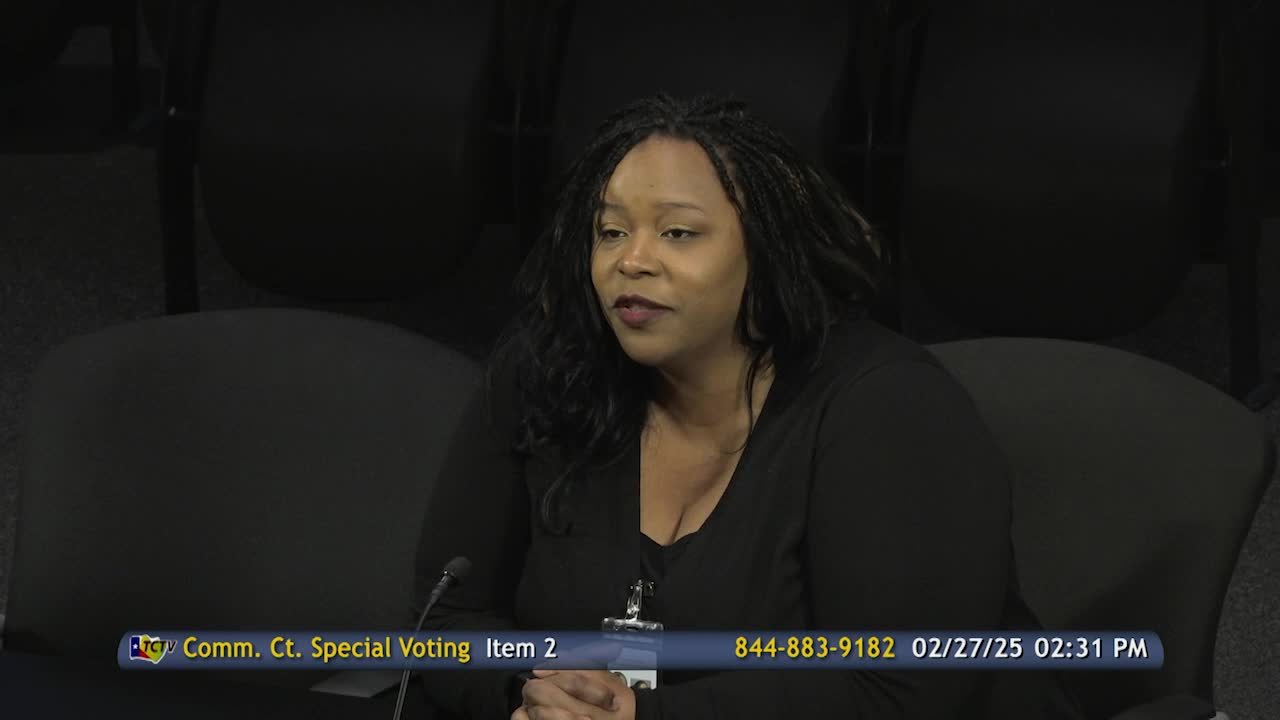
Public comment at the court included testimony from Shoshana Krieger, project director at BOSTA, who acknowledged improvements at some Housing Authority properties but said “there still, of course, remains significant work to be done,” and urged better protection for tenants who seek to organize. Krieger described an incident in which tenants at one property felt pressured to withdraw names from a tenant petition and said she had requested an investigation and training for on‑site management.
Howard told the court the authority had investigated the complaint. The authority identified the third‑party property manager as Carlton Living, said the staff member in question was moved off the property, and reported that a notice about tenants’ organizing rights (per federal regulations) was posted in public areas at the site. Howard also said the authority had reconstituted its resident advisory board with nine members (including voucher program and continuum‑of‑care representatives and residents of authority properties) and would meet regularly; the authority said a relocation firm helped temporarily relocate Carson Creek residents during the rehabilitation work.
Howard closed by previewing several workforce and tax‑credit projects that will come to the court for consideration in 2025 and by outlining a schedule of events marking the authority’s 50th year, including community and resident celebrations and a formal event in December.
Ending: The Commissioners Court did not take formal action on the presentation. Members asked follow‑up questions about landlord outreach, resident protections, and the Carson Creek rehabilitation timeline; the authority said it will return with project requests and additional updates as appropriate.