Get Full Government Meeting Transcripts, Videos, & Alerts Forever!
Get email alerts on the Budget And Finance topic
No spam. Unsubscribe anytime.
Commissioners approve FY2026 budget guidelines amid concerns about slower property-tax growth and federal funding uncertainty
Summary
Travis County planning staff presented FY2026 budget guidance showing constrained revenue growth tied to lower projected property-tax base increases and federal/state uncertainty; the court unanimously approved the guidelines and set calendar dates for submissions and hearings.
Travis County Commissioners on Feb. 25 received the Planning and Budget Office's (PBO) FY2026 budget guidelines and unanimously approved them, while discussing slower projected property-tax growth, the voter-approval tax-rate cap and broader federal funding uncertainty.
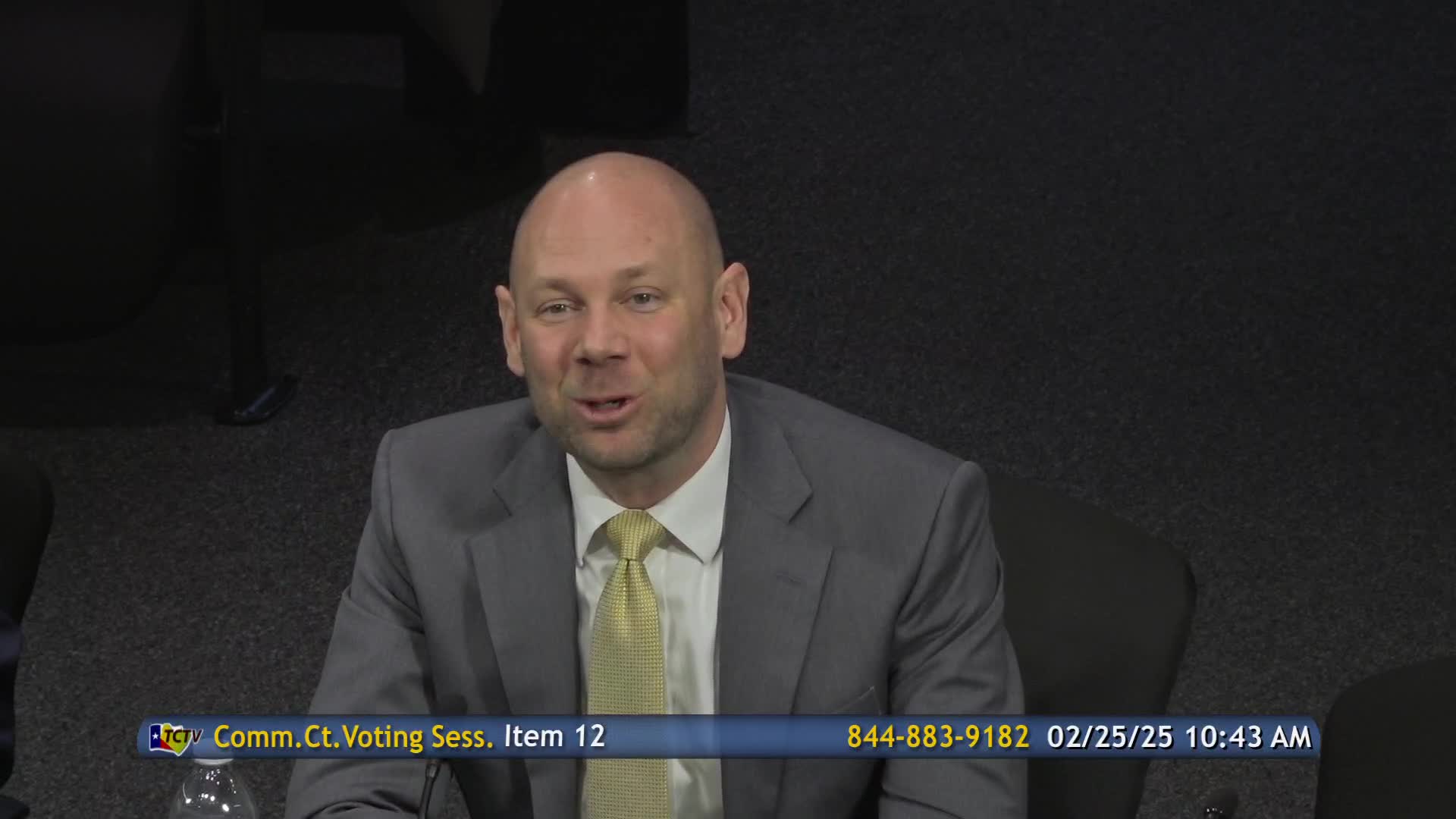
Jessica Rio, county executive for Planning and Budget, presented guidance with input from budget director Travis Gatlin, assistant director Alex Braden and capital analyst Michelle Circa. The PBO asked departments to prepare budgets that prioritize contractual obligations and core services, to submit budget requests by April 23, and said the preliminary budget would be published in July with the adopted budget expected by Sept. 30.
Key takeaways from the presentation:
- Forecast and tax base: PBO said the county's taxable value grew to about $325 billion for tax year 2025 after strong multi-year growth but that early appraisal-district estimates point to a likely near-term decrease (PBO modeled a 6% decline for planning) followed by more normal growth in later years; the office highlighted that the large new-construction value of $9.9 billion in 2025 is not expected to repeat in the near term and that lower new-construction values would reduce new revenue available for county priorities.
- Revenue rule and SB2 context: The office said the preliminary budget will assume the voter-approval rate (3.5% above the no-new-revenue maintenance and operations rate) as the working assumption, but noted that legislative action at the state or federal level could change local options and materially affect available resources.
- Cost drivers: PBO identified approximately $40.1 million in primary budget drivers for FY2026 (compensation and benefits, retirement contributions, IT/capital transitions such as SAP cloud migration, justice system and pretrial costs, and contractual increases for interlocal agreements). PBO noted modest projected health‑insurance cost increases (under 4% per actuary estimates) and set aside resources for anticipated retirement contributions pending actuarial notices.
- Program and process guidance: Departments were advised to prioritize contractual and mandated services, review vacancies older than 120 days, prepare three- to five-year budget plans for key requests, and limit new ongoing program requests given likely constrained resources. PBO reaffirmed the county's full-cost-recovery review for interlocal agreements and recommended continuing the established 15% cap on year-over-year increases where full-cost catch-up is in progress.
Commissioners acknowledged uncertainty from federal actions and state legislative proposals; several members asked PBO to coordinate with urban-county budget offices and share what other jurisdictions are seeing. Commissioner comments emphasized (1) the importance of reserves and targeted flexibility in an uncertain environment, (2) the need to protect investments in basic services for vulnerable residents if federal cuts materialize, and (3) continuing transparency on overtime and vacancy management (the court asked for an update on the overtime incentive cost and vacancy progress for corrections).
The court recorded a unanimous vote to approve the budget guidelines (motion by Commissioner Shea; second by Commissioner Gomez). PBO will return with a June update and publish a more detailed calendar at that time; the office also scheduled a staff-only budget workshop for March 7 and an employee public hearing for June 3.
Why this matters: The guidelines frame department requests, prioritize limited new funding for FY2026 and set the schedule for decisions that shape county services next fiscal year. The PBO emphasized that under slower property-tax growth and continuing external fiscal uncertainty the county will have to be choosy about new ongoing commitments.
Ending: PBO said it will bring another update in June and provide targeted briefings (for example on correctional staffing/overtime) before mid‑year decisions; staff also offered to brief the court earlier if circumstances change.