Get Full Government Meeting Transcripts, Videos, & Alerts Forever!
Get email alerts on the Portland Carbon Emissions topic
No spam. Unsubscribe anytime.
City staff tell committee Portland’s emissions down since 1990 but current trajectory won’t meet 2030 goal without major changes
Summary
City staff presented the 2022 emissions inventory showing Portland/Multnomah County 21% below 1990 levels but warned a 2% rise from 2021 and the limits of local authority mean the city is unlikely to meet its 2030 target without large-scale utility and economy‑wide action.
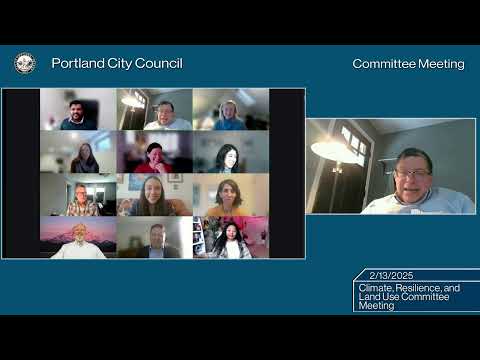
City sustainability and transportation staff told the Climate Resilience and Land Use Committee Thursday that Portland and Multnomah County have reduced greenhouse gas emissions since 1990, but current trends and dependencies on the electric grid mean the city is not on track to meet its 2030 benchmark without significant broader action.
“Top line, we’ve accomplished much already,” said Vivian Satterfield, the city’s chief sustainability officer. “But we are not on track to meet our current climate goals.” Satterfield and climate staff presented the city’s most recent sector‑based inventory (the city uses Multnomah County as the inventory boundary) and explained the major sources and policy levers the council can use.
City staff said the 2022 inventory — the most recent year available because inventories run two years behind — shows emissions are 21% below the 1990 baseline, but that 2022 represented a 2% increase over 2021. The inventory attributes emissions by sector: transportation (41%), buildings (residential and commercial combined, 39%), industry (13%) and landfill waste (2%). Electricity, gasoline, natural gas and diesel are the largest source categories.
Andrea Jacob, manager of the Bureau of Planning and Sustainability’s climate policy team, summarized the scale of the task: “Without significant economy‑wide action beyond what the city of Portland can do, it’s unlikely that we can hit our 2030 target at this point.” Jacob noted that national economic patterns and local weather variability affect year‑to‑year totals.
Kyle Deesner, a climate policy analyst, said the 2021–22 uptick was driven largely by weather — a cold winter and hot summer drove higher building energy use — while high fuel prices in 2020 had temporarily reduced transportation emissions. The staff reiterated inventories use a sector‑based approach and that Portland also maintains a consumption‑based inventory that captures emissions embodied in goods and services consumed in the county; consumption‑based accounting shows higher total emissions and that production-phase emissions represent roughly 62% of that total.
Staff outlined the pathways modeling tool they use to test scenarios for reaching city benchmarks and explained that there are no single silver bullets: decarbonizing the electric grid, rapidly electrifying transportation and buildings, reducing vehicle miles traveled, and adopting fuel‑standards for diesel are all necessary and interdependent.
On the electric grid, staff warned that achieving the city’s targets depends heavily on utilities meeting state and local clean energy commitments. “Our ability to meet our carbon targets rests on the ability of the utilities to get to theirs,” Jacob said, noting utilities have signaled difficulty meeting intermediate targets in state legislation (referred to in presentation as House Bill 2021).
Kristen Hall, planning and project delivery group manager at the Portland Bureau of Transportation, said transportation decarbonization requires both reducing miles driven per capita (studies show a 20–30% per‑capita reduction is necessary) and rapidly transitioning remaining miles to low‑ or zero‑carbon fuels. Hall called for rethinking funding models that currently rely on fuel taxes and parking revenue, both of which decline as electrification and mode shift succeed.
On buildings, staff described ongoing work on carbon and temperature standards for existing large multifamily and commercial buildings, retrofit finance, and the importance of not locking in new gas infrastructure in new construction. Staff noted programs such as the Portland Clean Energy Fund are a local tool but said funding gaps remain for many retrofit and transition efforts.
On industry and city operations, staff described a recently secured package of federal and other funding to finance technical assessments and pilots; Satterfield said the city is launching a $20,000,000 clean‑energy fund focused on industry decarbonization while noting that some technologies for industrial decarbonization do not yet exist at scale.
Committee members asked for follow‑up materials and data: councilors requested up‑to‑date TriMet and bike ridership numbers, more detail on the proposed renewable fuel standard and utility timelines, analysis of permitting barriers for residential solar and the status of transit priority projects such as the Rose Lanes and a proposed BRT (FX) treatment on 82nd Avenue. Staff committed to follow up in writing and future briefings.
The presentation and discussion underscored staff’s central message: Portland has made progress but will need coordinated state and utility action, substantial financing and multiple concurrent policies — from grid decarbonization to VMT reduction and building retrofits — to meet the 2030 and 2050 targets.