Get Full Government Meeting Transcripts, Videos, & Alerts Forever!
Get email alerts on the Committee Priorities topic
No spam. Unsubscribe anytime.
Portland climate committee launches with emphasis on emissions, equity and multiagency coordination
Summary
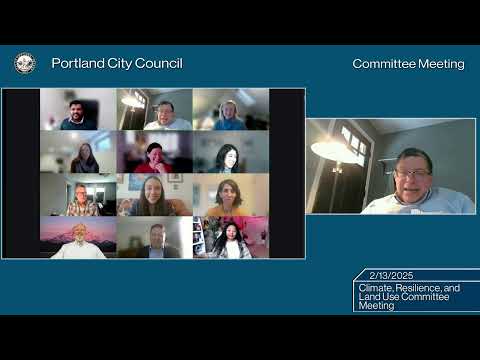
The new Climate Resilience and Land Use Committee met Feb. 13 to outline priorities including emissions reduction, environmental justice, land-use policies tied to housing, coordination on the critical energy infrastructure hub and expanded community engagement.
The Climate Resilience and Land Use Committee opened its first meeting Thursday, Feb. 13, with co-chairs and council members laying out priorities that center greenhouse gas reductions, climate resilience and equity across land-use and transportation decisions.
The committee’s initial work plan will emphasize advancing climate action and emissions reduction, preventing concentrations of pollution in overburdened neighborhoods, aligning land-use policy with housing needs, and strengthening coordination with utilities, the state and regional transit agencies, committee members said.
“Although what we do in Portland is only a small piece of what the world needs to do, if we do not do our part in trying to reduce our greenhouse gas emissions, then in my view, we will be complicit,” Councilor Novick said in opening remarks. He framed the committee’s agenda around emissions reduction, climate resilience and disaster preparedness, and specifically mentioned the need to coordinate on an earthquake response and the critical energy infrastructure (CEI) hub.
Co-chair Councilor Murillo said the committee should elevate voices that have not been heard historically: “There are local tribes. There are people who have stewarded the land for a long time who can show us the way,” she said, and she emphasized applying an anti‑racist lens to committee work so communities historically excluded from decision‑making are centered.
Several council members urged partnership across jurisdictions and sectors. Councilor Ryan Avalos highlighted the role of neighborhood volunteers in disaster response and urged focusing on implementation of existing climate plans rather than producing additional new plans. Another council member noted the need to align federal, state, county and city efforts for large infrastructure projects such as the CEI hub and stressed the importance of measurable community metrics or a “dashboard” to track progress.
Committee members identified multiple cross‑cutting areas for future work: transportation shifts that reduce vehicle miles traveled; electrification and grid readiness; building decarbonization and retrofit strategies; parks funding and its interaction with the General Fund; and clean industry pilots tied to workforce and community benefits. Councilors also asked for stronger attention to youth engagement and to historically excluded neighborhoods, with several speakers noting East Portland will face disproportionate early impacts from climate change.
The committee will meet every other Thursday from 9:30 a.m. to 11:30 a.m. on weeks the council does not meet, with the co‑chairs and staff planning to flesh out a formal work plan and bring subject matter presentations and community input to future meetings.