Get Full Government Meeting Transcripts, Videos, & Alerts Forever!
Get email alerts on the Education Budget topic
No spam. Unsubscribe anytime.
Wicomico County Public Schools proposes roughly $279 million FY26 operating budget as enrollment rises
Summary
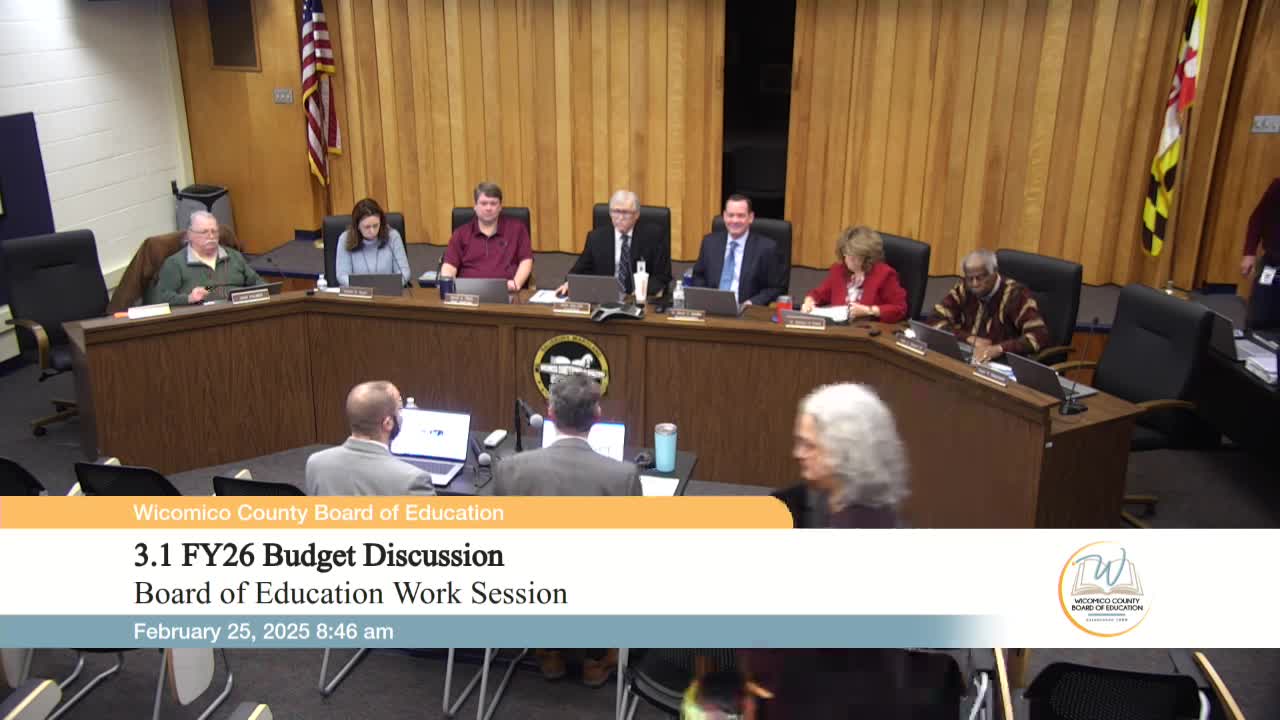
Superintendent Dr. Rager presented a proposed FY26 operating budget built around $279 million in revenue, citing a 496-student enrollment increase, rising health-insurance costs and a state teacher pay mandate; the board will consider adoption March 11 and must submit to the county executive by March 15.
Wicomico County Public Schools Superintendent Dr. Rager told the Board of Education on Feb. 26 that the district’s proposed fiscal year 2026 operating budget is based on a projected $279,018,122 in revenue and would request additional county support to cover inflation and restore lost funding.
The proposal centers on rising enrollment and operating costs. "The budget presented today is based on a proposed revenue of $279,018,122," Dr. Rager said, adding the proposal includes a request to county government for maintenance of effort plus CPI and an additional 2 percent investment to restore funding lost over the past decade and a half.
The budget team said the request to county government is approximately $55,000,008 and that the FY26 proposal represents an 8.64 percent increase in total projected revenue over last year. Board materials show a close variant of the projected total as $279,018,001.22.
Why it matters: the district faces near-term cost pressures — mandated teacher starting pay, insurance and replacement of technology bought with federal pandemic funds — and uncertain state funding tied to pending legislation. Dr. Rager told the board the superintendent’s priorities that shaped the budget are school climate and safety, student achievement and engagement, a high-performing workforce, and parent and community involvement.
Key details - Enrollment and state aid: the presentation said the district’s September 2024 head count increased by 496 students; the slide in the packet lists the September 30, 2024 enrollment figure as 15,082 (as shown in the presentation), which the presenters said increases the district’s state foundation program and other formula-driven revenues but creates near-term operating pressure because some state funds arrive on a July 1 fiscal cycle. "We have those students in our school every day since that time when we don't receive that increase in state funding for those students until July 1," Dr. Rager said. - Federal pandemic funds: presenters said WCPS received $73 million in ESSER/CARES funding since 2020 and spent much of that on capital items (including thousands of computers), which are now nearing end-of-life and driving technology replacement needs included in the FY26 request. - Cost drivers: the budget notes an estimated $4 million increase in health insurance and other inflationary increases in electricity, software maintenance (including visitor/emergency management systems), transportation contractor costs and operations and maintenance. A $1.8 million lease-purchase for technology replacement and $747,093 for textbook and instructional material renewals were highlighted. - Staffing requests and unfunded positions: the budget proposes new positions to meet a growing multilingual population (coordinators, multilingual teachers, instructional assistants and staff for a newcomer center), additional elementary teachers for class-size reduction, five certified nurse assistants, counselors and two special education teachers. The presenters said roughly 44.5 full-time positions requested in line-item submissions remained unfunded in the proposal; those included additional reading-intervention staff, arts teachers, and some office and IT positions. - County funding and comparisons: presenters said the district is asking the county for a maintenance-of-effort allocation that includes a 3 percent CPI adjustment and a 2 percent investment. Slides shown to the board indicated Wicomico ranks last in per-pupil county funding among Maryland local education agencies on a county-only per-pupil basis. - State funding uncertainty: the budget uses current assumptions that reflect pending legislation identified in materials as House Bill 504 and Senate Bill 429 (the presenters called the package the Maryland "Excellence in Maryland Public Schools Act"). The presenters warned that changes in those bills could alter the state portion of the FY26 budget.
Process and next steps Dr. Rager and comptroller Jesse Reid said the board will continue deliberations: the work session presentation will be followed by a board adoption vote planned for March 11, the board must submit the adopted budget to the county executive by March 15, and the Maryland General Assembly is due to pass its budget by March 31. The board’s final approval after county action is expected at the June 10 meeting and may include adjustments based on county and state actions.
Questions and context Board members asked for more detail on per-pupil dollar comparisons among Lower Shore counties and on whether enrollment-count timing (September 30 census) can be changed; presenters said they had not seen proposals to change the state formula deadline and that the district would pursue advocacy through the Maryland association of school superintendents. Comptroller Jesse Reid described the district’s use of the Maryland Local Government Investment Pool (MLGIP) for operating funds and said the accounting manager actively manages those funds to earn interest while keeping operating payments available.
The board did not take a formal vote during the Feb. 26 work session; presenters asked the board for questions and said they would return with any adjustments as county and state information becomes clearer.
Ending Superintendent Dr. Rager told the board the budget process is intentionally conservative: "We don't feel it'd be prudent to budget on funds that we may not be getting," he said. The board will consider adoption March 11 and submit a version to the county executive by March 15 as required by local procedures.