Get Full Government Meeting Transcripts, Videos, & Alerts Forever!
Get email alerts on the Governance Procedures topic
No spam. Unsubscribe anytime.
Portland governance committee debates new procedures for appointments, committee referrals and public testimony
Summary
Portland’s Governance Committee opened a first-round discussion of draft rules on how nominees, ordinances and reports should move between committees and full council and how public testimony should be handled, asking staff and legal to refine language and bring formal proposals back.
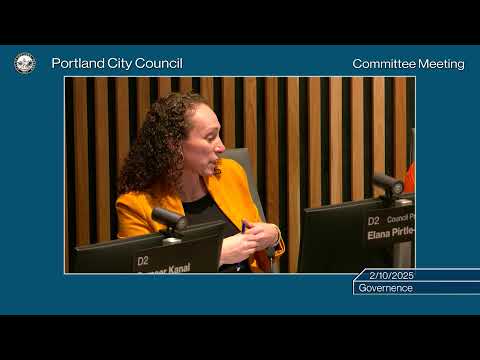
Portland’s Governance Committee spent its Feb. 10 meeting discussing draft resolutions that would set internal procedures for how nominations, ordinances and reports move between committees and full City Council, and how the city will handle public testimony on items that have already been considered in committee.
Committee leaders said the goal is to balance transparency and efficiency as Portland transitions to a district form of government and a new council structure. The discussion covered a proposed internal process for posting nominees for boards and commissions, whether nominees should be asked to appear before the Governance Committee, how and when policy committees should be looped in, and limits or approaches for public testimony at full council after an item has been heard in committee.
Council President Pertel Guinee and Chair Koyama Lane explained a draft resolution to require administration-submitted appointee materials to be provided to council leadership and the Governance Committee at least one week before the posting deadline for committee agendas, giving council time to review nominees. The draft would send nominees to the Governance Committee for review before a recommendation to full council; the committee could ask nominees to appear in person or virtually.
Councilors asked for changes and clarification. Councilor Clark asked whether the one-week posting would apply to subject (policy) committees and whether policy chairs would be notified; President Pertel Guinee and other members said policy chairs should be notified and the Governance Committee chair and vice chair could coordinate notifications. Councilor Dunphy urged a cultural norm that nominees appear before the committee, though not a strict requirement, and suggested offering virtual attendance and flexible scheduling to respect volunteers’ time. Councilor Ryan and others recommended a consent-agenda approach for routine appointment reports, with an explicit pull mechanism to allow fuller review where needed.
Assistant City Administrator Betty Lundberg told the committee there are nearly 80 community-based bodies that could be affected by any new appointment process, and staff warned about the workload implications of adding mandatory hearings for every nominee. Members discussed using a single report to forward multiple nominees to consent, with the Governance Committee able to remove names for separate consideration.
On procedural issues for ordinances and resolutions, the committee discussed a draft that would generally send code-changing ordinances to the appropriate policy committee for deliberation before reaching full council, while allowing exceptions when the council president, committee chairs and the introducing councilor agree an item should go straight to full council. Members raised a legal question about current city code language that states committees are advisory and may only make recommendations on matters "referred to them by the council," which could require a referral step. Several councilors asked city attorneys to analyze whether the council president and vice president could refer items to committee on behalf of the council to avoid circular referral delays.
On public testimony, committee members agreed committees should be the primary venue for public input and that the full council should not routinely hear duplicate testimony. Ideas included: (1) prioritizing speakers who did not testify in committee, (2) allowing a limited number of representative speakers at full council, and (3) providing a consolidated staff report or a compiled summary of committee testimony and written comments to full councilors so they can review the full record without requiring members of the public to testify twice. Members also discussed possible limits on councilors’ time during full-council deliberations to keep meetings efficient.
The committee did not adopt formal rules at the Feb. 10 meeting; members asked staff and the city attorney’s office to refine the drafts and return with revised language. Councilors said they would like clearer rubrics for appointments that account for skills, lived experience and geographic representation under the district-based council, and flagged a need to "scrub" and consolidate the inventory of boards and commissions over time.
The chair scheduled follow-up work and asked staff to bring a more formal resolution to a future Governance Committee meeting and to consult with legal staff before that formal submission. The committee will revisit the topics at its next meeting on Feb. 24.