Get Full Government Meeting Transcripts, Videos, & Alerts Forever!
Get email alerts on the Paid Family Medical Leave topic
No spam. Unsubscribe anytime.
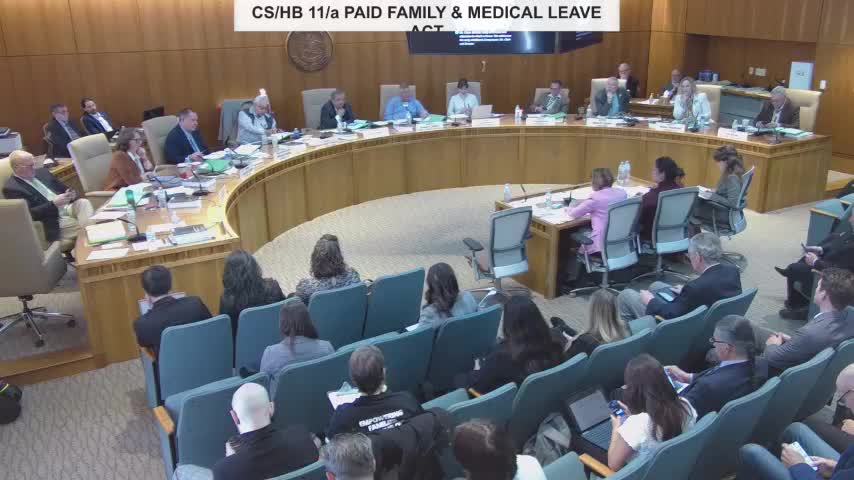
Senate committee rejects House Bill 11 after hours of testimony on paid family medical leave
Summary
A Senate committee voted against advancing House Bill 11 on a 3–8 roll call after more than two hours of testimony from employers, labor and advocacy groups.
A Senate committee voted against advancing House Bill 11 on a 3–8 roll call after more than two hours of testimony from employers, labor and advocacy groups. The bill would have created a state-managed paid family medical leave program with a separate “welcome child” stipend for new parents and a family-wellness short-term disability component.
Supporters told the committee the measure was scaled back from earlier versions to respond to employer concerns: bonding leave was reduced from 12 weeks to 6 weeks, and lawmakers pared benefit design and added a state-funded stipend for new parents. Representative Chandler, the bill sponsor, said the bill aims to support family bonding, fill gaps where employees lack short-term disability coverage and include protections for safe leave and military exigency.
The bill’s backers included nonprofit home-visiting providers, labor unions, veterans’ groups and county officials. Jessa Cowdery, vice president of operations at CommonSpirit St. Joseph’s Children, described the stipend as “a tremendous financial burden lifted off my shoulders” for families in home-visiting programs. John Lipschutz, representing the New Mexico Federation of Labor, said the federation stands in support because “all workers deserve the right to have paid leave.” Other supporters urged restoring longer leave and stronger stability for the fund.
Opponents — including associations for developmental disability providers, chambers of commerce, agricultural groups and a large coalition of business organizations — argued the bill imposes an unfunded employer mandate, risks insolvency of the proposed fund, and would increase costs for small and rural employers who lack temporary staffing options. Jim Copeland of the Association of Developmental Disabilities Community Providers warned the employer contribution “becomes a double unfunded mandate” for DD waiver providers and said implementation could “further limit the availability of DD services in New Mexico.”
Committee members questioned multiple implementation details raised during testimony and follow-up by sponsors and staff: how employers would apply to opt out if they already offer comparable plans, documentation required to demonstrate “substantially similar” private benefits, how the welcome-child stipend would interact with federal means-tested benefits, the fund’s long-term solvency, and whether the Early Childhood Trust Fund could be used to support the stipend. Amanda Bridal (chief of staff, as identified in the hearing) and other sponsors referenced a State Investment Council (SIC) analysis and Legislative Finance Committee (LFC) projections that, in their view, showed using a portion of the early childhood fund would not halt its growth, though senators asked for more detail and noted the department charged with early childhood had not yet submitted a formal analysis.
Other specific points raised in the hearing: - Benefit design and funding: The sponsor said prior versions provided 12 weeks of parental bonding with wage replacement (full wages for minimum-wage workers, two-thirds of wages above minimum up to a statutory cap); the current proposal reduced bonding leave to 6 weeks and separated a “family wellness” short-term disability/insurance component. - Welcome child stipend: The bill includes a $3,000 monthly stipend (described in the hearing as up to $9,000 total) for eligible working parents; sponsors said the stipend would not begin to be drawn until 2028 and would require future appropriations. Questions remained about whether nonworking caregivers would be eligible (sponsors said the stipend targets working parents who pay into the program). - Employer opt-out and implementation: Employers that already offer substantially similar plans could apply to the Department of Workforce Solutions for an exemption under rules to be promulgated; sponsors said documentation from the insurance carrier or plan summary would likely be part of that process but could not give a precise checklist. - Eligibility: Sponsors said an "eligible employee" must have worked six months in the prior 12-month period to qualify for benefits. - Startup and administration: Sponsors said the House included $35 million for startup costs in its budget; sponsors and staff said welcome-child stipend appropriations would be considered in future budget cycles and that Workforce Solutions would administer claims and investigations, similar to unemployment insurance processes. - Tax reporting / ARPA question: Senators raised that certain federal reporting rules (ARPA-era guidance) could mean program payments generate IRS reporting forms (1099s) and possible tax burdens for recipients; sponsors acknowledged the question and said it required follow-up.
After questions from senators and extended public comment, a motion to give the bill a “do pass” recommendation failed; the roll call recorded eight votes in the negative and three in favor, and the committee registered a do-not-pass recommendation on House Bill 11. Sponsors said they remain open to further negotiation and to working with stakeholders to refine eligibility, solvency assumptions and administrative rules.
The committee recorded substantive concerns from rural employers about workforce availability and from disability service providers about reimbursement rates and federal program interactions; supporters emphasized early childhood bonding and long-term child-development benefits as justifications for the proposal.
Votes in committee: The motion to recommend a do-pass failed, producing a committee recommendation of do not pass (8 no, 3 yes). The roll-call names recorded in the transcript include yes votes from Senators Padilla, Steinborn and Trujillo and no votes from Senators Brandt, Campos, Gonzales, Lanier, Tobiasin, Woods, Shando and Munoz (as stated on the record). The transcript lists the motion seconded by Senator Trujillo; the mover was not specified on the record.
What’s next: Sponsors said they will continue discussions with stakeholders on design, solvency and administration. The committee’s do-not-pass recommendation means the bill will not advance from this committee in its present form unless reintroduced or otherwise revived by later action.