Get Full Government Meeting Transcripts, Videos, & Alerts Forever!
Get email alerts on the Healthcare Hospital Mergers topic
No spam. Unsubscribe anytime.
Committee accepts substitute for hospital-transaction oversight bill after debate over scope and authority
Summary
House Health Committee members voted to register a “do not pass” recommendation on the original House Bill 586 but approved a judiciary committee substitute that would create a permanent review process for hospital mergers, acquisitions and certain related transactions.
House Health Committee members voted to register a “do not pass” recommendation on the original House Bill 586 but approved a judiciary committee substitute that would create a permanent review process for hospital mergers, acquisitions and certain related transactions.
Leader Peter Sapanski, the bill sponsor, told the committee HB 586 follows last year’s temporary Senate Bill 15 and “is that piece of legislation.” He said the substitute adds whistleblower protections, a public comment period and enforcement authority and relocates oversight from the Office of the Superintendent of Insurance to the Health Care Authority.
The measure, as described by Sapanski, would require entities to file notices of transactions that change ownership or control of a hospital or in cases where a hospital or provider becomes affiliated with a health insurer. Sapanski said the bill is intended to be a long-term framework to protect access to care.
Gina de Blasio, identified in the hearing as secretary of the Department of Health, said the legislation “is really important. It’s really about protecting access to care, in New Mexico and particularly for rural communities in New Mexico.” Several hospital system representatives and advocates testified that they supported the substitute’s balance of oversight and predictability. Troy Clark, president and CEO of the New Mexico Hospital Association, and Larry Horan, a registered lobbyist for Presbyterian Healthcare Services, both described the bill as a negotiated compromise.
Community and patient-rights groups also supported the substitute. Rae Charest of Bold Futures said the added public-comment and community‑forum requirements respond to earlier consolidations where residents reported not being notified. Lena Weber, policy director at the ACLU of New Mexico, said the community‑engagement mechanism is “crucial.” Erica Sanchez of the New Mexico Center on Law and Poverty said the plan “balances public notice and engagement with oversight and the confidentiality of the hospitals.”
Representatives pressed sponsors on definitional scope. Representative Martinez asked whether the proposal would capture routine equipment purchases; Sapanski said the notification requirement is meant to apply only to transactions that transfer “all or substantially all of the assets, equity, or operations” and not ordinary purchases. Members asked whether independent clinics, dental services organizations or nonprofit clinic networks would be covered; sponsors repeatedly said the bill targets hospitals and only reaches independent providers when they are acquired by an organization affiliated with an insurer (for example, Optum/UnitedHealthcare), not ordinary independent practices.
Committee members also asked how the Health Care Authority would review staffing, wages and mortgages. Sapanski said the authority could review whether a proposed transaction would materially reduce access, quality, or workforce protections and that mortgage or lease reporting is intended to detect asset-stripping scenarios seen in other states. The draft also includes an administrative-enforcement section that allows fines for willful failures to notify.
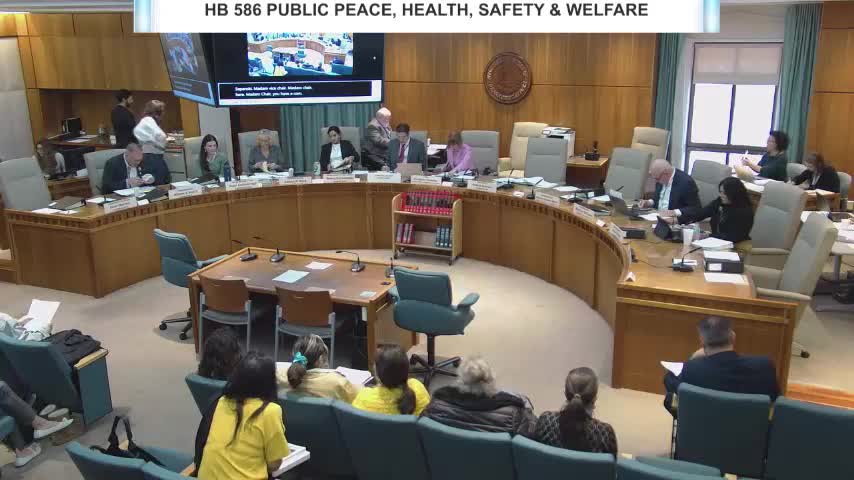
After extended questioning and public testimony, Representative Romero moved the procedural package recorded by the committee: a do not pass on the original House Bill 586 and a do pass on the House Judiciary Committee substitute for HB 586; Representative McQueen seconded. The committee reported the substitute favorably and recorded a do-not-pass on the original bill.
The substitute was advanced out of committee; the record shows members explained votes on the floor when asked during the roll call.
The substitute will proceed according to the House calendar; committee members noted it is intended to create permanent, statewide oversight on hospital transactions while preserving the ability of hospitals to operate day‑to‑day services.
Votes at the committee session were recorded as a do not pass on the original House Bill 586 and a do pass on the House Judiciary Committee substitute for House Bill 586.