Get Full Government Meeting Transcripts, Videos, & Alerts Forever!
Get email alerts on the Tax Increment District topic
No spam. Unsubscribe anytime.
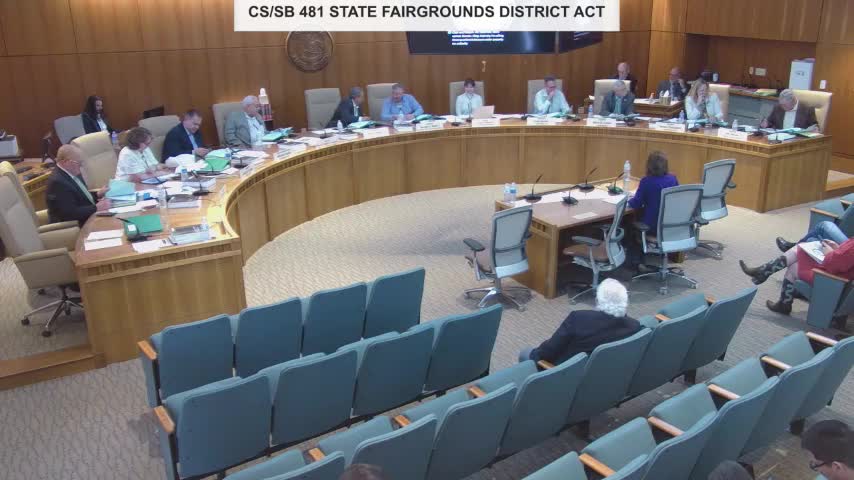
Senate committee hears plan for state-level TID to redevelop Albuquerque State Fairgrounds
Summary
Lawmakers discussed Senate Bill 481, which would create a Tax Increment Development District (TID) over the New Mexico State Fairgrounds to capture gross-receipts and gaming taxes for redevelopment; committee adopted a technical amendment and members pressed sponsors on board composition, revenue assumptions and land acquisition.
Senate committee members heard detailed testimony about Senate Bill 481, a proposal to create a state-level Tax Increment Development District (TID) covering the New Mexico State Fairgrounds in Albuquerque and nearby contiguous property to fund redevelopment of the roughly 236‑acre site.
The bill sponsor described the proposal as "an opportunity for the state to undertake a Marshall Plan to reinvigorate" neighborhoods around the state fairgrounds and said the area is "now the state epicenter for violent crime, drugs, prostitution, cartel activity, human trafficking, pedestrian fatalities." The sponsor said a master plan procurement is already under way and that the TID would provide a financial vehicle to implement the plan.
Why it matters: supporters told the committee the district would direct local revenue back into the immediate area to finance infrastructure, housing and commercial development, and potentially reverse long‑term decline around the fairgrounds. Critics on the panel pressed for clearer limits on the board that would govern the district, asked for details about what revenues the district would actually capture and whether creating the TID would shift tax revenue away from local governments that provide services.
Details presented and disputed
- Scope and governance: The bill would create a Fairgrounds district over state‑owned fairgrounds property and any contiguous land added later. The district would be governed by a board made up of elected officials (or their designees) and one community member, per the sponsor's description. The sponsor noted the district "would not have the power of eminent domain" and that ownership of the land would remain with the state.
- Revenue and bonding: The sponsor said "75% of the gross receipts generated within the District would stay within the District to finance infrastructure," and that gaming revenues from the racino would be included even though gaming receipts are currently excluded under existing TID law. Bonding capacity in the bill was described as "up to a half a billion dollars" and any bonds would require approval by the New Mexico Board of Finance and the New Mexico Finance Authority; legislative approval would be required for any new taxes created by the district.
- Current revenue amounts cited: testimony put gaming receipts at roughly $11–12 million annually, with 75% available to the district (about $8 million per year as presented). Witnesses said current gross receipts tax generated on fairgrounds activity is small—"several hundred thousand to a million dollars a year"—but argued construction and future commercial activity would generate additional taxable gross receipts during and after redevelopment.
- Property and leases: Committee members asked about existing leases. Testimony noted the casino has a 25‑year lease and the racetrack is not completely tied in to the same arrangement; sponsors said those uses would remain while redevelopment is planned. Committee members also asked about a corner parcel that appears to be privately owned; testimony identified that parcel as privately held (the speaker said it is currently "owned by Microsoft") and said the bill contemplates acquiring that parcel (the fiscal materials cited a $7,000,000 cap‑outlay line to purchase it).
Questions and concerns from senators
Committee members raised several recurring concerns: whether a development partner is already lined up (sponsors said no), whether local governments would lose revenue for services they provide if revenues are captured by the state TID (the fiscal report and sponsors stated the bill does not include local government participation), and whether the board could end up dominated by private interests because of designees and appointments. Sen. Steinberg explicitly called board composition "pretty important" and urged tightening the governance language. Another senator noted the FIR (fiscal information report) shows local government participation is not required by the bill.
Amendment adopted
The committee adopted an amendment clarifying the bill's membership language so that state legislators named to the board could serve "or their designee." The motion to adopt the amendment was moved from the floor; committee members raised no objection and the amendment was adopted for discussion purposes.
Next steps and uncertainties
Sponsors emphasized the master plan RFP already issued by the General Services Department and described the TID as contingent on the outcomes of that planning work. Several senators said success would depend on the master plan findings and on future approvals by the Board of Finance, Finance Authority and the Legislature. No final committee vote on the underlying bill is recorded in the provided transcript.
Ending
Committee debate focused on governance, revenue assumptions and land acquisition details while supporters framed SB 481 as a tool to finance a large‑scale redevelopment of the State Fairgrounds. Committee members asked for clearer fiscal and governance details before advancing the measure further.