Get Full Government Meeting Transcripts, Videos, & Alerts Forever!
Get email alerts on the Land Grants Acequias Infrastructure topic
No spam. Unsubscribe anytime.
Senate panel backs bill to create land grant and acequia infrastructure funds; amendment adds colonias parity
Summary
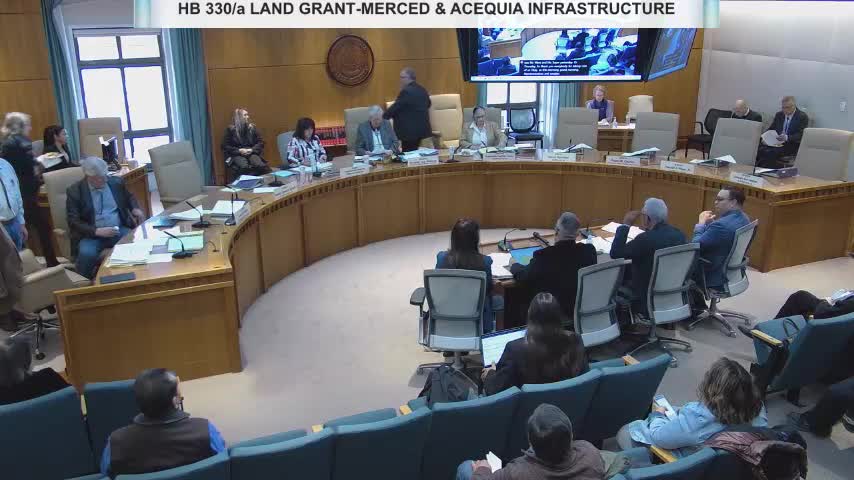
Lawmakers advanced House Bill 330 to create dedicated severance-tax bond allocations for land grant and acequia infrastructure and to increase parity between tribal and colonias infrastructure funds. Committee adopted an amendment and gave the bill a due-pass recommendation to finance.
House Bill 330 would create new, recurring infrastructure funding streams for New Mexico land grant communities and acequias and add a land-grant infrastructure allocation to the state bonding formula.
The measure directs the State Board of Finance to include the new allocations when it estimates the annual bonding capacity for severance-tax bonds and would set aside roughly 1.1% of estimated bonding capacity for a land grant infrastructure fund and 1.1% for an acequia infrastructure fund, each currently described in committee testimony as generating about $19 million under present bonding estimates. "The purpose of this bill is to have a reliable recurring funding source for Asequia and land grant infrastructure," said Paula Garcia, executive director of the New Mexico Acequia Association.
A committee amendment that adds the colonias infrastructure fund to the parity arrangement with the tribal infrastructure fund was adopted. The amendment reduced the initially proposed 2% transfer to a split that raises the colonias and tribal funds to 5.5% each (from 4.5%), while keeping the new acequia and land-grant allocations at 1.1% each. "What this amendment does is ... bring the colonias in," said a sponsor during debate; committee leadership later reported the amendment passed by recorded tally. After debate and public testimony from acequia and land-grant representatives, the committee voted to give the bill a due pass to the finance committee.
Advocates told the committee the new funds would address long-standing capital needs in rural communities. "Acequias support the agricultural economy and livelihoods of thousands of families," Garcia testified, adding that acequia unmet needs compiled by her organization exceeded $70 million in recent years. Arturo Archuleta of the New Mexico Land Grant Council outlined project types that the land-grant fund would support, including community centers, affordable housing infrastructure, water and wastewater systems, dam repairs and road and equipment purchases. "The type of projects that land grant communities engage in ... include community multipurpose center construction and improvements, affordable housing and infrastructure for those affordable housing developments," Archuleta said.
Public commenters and local officials urged passage. Harold Trujillo, president of the New Mexico Acequia Association, described long timelines for capital outlay projects under current practice and asked the committee to back a steady, recurring program that would let communities complete engineering and construction more reliably. Representatives of the Pojoaque Pueblo and other tribal governments also voiced support for expanding tribal infrastructure funding.
Committee members pressed witnesses on administration and oversight. Committee members were told the Interstate Stream Commission’s acequia bureau already administers a separate acequia fund and that the Land Grant Council provides bookkeeping and technical support to many land grants. Witnesses said entities receiving funds would be subject to the Audit Act, the Inspection of Public Records Act and the Open Meetings Act. The committee also discussed staffing needs in DFA, the State Engineer’s Office and other agencies to implement and administer the new funds.
By committee action the amendment was adopted and the bill sent with a due-pass recommendation to Senate Finance. The committee summary and roll-call tallies were read on the record during the hearing.
The bill now proceeds to the Senate Finance Committee for further review and fiscal analysis.