Get Full Government Meeting Transcripts, Videos, & Alerts Forever!
Get email alerts on the School Accountability ISH Review topic
No spam. Unsubscribe anytime.
EEAC begins SIP/EACH plan reviews; committee trained on locating education, accountability, solutions and healing
Summary
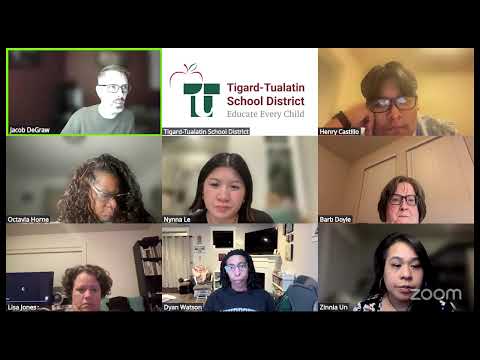
The Education Equity Advisory Committee trained members March 3 on how to review school continuous improvement (SIP) and EACH (ISH) plans and assigned each reviewer a school to evaluate.
The Education Equity Advisory Committee spent part of its March 3 meeting reviewing the process for evaluating school continuous improvement plans (SIPs) and EACH plans (the ISH—education, solutions, healing—framework) and assigned reviewers for each school.
Zinnia (district staff) told the committee that the district frames SIPs in three areas—academic, culture and climate, and the underlying conditions needed for outcomes—and that schools now include an adopt/abandon/adapt note explaining why a change idea was continued or stopped. Committee members were asked to consult the policy document referenced in the meeting (the JBC GBV bias incident and hate speech policy) and to look for examples of education, accountability, solutions, and healing in school documents.
Jacob, the committee chair, demonstrated where to find the EACH rubric and school SIP/PDF files in the EEAC shared drive and walked members through the expected workflow: each member should make a copy of the EACH rubric, add their assigned school to the file name and the document header, review the EACH plan section at the bottom of the SIP first, then work through the continuous improvement (SIP) section to identify specific examples of education, solutions and healing. For EACH-plan checklist items that are present but lack detail, reviewers were instructed to mark presence and use the rubric’s “clarifications/conflicts” column to request more information.
Committee members raised practical questions during the training: a student reviewer, Olivia, initially could not find the shared drive but confirmed access after guidance. Members also asked how to interpret tier 1/2/3 moves. Zinnia explained tier 1 covers universal, schoolwide moves (for example, ASB leadership training or schoolwide student voice councils) while tiers 2 and 3 capture more targeted or intensive interventions and supports.
Jacob assigned individual schools for review during the meeting. Assignments included: Barb (Alberta/Bridgeport? clerk noted—see file) — the chair explicitly assigned: Barb → Alberta/Brid(al) (noted in assignment list), Diane → Arrettkin (recorded as Art Retkin), Henry → Byram, Lisa → Bridgeport, Moss → Charles F. Tigard (CFT), Nina → Deer Creek, Octavia → Durham, Olivia → Mary Woodward, Jacob → Metzger. Committee members were asked to confirm assignments in chat and to complete rubric copies asynchronously if needed; Jacob said the group would continue reviews at the March 30 meeting.
During a brief check-in at 8:10 p.m., reviewers shared early observations: a few EACH plans (for example, Mary Woodward and Metzger) lacked hate-speech bias-incident data or concrete evidence of impact; Bridgeport’s EACH plan was a more complete example. Members agreed to provide specific, actionable feedback using the rubric so schools can improve future submissions. Jacob closed the training by noting the activity will continue in the next meeting and that members can finish reviews offline and submit completed rubrics ahead of the March 30 session.
The committee did not take formal votes. The documented outcomes of the training were the assignment list and procedural directions for how reviewers should use the rubric and where to find materials in the shared drive.