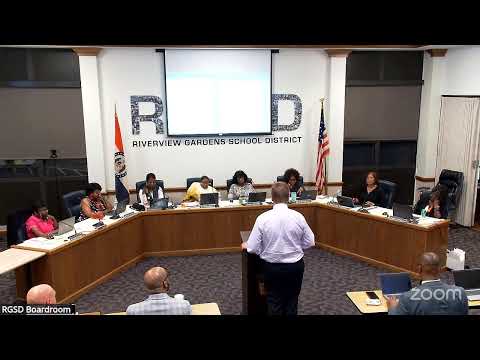
Board hears proposals for E‑Rate contracts, hotspots for unhoused students and network upgrades
Loading...
Summary
Riverview Gardens administrators outlined E‑Rate-funded technology items including continuing WAN/Internet contracts, firewall license renewal, up to 350 hotspots for unhoused students, and switch upgrades to support Wi‑Fi improvements. No formal roll-call votes were recorded on these discussion items.
District technology and procurement staff asked the Riverview Gardens Board of Education to authorize continuation of existing E‑Rate contracts and proceed with several E‑Rate-funded purchases intended to expand and harden the district’s network.
Dr. Jocelyn Larry, the district’s technology presenter, told the board there is federal scrutiny of the E‑Rate program but recommended proceeding with current plans: "There is a movement going on in DC to defund, if you will, E Rate," she said, then urged the board to act as if funding will continue while staff make contingency plans.
Items discussed included continuing wide-area network and Internet service contracts (providers cited during the presentation included Charter, ENA and AT&T), renewal of a firewall license, purchase of cellular hotspots to provide home Internet for unhoused students under McKinney‑Vento obligations, and replacement of end‑of‑life network switches.
Firewall license and CIPA compliance: Dr. Larry said the district’s firewall license had expired and that renewal is required to maintain Children's Internet Protection Act (CIPA) compliance to receive federal funds. The license renewal cost cited in the presentation was $21,388 from the federal E‑Rate administrator (USAC) and $3,208 from the district.
Hotspots for unhoused students: The technology team recommended procuring cellular hotspot devices and service through AT&T for an estimated pool of about 350 unhoused students. Dr. Larry said the recommended device option carried a one‑time device fee (presenter cited about $57 per device) and a monthly service price (presenter cited $10 per month). The presenter said USAC would cover approximately 90% of recurring service costs under typical E‑Rate rules and the district would pay the local share. Dr. Larry noted the vendor selection was made using the required evaluation process and the committee recommended the lowest‑cost responsive bidder.
Switches and access points: The presentation called for replacing end‑of‑life switches that carry traffic for computers and security cameras and that pose a network security risk. The recommended switch upgrade package totaled $412,139; the presenter said approximately $350,318 would come from USAC and the district’s share would be about $61,821.
Board members asked technical and procedural questions during the discussion. One board member asked whether teachers can monitor student devices in class; Dr. Larry said the district has an Aristotle K‑12 monitoring product available and that accounts exist for individual students. Other members asked about device inventory, under‑utilization protections for hotspots and whether the district could order extra devices to cover losses; Dr. Larry said the current arrangement requires devices that are unused for 30 days to be turned off and that she would follow up on replacement options.
No formal roll‑call votes were recorded in the transcript on the E‑Rate continuing contracts and equipment purchases discussed; presenters characterized the items as recommendations and asked the board to permit staff to move forward with procurement under E‑Rate rules and contingencies if funding changes at the federal level.