Get Full Government Meeting Transcripts, Videos, & Alerts Forever!
Get email alerts on the Land Use topic
No spam. Unsubscribe anytime.
Hillsboro staff give council a Land Use 101 briefing on legislative vs. quasi‑judicial decisions
Summary
City planners presented a primer on how state and local rules shape zoning, what counts as a legislative decision versus a quasi‑judicial hearing, ex parte contacts and conflicts, and the legal tests staff use when imposing conditions on development.
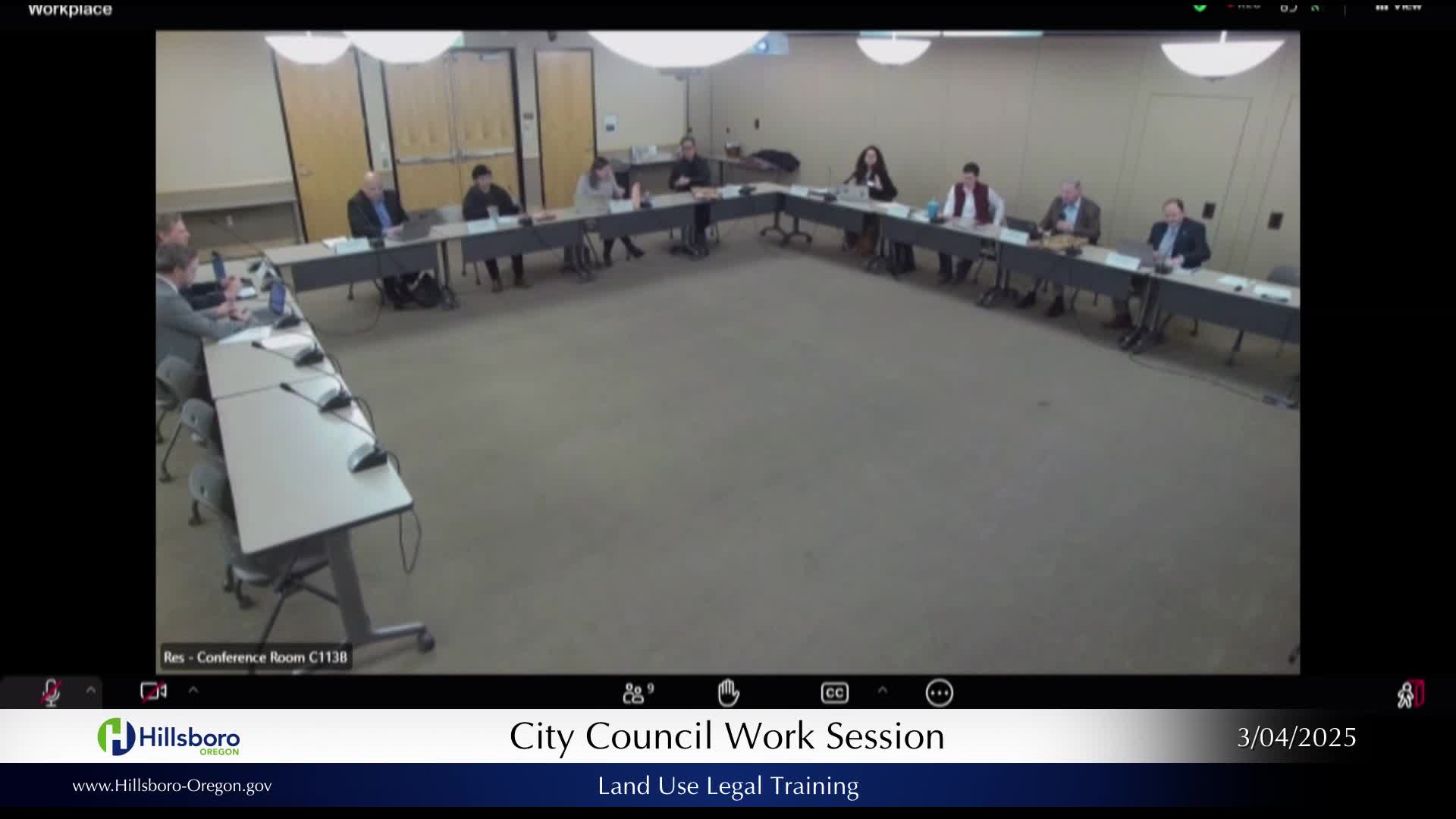
City staff led a March 4 work session to give Hillsboro City Council members a primer on land use law and the council’s dual role as policy‑maker and decision maker. Staff framed the difference between legislative actions — such as comprehensive plan and code amendments — and quasi‑judicial decisions that apply rules to a particular property or application.
The overview mattered because the different role changes what councilors may do and say. “The first part will be going over what is a legislative type of decision and action,” Dan Diaz told the council, “and then what is a quasi judicial, which is more of an applicant initiated?” Chad Jacobs and Diaz co‑presented the training, which staff said was intended to help the council avoid procedural errors that can expose city decisions to appeal.
Why it matters: legislative actions set city‑wide policy standards that staff and future applicants must follow, while quasi‑judicial proceedings require councilors to act like judges, basing decisions on the hearing record. Staff repeatedly stressed that mixing the roles or taking information outside the hearing can create legal risk and delay projects. “You get to be a judge, and you get to be, you know, a member of Congress,” Jacobs said. “You get to do all that at once.”
Key points presented - State framework and appeals: Speakers summarized Oregon’s 19 statewide planning goals, the roles of the Department of Land Conservation and Development (DLCD) and the Land Use Board of Appeals (LUBA), and the path from local decisions to LUBA and then to the courts. Jacobs described LUBA as the administrative agency that “hear[s] appeals related to land use to try to keep a lot of those issues outside of the court.” - Legislative versus quasi‑judicial: Staff said legislative actions establish generally applicable rules (comprehensive plan, city development code, transportation system plan), and councils are permitted to show a policy preference before a vote. By contrast, in quasi‑judicial hearings — for example, an applicant‑initiated zone change or most development reviews — councilors must rely on the evidence in the hearing record and disclose any outside contacts. - Evidence, findings and process: Diaz explained that approvals must be supported by findings that connect facts to the applicable standards. He highlighted the city’s 120‑day deadline for issuing a final local decision after an application is deemed complete and said applicants may be entitled to extensions or to appeal if the city misses that deadline. - Ex parte contacts and bias: Staff outlined the difference between permissible communications and ex parte contacts that must be disclosed on the record. “If you receive an email from a resident pertaining to an agenda item, and you share that with the rest of the council through our records, that is — do you still have to declare that even though all of council has received it as well?” Diaz asked rhetorically, answering that the key is whether the information is already part of the public record; if it is not, it must be disclosed so others can respond. - Clear‑and‑objective standards and state law: Presenters noted recent state changes that require many housing regulations to be “clear and objective,” which can limit the city’s discretion on design‑oriented provisions. Diaz warned councilors that standards that are overly subjective can be unavailable for use in certain housing applications. - Takings/exactions test: Staff summarized constitutional limits on conditions imposed on development, referencing the nexus and rough‑proportionality analysis (the Nollan/Dolan standard) used to test whether a required dedication or improvement is legally allowable.
Examples and application to Hillsboro: presenters used local examples — the South Hillsboro community plan, Witch Hazel Village South, Amber Glen, and the Jackson East designation — to show how comprehensive plans, code and site reviews interact. Staff described legislative zone changes that cities adopt across many parcels and contrasted them with applicant‑initiated zone change requests that are judged against the city’s existing criteria.
How councilors should engage: staff urged councilors to participate in the policy (legislative) process when community vision and standards are being set, and to avoid outside communications on active quasi‑judicial matters. When public testimony focuses on issues that do not map to approval criteria (for example, neighborhood grief about removed trees that are not tied to the code criteria), staff recommended acknowledging residents’ concerns while directing the record back to the applicable criteria.
Next steps and resources: staff said the city will circulate the more detailed training slides used for this session and invited councilors to follow up on technical legal questions through the city manager’s office or the city attorney when appropriate. Diaz and Jacobs also offered to provide more focused briefings on specific topics such as natural resource overlays or system development charge methodology on request.
Ending: The work session closed with staff and council agreeing to bring any needed follow‑ups (including further council rule discussion) to future meetings. "We will put these changes in motion. You'll see these on the next council agenda for adoption," the city manager said at the end of the session.