Get Full Government Meeting Transcripts, Videos, & Alerts Forever!
Get email alerts on the Higher Education Employment topic
No spam. Unsubscribe anytime.
Committee advances bill that defines "reasonable assurance" for adjunct faculty unemployment claims
Summary
The Senate Education Committee recommended House Bill 67 for passage after sponsors said the bill aligns state law with federal guidance and establishes five objective factors to decide reasonable assurance for adjunct and contingent faculty unemployment eligibility.
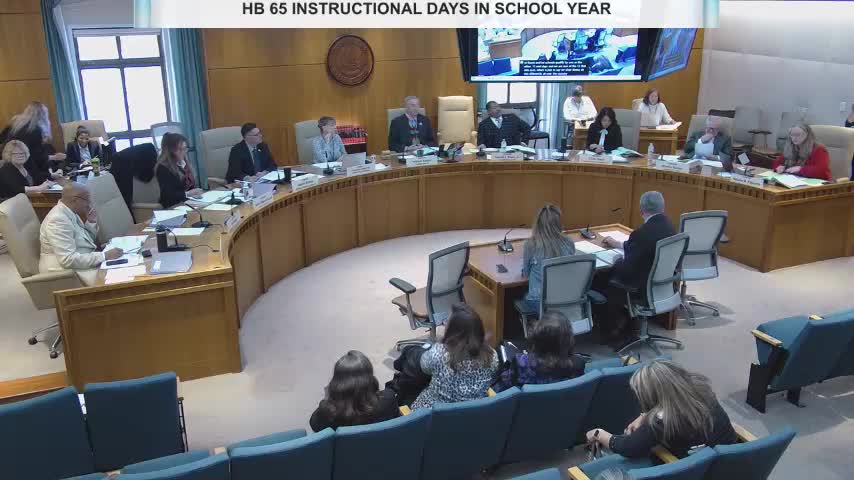
The Senate Education Committee on March 14 recommended House Bill 67 for passage. The bill clarifies how “reasonable assurance” is determined for adjunct and other contingent higher-education faculty when unemployment eligibility is considered.
Sponsor representatives said the measure sets five objective criteria: whether an educational institution made a written, oral or implied offer of employment for the following academic term; whether the offer was made by an individual with authority to hire; whether the position offered is substantially similar or higher than the prior position; whether the offered compensation is at least 90% of the claimant’s prior academic‑year earnings; and whether the offer is not contingent on factors within the institution’s control. The sponsor said the test aligns New Mexico law with federal unemployment requirements.
An expert witness, Grace Roadhouse, a labor lawyer, testified the bill reduces subjectivity in unemployment eligibility determinations and should make evaluations more consistent for employees, institutions and the Department of Workforce Solutions. John Durch of the American Federation of Teachers in New Mexico said unions had worked on the issue since 2023 to remove ambiguity for adjunct staff.
Committee members raised questions after receiving a fiscal impact report at the hearing. One senator read a summary that noted the University of New Mexico and other state institutions said it was not clear how Workforce Solutions would interpret “contingency factors within the institution’s control,” and university analyses signaled state unemployment insurance costs could rise. Sponsors and witnesses said none of the universities had filed formal opposition and that the bill contains no appropriation; they also said any administrative impact would be felt in the summer after passage, allowing time for budget adjustments.
A motion to pass the bill carried on a recorded roll call. The clerk announced a do-pass on a 6‑2 vote with one absence; Senators recorded as voting no and recorded yes votes were read into the record during roll call. Sponsors said the change would not apply to K–12 teachers or tenured professors and would apply only to adjunct and contingent higher‑education instructors.