Get Full Government Meeting Transcripts, Videos, & Alerts Forever!
Get email alerts on the Economic Development topic
No spam. Unsubscribe anytime.
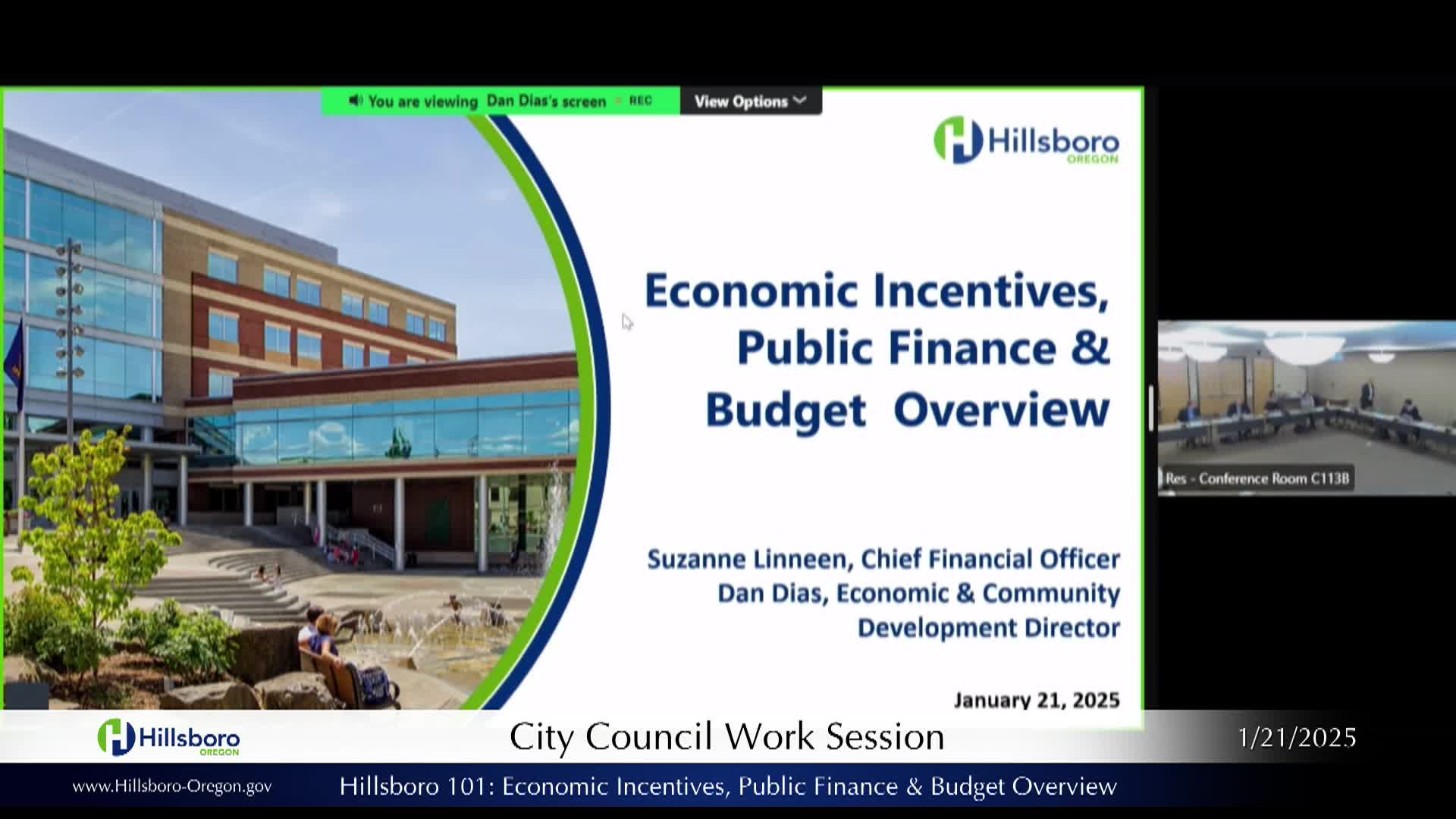
Hillsboro holds 'Hillsboro 101' work session on economic incentives, public finance and budget
Summary
City staff briefed the Hillsboro City Council on state and local revenue structures, property-tax limits, strategic investment program (SIP) and related incentives, and the city’s use of urban renewal and enterprise zones to fund infrastructure and workforce programs.
On Jan. 21, 2025, Hillsboro city staff delivered a “Hillsboro 101” work session that reviewed how state and local tax rules, economic incentives and urban renewal affect the city’s budget and long-term finances.
The presentation, led by Suzanne Lanine, the city’s chief financial officer, and Dan Diaz of economic development, framed why Hillsboro uses targeted incentives and how those tools interact with the city’s existing tax limits and revenue streams.
Lanine told the council that "Oregon has only two legs of the stool when it comes to how we fund, state government and local government. We have an income tax, and we have a state of property taxes, and we do not have a general sales tax, across the state of Oregon." She said that reality shapes both where businesses choose to locate and which kinds of taxes and incentives are most effective for the city.
Nut graf: The briefing tied several threads together. State ballot measures adopted in the 1990s (Measures 5, 47 and 50) limit property-tax growth and establish a permanent city rate; those limits make the city more reliant on growth, large capital investments and locally approved levies. To attract capital‑intensive firms and to fund infrastructure, Hillsboro makes regular use of strategic investment program (SIP) agreements, enterprise zones and urban renewal tax‑increment financing, and it directs some incentive receipts into public projects and workforce programs.
Key points from the work session
- Property‑tax limits and local tools: Lanine said the city’s permanent property‑tax rate is fixed under state law and that the main local tool to raise operating revenue is a voter‑approved local option levy (Hillsboro has been asking voters periodically; the current ask is $1.72 per $1,000 of assessed value). Lanine explained how Measure 5/47/50 caps and the assessed‑value growth limit (about 3% per year absent new construction) create “compression” that can erode local levies in some tax codes.
- Strategic Investment Program (SIP) and gain share: Diaz summarized the SIP as a property‑tax abatement program aimed at capital‑intensive employers, and he described gain share as the portion of new state income taxes that can be returned to local jurisdictions that forgo property taxes under an SIP. He summarized the trade-off: SIP and enterprise incentives can produce large capital investments and high wages that grow the tax base over time, but local receipts from gain share depend on continued SIP activity and on state law (there is a statutory cap on annual gain‑share payments).
- Enterprise zones and community service fees: Staff described the enterprise‑zone program as a shorter, lower‑threshold property‑tax abatement that requires job and reporting commitments. Hillsboro directs a portion of enterprise‑zone community service fees to workforce and small‑business programs (e.g., PCC Future Connect, grants for small businesses and local procurement initiatives).
- Urban renewal and site readiness: The city reviewed its three urban‑renewal efforts over time and focused on the North Hillsboro Technology Park district. Staff said tax‑increment financing has been used to buy land, extend roads and utilities (Huffman Road, sewer pump‑station placement) and build trails, and they showed drone footage of recent development. The presentation included fiscal figures for the North Hillsboro district’s frozen base and increment growth.
Numbers and fiscal context cited in the briefing
- City permanent property‑tax rate (per the presentation): 3.6665 per $1,000 of assessed value; local option levy: $1.72 per $1,000; WCCLS library levy: 22 cents. - North Hillsboro urban‑renewal district: staff reported a frozen base around $380 million in assessed value and tax‑increment collections rising to roughly $17.4 million (levy at 96% collection) for 2024–25; the district currently carries roughly $120 million of debt against identified projects. Staff said the district reached the state revenue‑sharing trigger in 2024–25 and expects further sharing before the district closes. - SIP/gain share history: staff presented 25 years of SIP/gain‑share receipts and said the city’s share of SIP/gain revenues has funded projects and programs over time; staff noted both Intel and Genentech had substantial SIP agreements in Washington County and that some earlier SIPs are reaching the end of their abatement periods this budget cycle.
Discussion and council questions
Council members pressed staff on compression risk, the mechanics of new taxing districts, how urban‑renewal project lists relate to maximum indebtedness, and whether the city could seek state changes to SIP or gain share rules. Diaz said the city advocates for legislative fixes when the state’s SIP implementation produces unintended consequences (for example, a prior change that added ports to certain review processes); Lanine said the finance team will return with a deeper budget presentation on Feb. 26 and additional briefings ahead of the council retreat.
Ending: Staff said the work session is the first of several Hillsboro 101 briefings planned this year; they recommended follow‑up sessions on land use, the biennial budget and targeted workforce programs. Suzanne Lanine closed by reminding the council the team will "do a deeper dive on budget come February 26," and staff committed to provide data and follow‑up answers to council questions that could not be resolved at the meeting.