Get Full Government Meeting Transcripts, Videos, & Alerts Forever!
Get email alerts on the Financial Exploitation topic
No spam. Unsubscribe anytime.
Senate committee sends elder‑fraud bill to floor after broad support from banks, law enforcement
Summary
House Bill 323 would let financial institutions temporarily pause suspicious transactions involving likely victims of financial exploitation and grants limited immunity and time to investigate. The Senate Commerce and Human Resources Committee voted to send the bill to the floor with a due‑pass recommendation, 7‑1.
BOISE — The Senate Commerce and Human Resources Committee voted 7‑1 to send House Bill 323 to the Senate floor with a due‑pass recommendation after testimony from financial institutions, law enforcement and advocates who described widespread elder financial exploitation.
Representative Jeff Ehlers, R‑Meridian, the bill sponsor, told the committee HB 323 gives banks and credit unions a tool to “pause” a transaction when the institution has a reasonable belief a financial exploitation is occurring. The bill would permit an initial hold while the institution notifies other account parties and gives the institution up to 15 days to investigate, with an option for an additional 15‑day extension.
Ehlers said the measure targets adults age 65 and older and natural persons with a mental or physical impairment who are particularly at risk. He described the proposal as similar to laws enacted in about 40 other states that allow financial institutions to take limited action to stop suspicious transactions and coordinate with law enforcement.
Industry witnesses described the scale of the problem. Mike Schenck, chief executive officer of Westmark Credit Union, called exploitation “an epidemic” and said branches encounter suspected fraud weekly; he urged passage so institutions could “put the brakes on that” and contact trusted family or law enforcement. Devin Goodall of LPL Financial said broker‑dealers and advisers already train staff to detect red flags and that the bill would give firms limited immunity and a temporary pause while authorities investigate.
Law enforcement and victims’ advocates supported the measure as well. Brad Thorn, a cybercrime investigator with 26 years in law enforcement, described repeated cases in which customers were asked to withdraw cash or buy cryptocurrency and deposit funds under pressure. Terry Durden, in‑house counsel for the Ada County Sheriff, said Ada County saw 249 cases over two years with combined losses of about $4 million in the jurisdictions he tracks. Lisa Anderson of AARP Idaho described national and state fraud statistics and said financial institutions currently lack statutory authority to pause transactions in these circumstances.
Committee members raised questions about scope and profiling. Senator Guthrie asked whether staff discretion to identify cognitive decline risked profiling; witnesses said institutions use training, account history and trusted‑contact procedures to focus on genuine red flags rather than lawful customer activity. Senator Zito asked how institutions decide a transaction is suspicious; witnesses said staff use training and patterns of unusual activity and encouraged further testimony from industry representatives to explain internal processes.
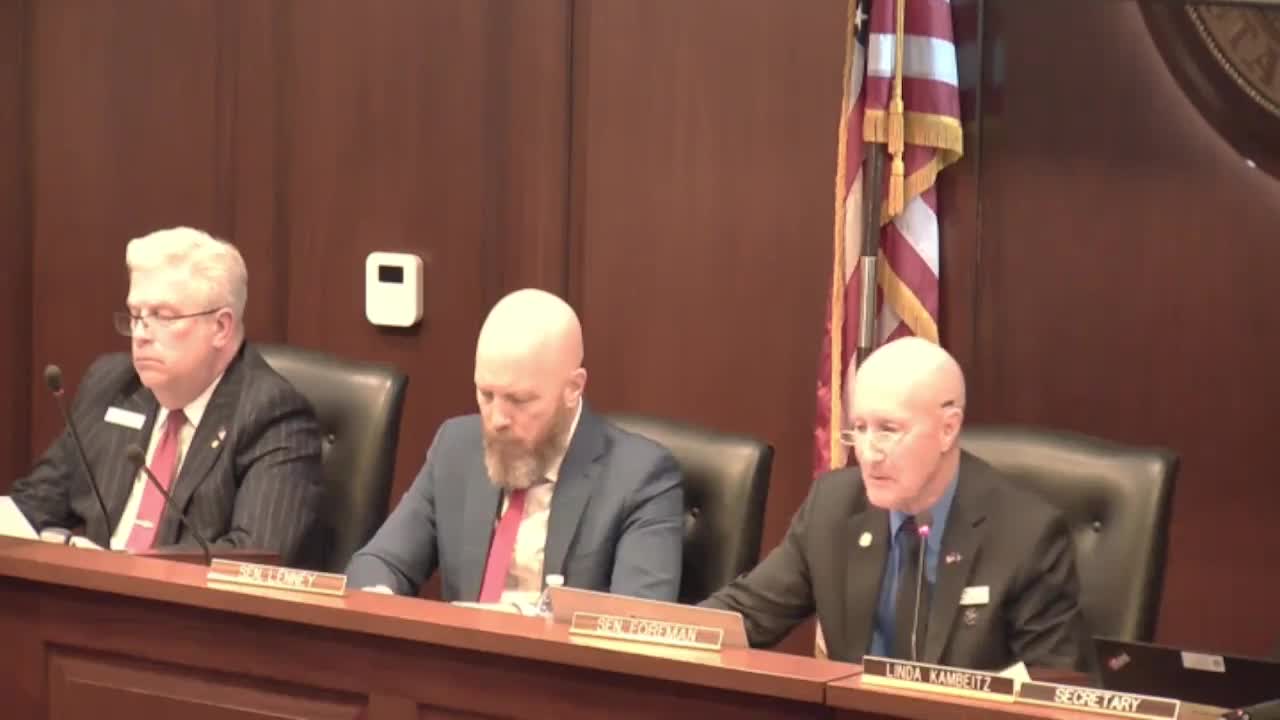
The committee then voted on a motion from Vice Chairman Lenny, seconded by Senator Lakey, to send HB 323 to the floor with a due‑pass recommendation. The roll call recorded several members saying “aye”; Chairman Foreman recorded his vote as “nay.” The chair announced the motion passed with seven in favor and one opposed.
What happens next: House Bill 323 is slated for consideration on the Senate floor with a due‑pass recommendation. Sponsors and supporters said they will continue outreach to ensure the bill’s language balances fraud prevention with protections for account holders.
Committee vote: motion to send HB 323 to the floor with a due‑pass recommendation — moved by Vice Chairman Lenny; seconded by Senator Lakey; committee vote 7 in favor, 1 opposed.