Get Full Government Meeting Transcripts, Videos, & Alerts Forever!
Get email alerts on the Emergency Management topic
No spam. Unsubscribe anytime.
DNR warns of early, active 2025 wildfire season; outlines preparedness and prevention steps
Summary
The Department of Natural Resources presented wildfire-prevention priorities to the House Resources Committee, saying warmer, drier conditions and longer seasons are driving higher risk and urging increased preparedness, fuels mitigation and community planning.
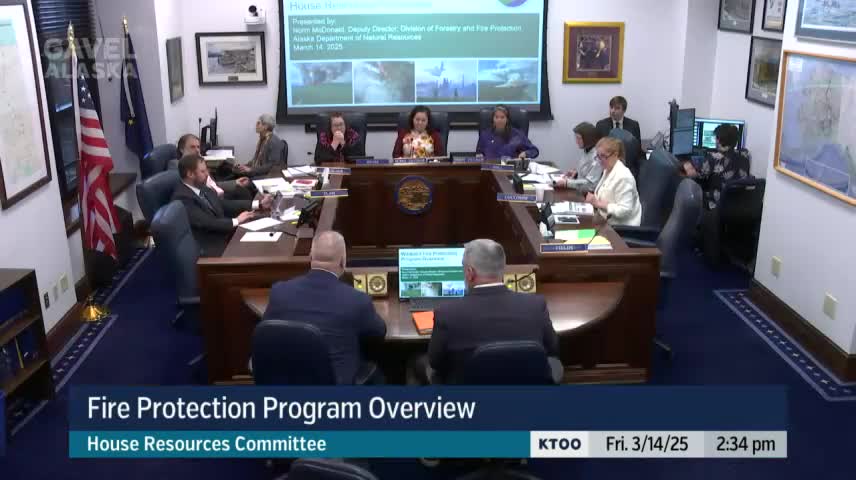
The Alaska Department of Natural Resources told the House Resources Committee on March 14, 2025 that state and provincial wildfire risk is increasing as seasons lengthen and conditions warm, and outlined preparedness, mitigation and response measures for the 2025 season.
Deputy Commissioner Brent Goodrum introduced Deputy Director Norm McDonald of the Division of Forestry and Fire Protection, who described the division's mission to protect state, municipal and private values across Alaska's protection area. McDonald said the division prioritizes preparedness, prevention, fuels mitigation and suppression to place the "right resources, right place, right time" for initial attack and large-incident response. He gave examples of recent large fires (Miller's Reach, Sockeye, McKinley) to illustrate the threat to homes and infrastructure.
McDonald told the committee that Alaska's fire season is lengthening and that Southcentral, the southern Southwest and Southeast Alaska face above-average fire danger for April and May. He said that warmer winters and little snow in some areas (Homer, Pilot Point) leave grass and surface fuels exposed and flammable early in the year. McDonald said the division had moved parts of the fire season start date earlier from April 1 to March 17 to allow earlier closure of open-burning and to mobilize seasonal crews for training and prepositioning.
The division also highlighted interagency mutual aid relationships, including the Northwest Compact and Stafford Act arrangements, which allow Alaska to trade firefighting resources with Canadian provinces and other U.S. states. McDonald warned that these mutual-aid resources are limited nationally when many regions are burning simultaneously and that importing outside resources significantly increases incident costs. He provided cost comparisons showing in-state management for a 7-day Type 3 incident averages roughly $430,000'$500,000 while using outside Lower 48 resources can raise costs to about $1.7 million for the same footprint.
McDonald described state programs for community wildfire protection plans (CWPPs), fuels projects (fuel breaks), training and workforce development, and a public education prevention program that staffed roughly 80 events statewide last summer. He said recruitment and retention improved after mission-critical incentive pay and that his office trained many more applicants this year than in past seasons.
Committee members asked about outreach and whether the division needs additional resources for public messaging; McDonald said the division is doubling down on public messaging, coordinating town halls and community meetings and preparing targeted outreach for Southcentral. Representative Mears and Representative Colom asked follow-up questions about virtual training and outreach; McDonald said classroom content moved online during COVID but field days remain for hands-on skills.
McDonald closed by saying Alaska should prepare for a potentially very active spring, and urged lawmakers to support prevention, fuels and workforce measures that reduce the chance of catastrophic losses to homes and infrastructure.