Get Full Government Meeting Transcripts, Videos, & Alerts Forever!
Get email alerts on the Wildlife Management topic
No spam. Unsubscribe anytime.
Committee hears bill to tighten residency rules for resident hunting, fishing and trapping licenses
Summary
House Bill 93 would align resident hunting, trapping and sport-fishing eligibility with a physical-presence standard similar to the Permanent Fund dividend; supporters said it would protect subsistence and reduce enforcement burdens, while questions remained about permanent ID cards and implementation.
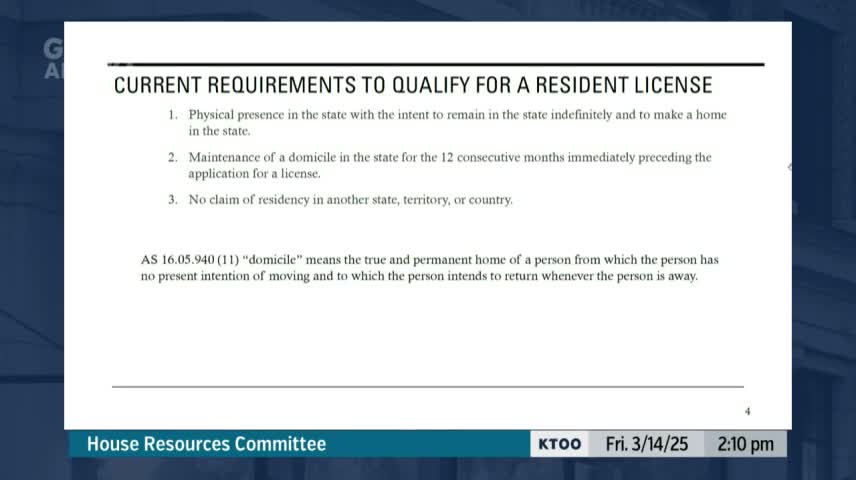
House Bill 93, presented March 14, 2025 in the Alaska House Resources Committee, would revise residency requirements for resident hunting, trapping and sport-fishing licenses so that applicants must be physically present in Alaska for 12 consecutive months immediately preceding the licensing date, with allowable absences mirroring many categories used for the Permanent Fund dividend.
Representative Rebecca Hemshutt introduced the bill and her staff, Thatcher Brower, provided a sectional analysis. The bill's central change would require that an applicant be physically present in the state for 12 months before applying for a resident license; allowable absences (medical, education, military and similar categories) would be expressly listed. The bill sets a delayed effective date of Jan. 1, 2027, to give residents time to adjust. Representative Hemshutt said the bill is intended to prioritize access to fish and game for year-round residents and to simplify field enforcement for wildlife troopers.
Supporters who testified in invited testimony included Jill White, government affairs liaison for the Central Council of Tlingit and Haida Indian Tribes of Alaska, and Kurt Whitehead, owner of Treasure Hunter Lodge and an advisory committee representative from Prince of Wales. Jill White told the committee the measure would "protect local resources for folks who live here year round" and help preserve subsistence traditions that offset higher food costs in rural communities. Kurt Whitehead described local enforcement and social concerns on Prince of Wales Island, saying seasonal residents sometimes use mailbox services or shared addresses and that enforcement currently results in a "paper chase" for troopers.
Committee members asked for clarifications about how the bill would interact with the Permanent Fund dividend and with permanent identification (PID) licenses for residents 60 and older. Representative Hemshutt and staff said the proposed residency standard would not be identical to the dividend test (which uses calendar-year presence), but it was designed to be consistent in allowable absences so that many residents could demonstrate eligibility via dividend documentation (for example, a MyAlaska statement or 1099 form). Regarding permanent identification cards for residents 60 and older, staff said the license remains permanent in form but the holder would need to meet the residency standard to qualify; the transcript indicates staff suggested Department of Fish and Game review to clarify whether a PID could be revoked if the holder no longer met the new statutory residency standard.
Representative Colom asked whether the problem being addressed was enforcement challenges for wildlife troopers or a revenue motive; proponents said the priority was protecting local subsistence and reducing enforcement complexity. Representative Rauscher raised concerns about whether permanent licenses could be jeopardized; staff and the sponsor responded that permanent ID holders would still hold a permanent license but must meet residency qualifications and that the committee could consider amendments. The committee took no final vote on HB 93 in this session and set the bill aside for further consideration and invited additional public testimony at a later hearing.
The bill includes a delegated regulation step: section 4 would direct the commissioner of fish and game to adopt regulations under the Administrative Procedure Act to determine eligibility details. The sponsor emphasized that the change is intended to protect year-round residents' access to fish and game and to make compliance and enforcement clearer for officers in the field.
No roll-call votes were recorded in the transcript for HB 93 during this hearing; invited testimony and stakeholder letters were logged and the sponsor said she is collecting additional letters of support.