Get Full Government Meeting Transcripts, Videos, & Alerts Forever!
Get email alerts on the Corporate Taxation Oil Gas topic
No spam. Unsubscribe anytime.
Committee debates SB92 to tax oil & gas S‑corporations; tax manager and CPA present fiscal modeling as public commenters weigh in
Summary
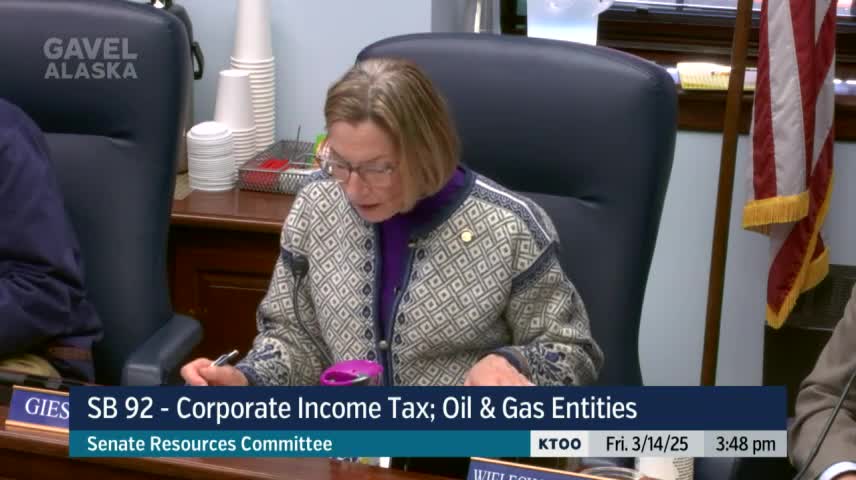
Senate Bill 92, which would levy a corporate tax on oil and gas entities that file as S corporations, was discussed at length March 14; staff and an invited CPA presented hypothetical tax models, Department of Revenue staff clarified the tax would apply to net income after deductions, and a mix of industry and public callers provided opposing and supporting testimony.
Senate Bill 92, proposing a corporate income tax on oil and gas entities that file as S corporations, was the second major item at the Senate Resources Committee meeting on March 14. Committee staff presented definitions, statutory context and draft bracket proposals; invited CPA John Letourneau walked the committee through hypothetical calculations. Department of Revenue tax staff participated online to answer technical questions. Public testimony included both opposition from an Anchorage supplier and broad public support from callers urging the committee to close what they described as an unfair loophole.
What the bill would do: As presented, SB92 would apply a corporate tax schedule to qualifying oil and gas S corporations, separate from the existing C‑corporation structure. Under the draft shown in committee, S corporations that qualified as oil and gas producers would be taxed on taxable income above an initial exemption amount (the presentation used a $5,000,000 threshold in examples), with a top marginal rate illustrated at 9.4% above the top bracket.
Technical clarifications from staff: Intimail Harbison (staff to Senator Giesel) reviewed entity definitions (C corporation, S corporation, LLC) and quoted state sources showing approximately 11,700 S corporations and around 67,133 active LLCs registered in the state (Department of Community, Commerce, and Economic Development figures cited). Department of Revenue staff joined online; Michael Williams, corporate tax manager, confirmed that “the tax is net income. So it's income less expenses and the taxable income is on the net.”
Invited analysis: John Letourneau, a certified public accountant, presented a set of hypothetical calculations using $50 million in gross receipts and $40 million in deductions (net taxable income $10 million). His slides compared the illustrative total tax burden under current law for a C corporation and an S corporation and then recalculated after applying the draft S‑corp entity tax in SB92. Using the hypothetical, he estimated that an S‑corporation entity tax with a $5 million exemption would reduce the state tax liability to about $470,000 for the entity in the example, and he walked the committee through federal tax interactions (including discussion of section 199A benefits at the federal level). Letourneau noted the figures were illustrative and that deductions and federal rules can materially change outcomes.
Members’ concerns and questions: Senators pressed on the choice of bracket thresholds and whether the bill produces parity with the C‑corporation structure. Senator Myers asked about parity with C‑corp brackets; Senator Willikowski said matching brackets might be reasonable and could increase revenues modestly. Senator Hughes asked staff to follow up on whether oil‑and‑gas–specific deductions (intangible drilling costs and depletion) apply differently to S corporations; Letourneau said the analysis had assumed comparable deductions but acknowledged he had not fully modeled each industry‑specific tax item and agreed to follow up upon request.
Public testimony: The committee heard short two‑minute calls. Jerry Weber (president, Little Red Services, North Slope supplier) testified in opposition, saying SB92 “strongly threatens Alaska’s oil and gas industry and also local companies by substantially raising oil and gas taxes” and warning of higher energy costs and job loss for Alaska suppliers if taxes rise. Multiple callers urged passage: former Senator Hollis French, Bob Schaevelson (Homer), Maddie Halloran (Anchorage), Ben Betzger (Cook Inletkeeper media specialist), Sarah Fuhrman (Fairbanks), Natalie Kylie Bergen (Alaska Public Interest Research Group), and Georgia Hood (Fairbanks) all voiced support, calling the bill a fairness measure that could produce significant state revenue. Callers and presenters referenced polling (Data for Progress) and estimates of potential revenue (the committee cited a fiscal‑note estimate around $126.5 million in FY27, recognizing FY26 includes a partial year effect).
Requests and follow up: Committee members directed staff to gather additional data: breakdowns of S‑corporation and LLC registrations by in‑state versus out‑of‑state ownership, C‑corporation counts, and a more detailed analysis of how industry‑specific deductions affect parity between entity types. The chair said legislative research is working to confirm how other states tax S corporations and that Gaffney Klein was asked to model fiscal impacts. The committee left public testimony open for further written submissions and scheduled follow‑up modeling for a later hearing.
Ending: No committee vote was taken on SB92 during the March 14 meeting; the chair left public testimony open and asked staff and outside modelers for additional information before future action.