Get Full Government Meeting Transcripts, Videos, & Alerts Forever!
Get email alerts on the Wildlife Permits topic
No spam. Unsubscribe anytime.
Senate Resources Committee votes SB97 out 5-2 after rejecting amendment that would limit permit transfers
Summary
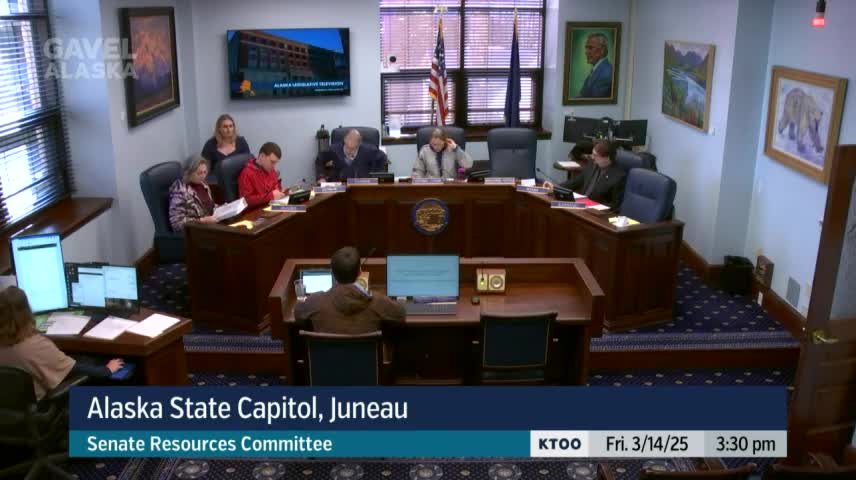
The Senate Resources Committee voted 5–2 on March 14 to report SB97 (big game commercial permits) out of committee after rejecting an amendment that would restrict permit transfers and require immediate re‑advertisement when a ten‑year guide concession becomes vacant.
The Senate Resources Committee voted 5–2 on March 14 to report Senate Bill 97, a bill to establish the proposed big game commercial services permitting program, out of committee with individual recommendations and attached fiscal notes.
Senators rejected a substantive amendment proposed by Senator Cindy Myers (A1) that would have removed permit-transfer language and instead required the Big Game Commercial Services Board to recommend to the Department of Natural Resources (DNR) that a permit be pulled and a new permit process be opened immediately when a guide vacates a ten‑year permit. The amendment failed on a roll call following floor discussion about preserving open competition and avoiding effectively permanent permits: the vote on amendment A1 was 1 yea, 6 nays.
The committee then considered the underlying bill and, after procedural discussion and the withdrawal of several other proposed amendments by Myers, Senator Willikowski moved to report SB97 out of committee with individual recommendations and attached fiscal notes. The motion passed 5 yeas and 2 nays. The committee recorded that legislative legal staff may make technical and conforming changes to the bill language before transmittal.
Why it matters: supporters of Myers's amendment argued that ten‑year concession permits can become de facto lifetime allocations if the renewal or transfer process is perfunctory, and they sought to ensure public access by forcing an immediate open application process when a permit area becomes available. Opponents and the committee’s legal counsel cautioned that altering the bill’s text could complicate a pending court challenge to prior, related legislation and might defeat the committee’s aim of producing a clean bill that could moot the lawsuit.
What the amendment would have done: Senator Myers told the committee that amendment A1 would “remove the transfer portion” and instead require the Big Game Commercial Services Board to recommend to the DNR commissioner that a permit be pulled and, after public notice, a new permit process be opened right away. Myers said the change was aimed at preventing a small group of guides from privatizing access through informal transfers.
Legal counsel’s view: Sonia Kawasaki, Senate majority legal counsel, advised the body that if the committee’s purpose was to try to moot an ongoing lawsuit related to prior enactments (identified in committee as SB 189), the safest path is to keep the text substantially identical to the law that is being litigated. Kawasaki said: “I would recommend that if the body wishes to aim for mooting the lawsuit that the substantive provisions of the SB 189 that is the subject of the lawsuit not deviate far from what was enacted by SB 189.” She added that a clean reenactment is more likely to avoid additional litigation over whether the new text is the same as the challenged law.
Roll calls and procedural notes: the amendment A1 was moved by Senator Myers and was defeated on a roll call (A1: 1 yea, 6 nays). The committee later voted to report SB97 out of committee on a motion moved by Senator Willikowski; the final tally to move the bill was 5 yeas (Senators Dunbar, Hughes, Willikowski, Clayman, and Giesel) and 2 nays (Senators Kawasaki and Myers). Several additional amendments proposed by Myers (A2, A3, A5) were introduced to put issues on the record but withdrawn during the hearing.
Next steps: the committee signaled it will remain after adjournment to sign transmittal documents. Legislative Legal was authorized to make technical and conforming changes to the reported version of the bill.
Ending: The committee’s action moves SB97 to the next step in the Legislature’s process; debate in the hearing emphasized competing goals of preserving open permit access for guides and avoiding changes that could complicate ongoing litigation related to previous legislation.