Get Full Government Meeting Transcripts, Videos, & Alerts Forever!
Get email alerts on the Legislative Ethics topic
No spam. Unsubscribe anytime.
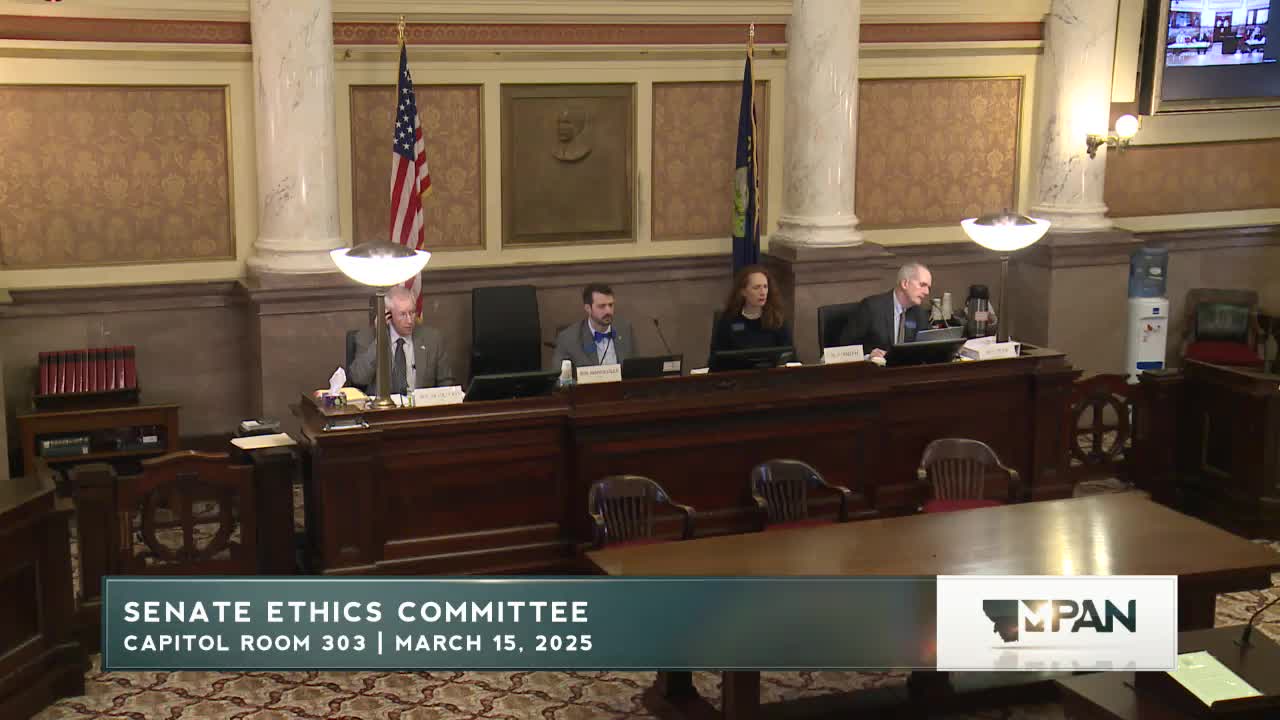
Senate ethics panel hears offer of proof, plays Eggleston statement in probe of Ellsworth contract
Summary
The Montana Senate Ethics Committee continued an adjudicatory hearing over a $170,100 contract with Agile Analytics, hearing the state's offer of proof, admitting a sworn statement and a video from Bryce Eggleston, and debating whether Senator Jason Ellsworth failed to disclose a private interest.
Helena — The Montana Senate Ethics Committee on Friday continued its adjudicatory hearing into contracts tied to former Senate President Jason Ellsworth, as prosecutors presented an offer of proof about what absent witness Bryce Eggleston would have testified and the committee reviewed Eggleston's sworn statement and a roughly 1 hour, 13 minute video statement.
The panel heard the state outline a numbered offer of proof alleging Eggleston repeatedly represented he would voluntarily testify but did not appear, that Eggleston had financial and personal ties to Ellsworth going back years, and that public records and prior sworn statements contradicted parts of Eggleston's testimony. "The state offers the following paragraphs and individual entries as its offer of proof," Special Counsel told the committee when submitting the list of proposed findings, which included invoices and Secretary of State filings the state said showed transfers and shared company roles.
Why this matters: The committee is weighing whether Ellsworth failed to disclose a personal or private interest under Montana's ethics law and whether the contracts at issue — two invoices and related procurement steps that together totaled $170,100 — were appropriate. Special counsel told the panel the question is one of full disclosure and the appearance of impropriety; defense counsel argued the record does not show a disclosable private interest and asked the committee not to treat media reporting or undeveloped allegations as findings.
Most significant facts and debate
- Offer of proof and evidence: Special counsel summarized dozens of numbered paragraphs as an offer of proof, including that Eggleston accepted invitations to testify but did not appear on 03/14/2025 and later asserted a right to remain silent. The state's list alleged Eggleston "was a no show," that invoices totaling $170,100 were billed "due on receipt," and that public filings show business relationships between Eggleston and Ellsworth going back years, including Time to Read and other corporate records. The offer included a declaration from Senator Sue Vinton describing social-media posts the state says show a personal relationship between Eggleston and Ellsworth.
- Admissibility fight: Committee members and counsel debated whether the panel could accept sworn statements and a recently produced video given short notice to the other side. Defense counsel objected to some submissions as duplicative or prejudicial and reserved procedural objections; Special Counsel and the state's attorney argued that sworn statements are permissible when a witness is unavailable and that the materials are relevant to the panel's fact-finding.
- Eggleston's recorded statement: The committee viewed a sworn recorded interview of Bryce Eggleston in which he described his relationship to Ellsworth and his qualifications. Eggleston said, "I've worked for Senator Ellsworth for many years. I've ran several of his businesses... I would consider him a friend," and told the panel he did not believe Ellsworth had a financial or ownership interest in Agile Analytics nor had negotiated compensation for Ellsworth related to the Agile contract. He described the contract scope as a post-implementation analysis, distinct from simple bill-tracking, and said he had purchased a $2,000,000 professional liability policy for the work and estimated legal costs he expected to incur if he performed the contract.
- Competing closing arguments: In closing remarks, defense counsel argued the inquiry risked politicization and urged the committee not to find a disclosable private interest because, defense counsel said, the evidence does not show an exchange of consideration or other elements required for a disclosure violation. Special counsel countered by asking the panel to "follow the money," noting a $500,000 appropriation tied to the committee's work and arguing the record showed concealment and misleading statements to staff and the Department of Administration; counsel cited Montana Code Annotated 2-2-112(3) and argued full disclosure is required for any official action that could present an appearance of impropriety.
What the committee did next
The panel agreed to receive and play Eggleston's recorded statement in the hearing. After closing arguments the committee set a follow-up meeting to draft a committee report and work toward findings of fact: the panel agreed to reconvene Monday at 10:00 a.m. in Room 350 to begin drafting findings related to the statutory standard the committee is applying.
Context and unresolved points
Committee members repeatedly said they were still working through procedural questions — for example, whether material produced with short notice should be admitted as evidence and how the panel should distinguish between information admitted for consideration and conclusions the committee will adopt in formal findings. Counsel disagreed about the significance of media coverage cited in the state's offer of proof; defense counsel said reporters' accounts included ellipses and inconsistencies, and the defense sought correction from reporters. The committee did not take any recorded formal votes during the session on guilt or sanction; the next step is to draft and consider a written committee report.
Next steps
The committee scheduled a continuation for Monday at 10:00 a.m. in Room 350 to begin drafting findings of fact and recommendations to the full Senate. The committee's report will determine which evidence the panel adopts into formal findings and whether it recommends any further action to the full Senate.
Ending
No formal committee finding was announced at the session's close. Panel members said they will distill the record and focus on the statutory elements of "personal or private interest" in Montana law as they prepare a report for the full Senate.