Get Full Government Meeting Transcripts, Videos, & Alerts Forever!
Get email alerts on the Medicaid Budget And Reform topic
No spam. Unsubscribe anytime.
Ohio Medicaid director outlines $3.6 billion cost-containment plan and next-generation managed care expansion
Summary
Director Maureen Corcoran told the House Medicaid Committee that the governor's budget relies on delivery-system reforms, IT upgrades and payment changes — including a single pharmacy benefit manager and a statewide expansion of the MiCare program — to contain more than $3.6 billion in state general revenue costs.
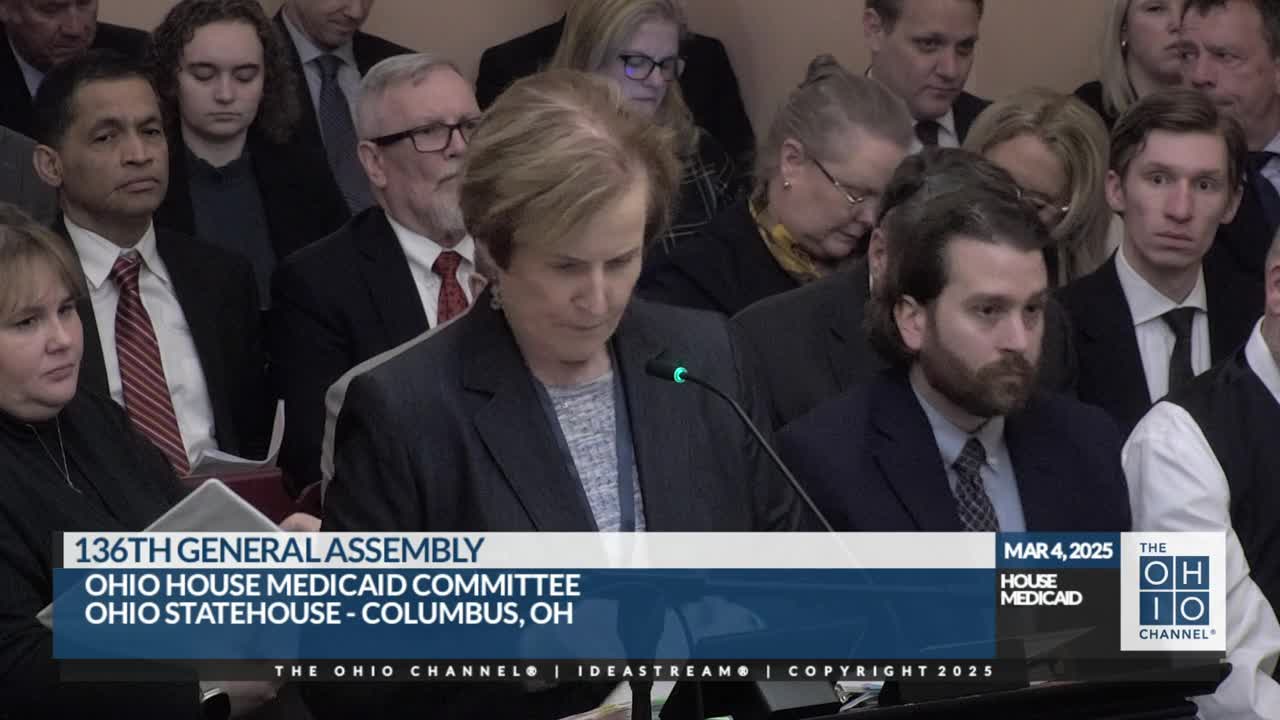
Maureen Corcoran, director of the Ohio Department of Medicaid, told the House Medicaid Committee on March 3 that the governor's budget includes cost-containment measures and program priorities intended to hold down state spending while expanding targeted services.
Corcoran said the budget reflects two years of “next generation” reforms that combine delivery-system redesign with new information technology. “If we can't see the care, we can't see the medications, we can't see who's getting paid,” Corcoran said, arguing that Ohio's Ohio Medicaid Enterprise System (OMES) and centralized pharmacy benefit management have greatly increased transparency and operational efficiency.
The nut graf: The Department projects more than $3.6 billion in state general revenue savings, including programmatic changes (eligibility and utilization management) and revenue offsets. The plan relies on managed-care delivery reforms, an expanded centralized pharmacy program, and a mix of hospital financing adjustments tied to quality metrics.
Most important details first: Corcoran credited the single pharmacy benefit manager and OMES for delivering both administrative savings and direct program benefits. She reported about $139.5 million in pharmacy savings and roughly $333 million in administrative savings booked in the first 24 months of the single PBM; she also said the state raised the average pharmacy dispensing fee from about $0.73 per fill to an average of $9 per fill, which Corcoran said “yields about $700,000,000 that would have been paid to pharmacy benefit managers, and now goes directly to our pharmacies.”
Corcoran described OMES as a “front door” for claims that has improved the department's ability to spot utilization and drug trends earlier, and she said over 98% of claims are successfully accepted into the new system.
Major program changes and timelines: MiCare (the program for people dually eligible for Medicare and Medicaid) is planned to expand statewide after procurement; Corcoran said the phased rollout begins in January 2026, moving from about 29 counties today to the full state. Managed-care plans will have five years to reach a target in which roughly 50% of provider payments are delivered through value-based arrangements that tie payment to quality and utilization metrics.
Children's health initiatives described include the Outcomes Acceleration for Kids (OAK) learning collaborative (regional teams focused on well-child care, asthma, behavioral health and sickle cell) and a comprehensive primary care for kids initiative that provides supplemental payments to pediatric practices to fund care coordination or social supports.
Corcoran said the budget continues investments in maternal and infant health aides, doula services and 12-month postpartum coverage, and includes continuous eligibility for children ages 0–3. Budget office staff, Beth Trucks Powell reported to the committee, estimated the incremental state cost for continuous eligibility for 0–3 at about $22 million in fiscal year 2026 and about $90 million in fiscal year 2027.
How the department plans to contain costs: Corcoran listed multiple levers. Those include (1) continuing to refine managed-care contracts and payment models, (2) using the actuarial “lower bound” estimate when setting managed-care rates, (3) changes to the state's handling of 340B-related claims (see separate coverage), and (4) a hospital financing package that includes an increased hospital franchise fee tied to state-directed payments and quality metrics.
Corcoran stressed that several savings must comply with federal rules and that some cost-containing steps (eligibility limits or service coverage changes) would require federal approval or statute.
Why it matters: The proposals affect Medicaid's more than 3 million enrollees, hospitals, pharmacies and community providers across Ohio. Corcoran highlighted transparency and payment reforms as essential to limit long-run cost growth while preserving services.
What to watch next: the MiCare statewide procurement and the department's waiver application for the community-engagement/work requirement for the Medicaid expansion population, which the department submitted to the federal government and opened for comment. Corcoran said the waiver was submitted as required by statute and that managed-care plans and the department have been preparing voluntary supports for affected members.
Ending note: Corcoran closed by saying she took “very, very seriously” stewardship of health care for roughly 3 million Ohioans and credited partnerships across state government and providers for recent program improvements.