Get Full Government Meeting Transcripts, Videos, & Alerts Forever!
Get email alerts on the Medicaid Expansion Trigger topic
No spam. Unsubscribe anytime.
Witnesses urge changes to Medicaid trigger language, warn of immediate loss of coverage for hundreds of thousands
Summary
Multiple witnesses at the Ohio House Medicaid Committee hearing urged lawmakers to remove or soften a budget 'trigger' that would end Medicaid expansion immediately if the federal matching rate falls, saying the move would cut coverage for roughly 700,000–770,000 Ohioans and strain hospitals, employers and the care workforce.
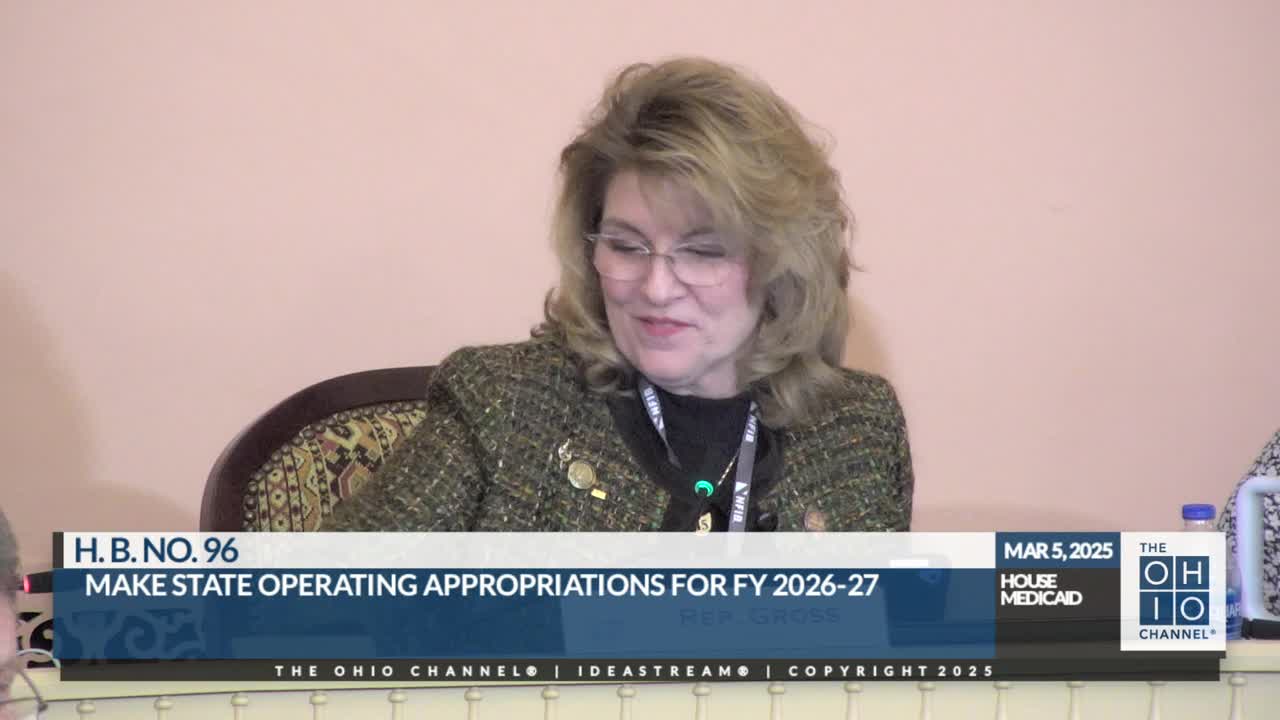
Chairwoman Gross and members of the Ohio House Medicaid Committee heard repeated pleas from health care providers, patient advocates and people who rely on Medicaid to drop or revise a provision in the proposed state budget that would automatically end Medicaid expansion if the federal matching rate (FMAP) for that population falls below 90%.
Advocates said the language in House Bill 96 would result in mass, immediate coverage loss with broad economic and health consequences. “The Center for Community Solutions estimates that 770,000 people in Ohio will immediately lose coverage if the federal match ends,” said Dr. Jules Vitaglia of the Ability Center of Greater Toledo, who called the provision a ‘‘seismic level shift in coverage.’’
Witnesses described the expansion population as largely working or low‑wage earners who rely on Medicaid because employer coverage is unavailable or unaffordable. Tara Britton, director of public policy at the Center for Community Solutions, said the trigger could be rephrased to give state leaders flexibility: “It could be changing the shall to a may,” she told the committee, and pointed to statutory language in other states as models for a non‑automatic response.
Why it matters: Speakers said ending expansion suddenly would increase the uninsured rate, pressure rural and safety‑net hospitals, force service reductions at clinics and community health centers, and reduce workforce participation by removing a key support for employees with low or intermittent incomes.
Evidence and estimates: Multiple witnesses cited similar figures. Dr. Vitaglia and others repeated the 770,000 estimate; other witnesses noted estimates ranging as high as about 900,000. Shay Gaddison of Northern Ohioans for Budget Legislation Equality said she relies on the program and warned of practical effects: “Sick people cannot work, and if you cannot work, then you cannot pay taxes.”
Questions and options for lawmakers: Committee members and witnesses discussed alternatives including (a) adopting statutory flexibility like Iowa or New Mexico, (b) phasing changes rather than immediate termination, or (c) state funding backstops if the federal match drops only a small amount. Representative Stevens and others asked about the degree of churn in the expansion rolls and whether some people move in and out of coverage; witnesses said there is turnover but that many beneficiaries remain dependent on expansion for continuity of care.
What witnesses asked of the committee: Remove the automatic trigger or replace it with a mechanism giving the legislature time and options to respond; invest to preserve coverage if the FMAP decline is modest; and consider targeted fiscal measures rather than across‑the‑board termination.
Ending: Lawmakers did not vote on the trigger during the hearing. Multiple witnesses said they would follow up with written data and examples; committee members asked advocates to provide models and numbers to help craft alternatives.