Get Full Government Meeting Transcripts, Videos, & Alerts Forever!
Get email alerts on the Program Evaluation Selection topic
No spam. Unsubscribe anytime.
Legislative Audit subcommittee selects 18 topics for 2025 evaluations, approves list unanimously
Summary
The Legislative Audit Commission Evaluation Subcommittee on March 14 approved a slate of 18 program-evaluation topics to recommend to the full commission, including audits of voter systems, long-term care oversight and autism services; the vote was unanimous.
The Legislative Audit Commission Evaluation Subcommittee voted unanimously March 14 to recommend 18 topics for program evaluations by the Office of the Legislative Auditor (OLA) in 2025.
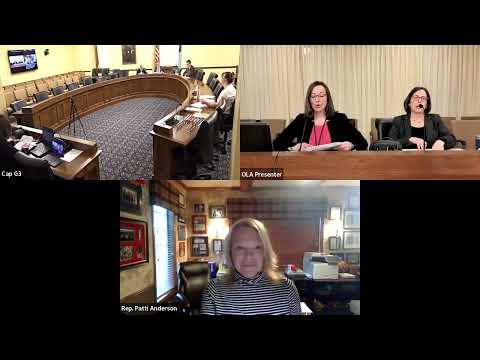
The subcommittee — chaired by Senator Dibble — approved a list that includes reviews of voter systems and registration, long-term care oversight, nursing facility transparency, autism spectrum disorder services and workforce and fraud-prevention items. Judy Randall, legislative auditor, and Jody Munson Rodriguez, deputy legislative auditor who leads OLA’s program evaluation division, briefed members on the process and the office’s schedule for preparing background materials.
The approved slate, read into the record by OLA staff, is: 4 — Fiscal notes; 11 — Nonemergency medical transportation; 16 — Board of Animal Health (oversight of companion animals); 26 — Minnesota Board of Public Defense; 31 — Minnesota Office of Ombudsperson for Families; 36 — Automatic voter registration; 41 — State oversight of long-term care insurance; 42 — Unemployment insurance; 53 — Minnesota Agricultural Water Quality Certification Program; 58 — Enterprise talent development; 64 — Nursing home and assisted living facilities licensing; 67 — Autism spectrum disorder services; 68 — Child care assistance program (CCAP); 78 — DHS oversight of MinnesotaCare; 82 — Financial transparency in nursing facilities; 85 — Medical Assistance fraud prevention; 96 — Taxpayers Transportation Accountability Act; and 110 — Voter registration system.
Senator Rest moved to approve the list; Representative Anderson seconded. The clerk then called the roll. The recorded vote was: Senator Dibble — yes; Senator Drazkowski — aye; Senator Rest — yes; Representative Anderson — yes; Representative Lee — yes; Representative Quam — yes. The motion carried unanimously.
The subcommittee discussion recapped a policy change adopted by the Legislative Audit Commission in October 2024 that formalizes criteria for topic selection. Munson Rodriguez summarized that the policy requires the office to consider state resources and control, timeliness and balance when preparing background papers, and it requires that at least one selected topic be a board, community council or authority (as defined in statute) and at least one be an OLA follow-up to a program evaluation completed at least five years earlier. "We would then prepare our one-page background information on each of the topics that are selected," Munson Rodriguez told the subcommittee, describing the next step before a final vote by the full commission.
Members debated whether to expand the short list from 15 to 18 topics. Several members said allowing up to 18 would let each of the six subcommittee members nominate up to three topics. Senator Dibble and others said the additional work for OLA staff should be manageable; OLA staff responded that the office could do the additional preparatory work. Representative Lee and others noted the list contains items that have previously been ranked highly or that have not previously been reviewed by OLA.
Members also discussed how some topics might be scoped. Representative Anderson and others raised concerns about item 67, autism spectrum disorder services, and whether it should be framed as a broad program evaluation or a narrower special review focused on specific allegations. Auditor Randall said item 67 was currently framed as a program evaluation examining overall service quality and effectiveness, and cautioned that members seeking an inquiry into alleged misconduct should be specific about scope because a program evaluation may not address allegations in the same way a special review would.
Munson Rodriguez previewed options the full Legislative Audit Commission will consider this week for changing the selection cadence: pick a larger slate once per year and stagger work so reports do not all come out during the legislative session, or select topics twice per year so not all evaluations begin at the same time. Members said they would be prepared to discuss those alternatives when the full commission meets.
The subcommittee completed its business and adjourned.
Votes at a glance
Motion: Approve the recommended slate of program-evaluation topics to forward to the full Legislative Audit Commission for 2025 work
Mover: Senator Rest
Seconder: Representative Anderson
Outcome: Approved (unanimous)
Recorded vote: Senator Dibble — yes; Senator Drazkowski — aye; Senator Rest — yes; Representative Anderson — yes; Representative Lee — yes; Representative Quam — yes.
Why it matters
The OLA’s program evaluations inform lawmakers, agency leaders and the public about program performance and risks. The subcommittee’s selection of 18 topics directs OLA staff to prepare background papers and narrow scopes for the full commission to consider; several of the chosen topics relate to long-term care and nursing facilities, voter registration systems and services for people with autism, which lawmakers and stakeholders have flagged for oversight in recent years.